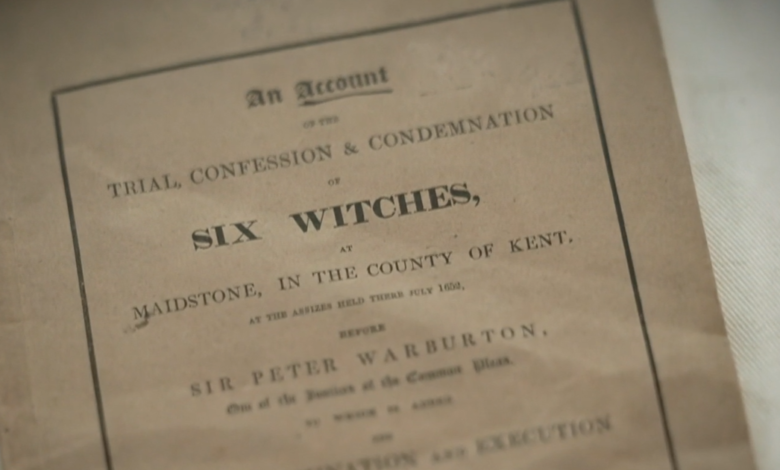
Just outside of London, the quiet country town of Maidstone bears a historic legacy far removed from its current peaceful appearance. Four centuries ago, the southern English municipality served as a primary site for deadly witch hunts.
Historical records indicate that more than 20 women convicted of witchcraft were hanged in Maidstone alone. Throughout England and Scotland, the height of the witch trials occurred during the 1600s, resulting in approximately 5,000 executions by hanging or burning.
“They were usually single women, spinsters, or widows, usually without a man to stick up for them,” Claire Kehily, a member of the Maidstone Borough Council, explained. “They were easier to target.” Inside the Maidstone town hall, Kehily oversees a prison cell reconstructed from an earlier medieval building where accused individuals were detained before trial.
In response to these historical atrocities, Kehily and her fellow councilors are actively lobbying the U.K. government and preparing to petition King Charles III for an official pardon covering all of Maidstone’s convicted witches.
“It matters because it was a miscarriage of justice,” Kehily said. “The crimes they were accused of they couldn’t have been guilty of. And they had no way of being found innocent in many of the cases. This is 400 years ago. But there are still miscarriages of justice. There are still, to these days, people being scapegoated for things.”
While the United States addressed its most famous witch trials—which took place in Salem, Massachusetts, during the 1690s and later inspired Arthur Miller’s McCarthy-era allegory “The Crucible”—by eventually pardoning all falsely accused individuals, the United Kingdom has not yet exonerated a single person convicted of witchcraft.
Samantha Harris, collections manager at the Maidstone Museum, highlighted an original 1652 town trial record detailing local proceedings against an accused witch. Harris noted that historical communities routinely used vulnerable women as scapegoats for unexplained natural disasters, illnesses, or agricultural losses, such as the unexpected deaths of pigs and cattle.
“There had to always be someone to blame,” Harris said, emphasizing that targeted individuals were frequently vulnerable members of society. “Death of pigs, cattle… We were scapegoating and blaming people that were often quite vulnerable.”
For Harris, the campaign carries deeply personal resonance. “Being single, being independent, these are things that would have been seen as threatening,” she said. “I probably would’ve been targeted absolutely as a witch at the time. If we don’t learn from the past, what’s to say things won’t be recurring again in the future? There’s a lot to learn from history.”