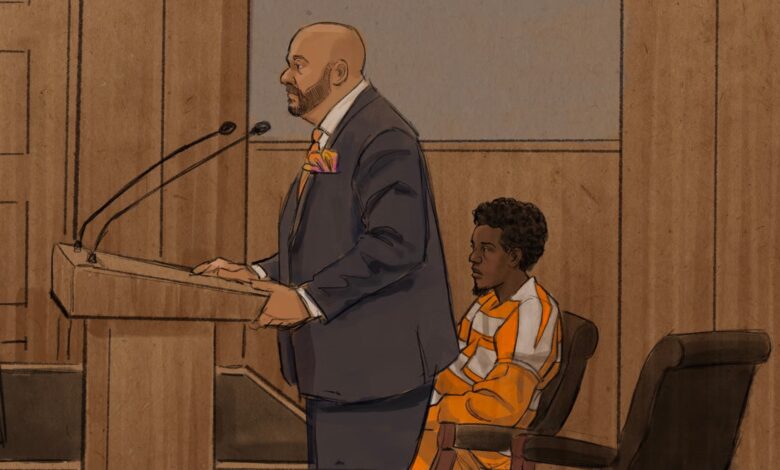
A federal judge on Wednesday sentenced former Safari Restaurant owner Salim Said to 30 years in federal prison for his involvement in what federal prosecutors describe as Minnesota’s largest fraud scheme to date. In addition to the prison term, Said was ordered to pay $44 million in restitution, a financial penalty he shares jointly with other defendants.
Said and Feeding Our Future founder Aimee Bock were convicted on all counts by a jury following a lengthy trial more than a year ago. Said faced 21 separate charges, which included conspiracy to commit wire fraud, conspiracy to commit money laundering, conspiracy to commit federal programs bribery, money laundering, federal programs bribery, and substantive wire fraud. His 30-year term stands as the second-highest sentence handed down in connection with the massive pandemic-relief meal fraud scandal, trailing only Bock, who is currently serving a nearly 42-year sentence. Another co-defendant, Abdiaziz Farah, received 28 years for his part in the fraud alongside an additional 10 years for attempting to bribe a juror during the initial trial.
During Wednesday’s sentencing hearing, federal prosecutors pressed for a 40-year prison term, while defense attorney Barry Zone argued for a 12-year sentence. Zone sought to distance his client from Bock, whom the government characterized as the ringleader of the operation, telling the court, “I’m not saying my client is an ordinary participant, but he’s also not the architect.” Zone also argued that he had not heard of a single child going hungry as a result of the scheme.
U.S. Attorney for Minnesota Rebecca Kline rejected that assertion during her arguments, emphasizing the broader societal impact of the crime. “This entire state and its taxpayers and people who rely on public institutions to meet their daily needs[…]Those are the victims here,” Kline said. Kline also disputed the defense’s attempt to separate Said from Bock, pointing out that Said had paid a bribe directly to the founder.
Zone presented personal background to the court, detailing severe trauma and abuse Said experienced as a child in Somalia, including accounts of being beaten and tied to a tree to test whether wild animals would attack him. The defense submitted letters from loved ones detailing this history. However, U.S. District Court Judge Nancy Brasel stated she struggled to connect Said’s childhood trauma with the greed demonstrated in the case, noting that he had stable employment and operated a restaurant before entering the conspiracy.
Addressing the court briefly, Said offered an apology for his role in the scheme and assured the judge he would never again find himself on the wrong side of the law. In delivering the sentence, Judge Brasel cited several aggravating factors, including Said’s prior fraud-related conviction. “You took more than taxpayers dollars to enrich yourself. You took the reputation of our state down with you,” Brasel told him.
Court documents and prosecutors trace Said’s involvement back to 2020, when he enrolled Safari Restaurant in the Federal Child Nutrition Program under the sponsorship of Feeding Our Future. Operating through non-profits and shell companies alongside codefendants, Said established multiple distribution sites across Minnesota. Authorities established that Said and his co-conspirators submitted fraudulent claims reporting thousands of meals served daily, generating $44 million in illicit proceeds.
Investigators found that Said funneled over $100,000 in kickbacks through his shell companies to Abdikerm Eidleh. The fraudulent funds were subsequently used to purchase a million-dollar home in Plymouth, a mansion on Park Avenue in Minneapolis, property in Columbus, Ohio, and high-end vehicles, as well as to finance extensive shopping sprees. The acquired properties and vehicles are subject to official forfeiture.
The broader judicial fallout from the multi-defendant prosecution encompasses numerous sentencings across the state, with federal authorities continuing to track related court proceedings.