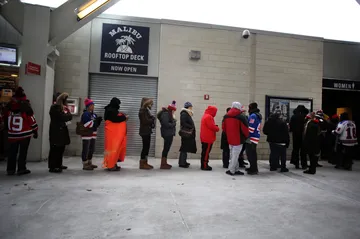
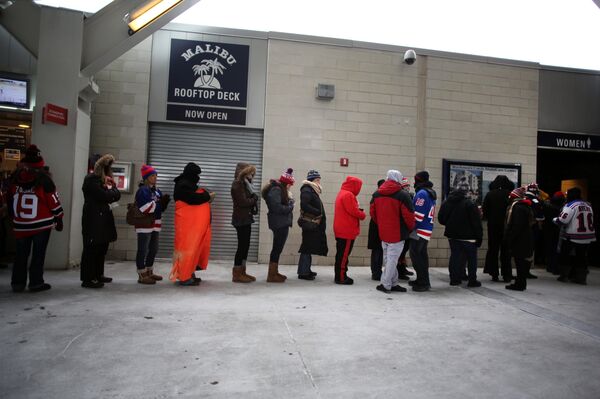
As women’s sports draw unprecedented crowds and female viewership expands across major leagues, sports venues across the United States are rethinking what a comfortable stadium experience entails—starting with the restroom. For much of the 20th century, standard architectural practice divided floor space equally between men’s and women’s facilities. Because urinals occupy significantly less physical space than individual stalls, that 1-to-1 footprint disparity has historically subjected female attendees to disproportionately long queues during intermissions.
Simulations conducted by University of Ghent researchers in 2017 indicated that women facing equal-space layouts can wait upwards of six minutes, compared to just 11 seconds for men. Academic inquiry into this imbalance dates back to the 1980s, when interior design professor Sandra Rawls gathered data at public arenas, malls, and airports in Virginia. Her findings showed that women spent an average of 180 seconds in public restrooms, versus 84 seconds for men. While these queues emerge in many public settings, they become acute in sports venues where thousands of spectators attempt to use facilities during brief game breaks.
Marisa Miles, a program manager at the American Restroom Association, noted that historic facility layouts fail to account for how women historically and currently utilize restroom spaces. While newly constructed venues employ modern design formulas, retrofitting older arenas remains complex and expensive. For instance, a 2023 renovation project covering 12 bathrooms at Acrisure Stadium in Pittsburgh cost $1.4 million.
To address these hurdles, venue designers and operators are implementing diverse architectural and operational strategies. Some facilities utilize flexible restrooms that dynamically convert from men’s to women’s layouts based on an event’s demographic makeup. U.S. Bank Stadium in Minneapolis, which opened in 2016 for the Minnesota Vikings, doubled its fixture count compared to its predecessor and eliminated communal trough-style urinals entirely.
Other innovations draw inspiration from passenger logistics. Ming Hu, a professor of business operations and analytics at the University of Toronto, suggested that stadiums could deploy queue-management signage reminiscent of transportation security checkpoints, guiding spectators toward underutilized facilities with shorter waits and displaying walking distances to alternative restrooms.
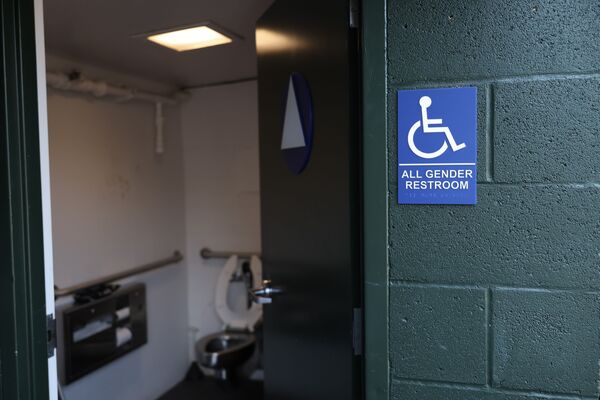
Regulatory frameworks have also shifted. Thirty-four states alongside Washington, D.C., Guam, and Puerto Rico have adopted versions of the International Plumbing Code. Mark Fasel, director of plumbing and mechanical resources at the International Code Council, noted that the code originally mandated a 2-to-1 ratio favoring women’s restrooms when established in 1995, and the 2021 edition introduced multi-user facilities designed to serve all genders.
Beyond traditional fixture counts, venue operators are addressing basic hygiene needs. Claire Coder founded Aunt Flow in 2016 as an 18-year-old to supply businesses and arenas with menstrual products. Although early resistance claimed no market existed for business-to-business period care, the company’s products are now established in more than 30 sports venues, including Atlanta’s State Farm Arena. Coder emphasized that strict stadium bag policies heighten the necessity of providing these products on-site. Recently, Columbus, Ohio, mandated free period products across all major professional sports venues.
Minor league baseball’s Columbus Clippers partnered with Aunt Flow at Huntington Park while also introducing family rooms for nursing and diaper changes. Mark Galuska, the team’s vice president and assistant general manager, recalled the inadequate facilities of older ballparks, such as Cleveland Municipal Stadium’s antiquated trough urinals, contrasting them with modern facility evolutions.
The push for equity extends past fan amenities into athletic facilities. Pheba Thomas, a project director at the architecture firm Gensler, is designing a training facility for the WNBA’s Los Angeles Sparks—a franchise first. Thomas highlighted that tailored spaces, such as lowering shower heads for WNBA players, and improved fan restrooms are integral to elevating the overall sports economy. When spectators invest financially in live events, adequate restroom access remains a critical component of their overall satisfaction.