
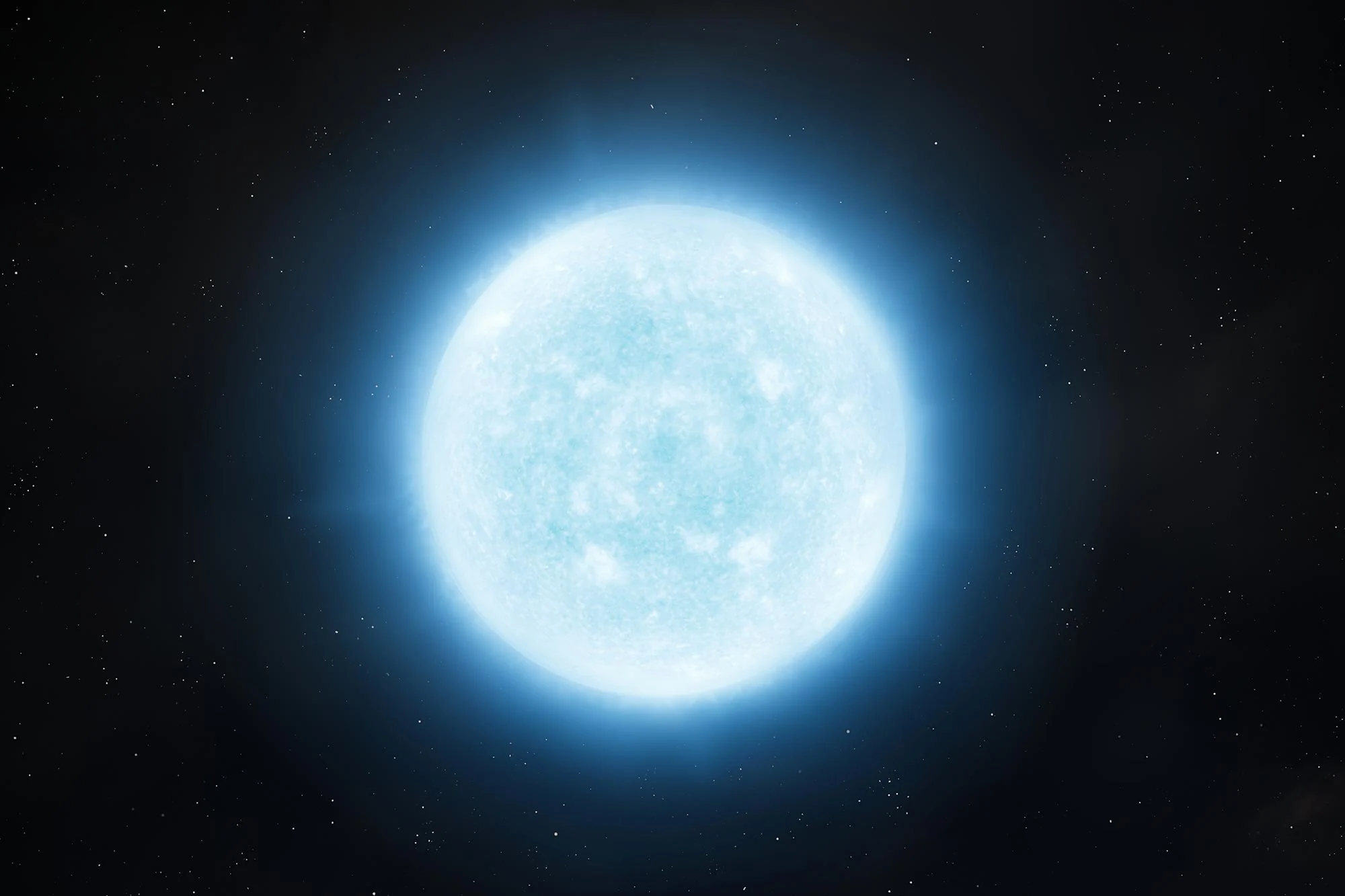
For decades, astrophysical theory has held that white dwarf stars possess a strict upper boundary known as the Chandrasekhar limit, typically pegged at roughly 1.4 times the mass of the sun. Surpassing this threshold normally strips a white dwarf of its stable structure, triggering gravitational collapse or a thermonuclear explosion. However, researchers at the Indian Institute of Science have used advanced computer modeling to demonstrate that powerful internal magnetic fields could alter this equation, allowing certain white dwarfs to reach approximately 2.4 solar masses.
Published in The Astrophysical Journal Letters, the study indicates that intense magnetism can supply vital internal support, enabling a dead star to maintain stability despite a mass far exceeding traditional theoretical projections. Normally, white dwarfs resist their own inward gravity through quantum degeneracy pressure exerted by electrons. As a star accumulates mass, gravity intensifies until it eventually overwhelms this quantum pressure, a mechanism that gave rise to the classic Chandrasekhar limit.
The research team found that magnetic fields introduce a crucial new variable into this framework. When a white dwarf accretes matter from a companion star, its mass and internal density climb, causing the stellar body to contract further. This compression amplifies the star’s internal magnetic field. The additional pressure generated by the magnetism helps counteract gravity, permitting the white dwarf to support a much heavier load.
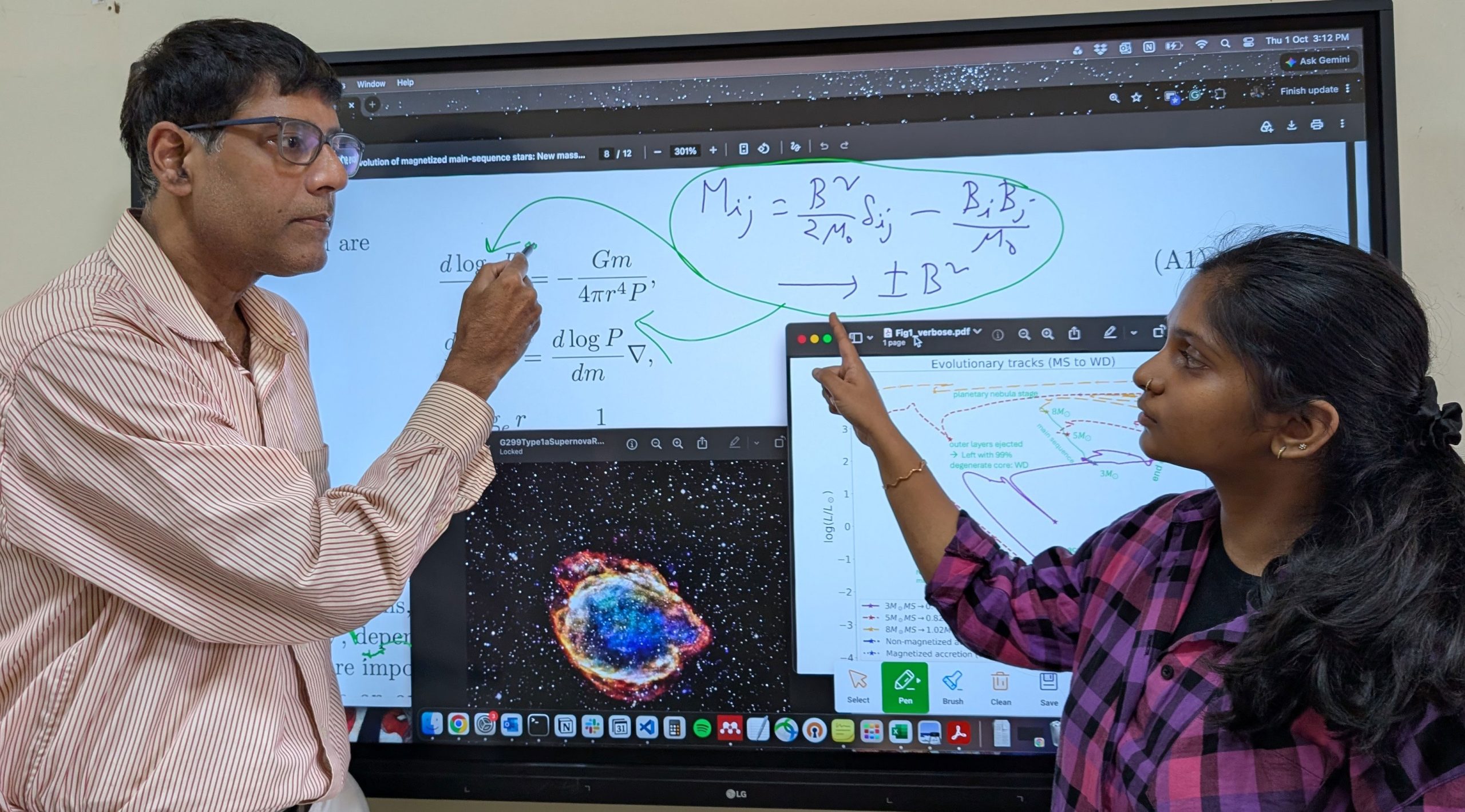
To test this hypothesis, the scientists modified the STARS stellar evolution program developed at Cambridge University. They incorporated magnetic field effects and cooling processes into the software, simulating an entire stellar life cycle starting from the main sequence phase, continuing through white dwarf formation, and ending with subsequent mass accretion from a binary companion. In one specific simulation, an initial star with roughly eight times the solar mass eventually formed a carbon-oxygen white dwarf with a mass of about 1.02 solar masses. When this remnant accreted matter at an annual rate of roughly one-billionth of a solar mass, its magnetic field intensified steadily, pushing the calculated stable mass limit up to approximately 2.4 times that of the sun. By contrast, a control simulation under identical conditions without magnetic effects maintained a ceiling near 1.4 solar masses.
Zenia Zuraiq, a physics doctoral student at the Indian Institute of Science and lead author of the study, emphasized that the significance of the work extends beyond merely establishing that super-Chandrasekhar white dwarfs are theoretically possible. The primary achievement lies in demonstrating that a star can genuinely attain such a state through natural evolutionary processes. By tracking the simulation from the main sequence stage through accretion, the findings show that this evolutionary pathway is physically viable under specific conditions.
The notion that white dwarfs might exceed the Chandrasekhar limit has been investigated by astronomers for decades. Earlier observations identified abnormally bright Type Ia supernovae that far exceeded standard model expectations, leading some researchers to hypothesize that the blasts originated from white dwarfs significantly heavier than 1.4 solar masses, with progenitor masses potentially nearing 2.8 solar masses. While previous theoretical calculations primarily focused on whether ultramassive white dwarfs could remain stable, the new research successfully simulates how they might actually form through stellar evolution, offering a more complete theoretical foundation.
Nevertheless, the researchers caution that such objects are likely rare, and the current study cannot yet establish how frequently they occur in the universe. This discovery could carry broader implications for how astronomers measure the expansion rate of the universe. Type Ia supernovae occur when runaway thermonuclear combustion ignites inside carbon-oxygen white dwarfs as internal temperature and pressure cross a critical threshold. Because these stellar explosions display predictable brightness characteristics that can be calibrated via light curves, astronomers routinely rely on them as standard candles to measure distant galactic distances and study cosmic expansion history.
If a subset of Type Ia supernovae actually stems from heavier, highly magnetized white dwarfs, their progenitors would differ markedly from traditional models. These variations could alter explosion brightness and evolutionary trajectories, potentially impacting the precision of cosmic distance measurements. Refining models of how these supernovae form will help astronomers strengthen the physical frameworks used to gauge cosmic expansion.
The study underscores that long-standing physical boundaries in astrophysics can be subject to overlooked variables. The Chandrasekhar limit does not apply uniformly under all circumstances, and intense magnetic fields may carve out a viable evolutionary route for heavy white dwarfs that was previously difficult to confirm. The paper, titled “Formation of Super-Chandrasekhar White Dwarfs via Evolution of Magnetized Main-Sequence Stars: New Mass Limits from STARS Simulations,” was published on October 8, 2026.