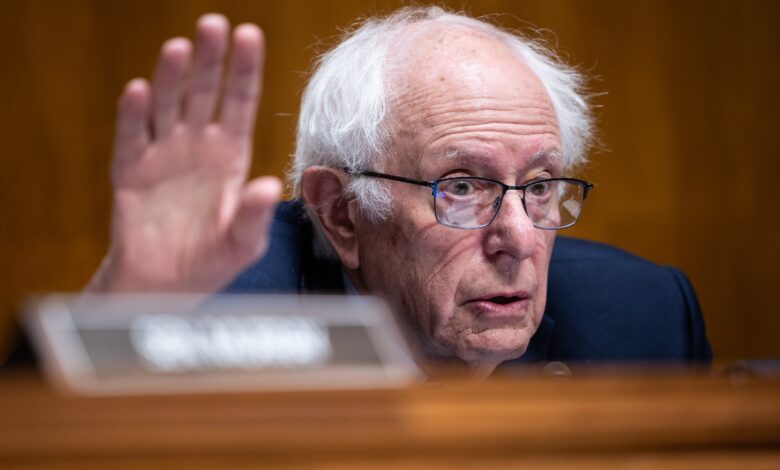
Vermont independent Senator Bernie Sanders is positioned to assume leadership of the powerful Senate Health, Education, Labor and Pensions Committee if Democrats manage to flip the Senate in upcoming elections. The potential gavel would provide the 85-year-old leftist lawmaker with a high-profile platform to advance his political movement and influence the 2028 presidential contest, a race in which he has indicated he is unlikely to run.
Sanders’ prospective chairmanship places him at the center of upcoming legislative battles during President Donald Trump’s administration. While Democrats harbor strong intentions to hold the administration accountable—particularly regarding the Department of Health and Human Services under Secretary Robert F. Kennedy Jr.—Sanders has signaled his intent to use the committee to tackle broad systemic challenges rather than focusing narrowly on individual agency operations.
“If I have anything to say about it… the agenda of the Democratic Party is going to be extremely bold. It is going to take on high costs,” Sanders stated regarding his prospective agenda. “The super PACs are not going to run the agenda anymore. We’re going to do what the American people want.”
With Sanders’ senate term extending through 2030 and Trump occupying the White House, the enactment of sweeping legislative initiatives remains unlikely in the short term. However, Sanders has a history of using his committee positioning to pull the Democratic caucus leftward. During Joe Biden’s presidency, he led the Budget Committee and advocated for expansive social safety net proposals, including a $15 minimum wage hike during pandemic relief negotiations and an ambitious $6 trillion plan for the Inflation Reduction Act that sought to add dental, vision, and hearing coverage to Medicare.
Although those broader ambitions were scaled back amid legislative struggles for votes, Sanders consistently utilized committee hearings to spotlight national issues ranging from climate change and income inequality to corporate labor practices. Now, direct oversight of health matters positions him to make universal health care a central focus once again. Characterizing the current medical system as broken, dysfunctional, and expensive, Sanders has warned fellow Democrats against pursuing incremental reforms upon regaining congressional control.
That uncompromising stance finds a more receptive audience within the Senate Democratic Caucus than it did during earlier legislative battles. Departed moderates have left behind a caucus where several prospective 2028 presidential hopefuls hail from the party’s progressive wing. Senator Chris Van Hollen of Maryland, a potential 2028 contender often mentioned as a future leadership figure, expressed support for pursuing a Medicare-for-All framework to combat rising healthcare costs.
Beyond healthcare, a Sanders-led HELP Committee would wield significant influence over labor and education policy. Sanders intends to pursue legislation raising the minimum wage, expanding union organizing rights, and protecting employees from job losses driven by artificial intelligence. Regarding AI expansion, Sanders asserted that lawmakers must slow the implementation process down, stating that the American public desires a legislative pause.
On education policy, Sanders has previously advocated for tuition-free four-year public college and higher teacher compensation, while various Democratic colleagues focus on countering the Trump administration’s efforts to downsize or eliminate the Department of Education. Although Sanders’ office previously published reports documenting declines in the department’s civil rights enforcement, other panel members have spearheaded legislative opposition, such as Senator Tim Kaine negotiating a deal with outgoing committee chair Senator Bill Cassidy of Louisiana to block the offloading of key federal programs.
Cassidy’s departure from the Senate at the conclusion of the year leaves the top Republican position on the committee open. While Senator Rand Paul of Kentucky is next in line, he may opt to continue leading the GOP on the Homeland Security and Governmental Affairs panel, potentially shifting the position to Senator Lisa Murkowski of Alaska. Murkowski has previously raised concerns regarding HHS leadership, which could create avenues for bipartisan oversight, while Sanders might also find common ground with AI-skeptical Republicans like Senator Josh Hawley of Missouri.
Supporters on the progressive left view Sanders’ potential ascension to the committee chairmanship as a vital opportunity to establish a distinct political vision for working families rather than seeking legislative compromises. Representative Greg Casar of Texas emphasized that Sanders’ lifelong advocacy for universal healthcare and living wages will drive substantial change. Joseph Geevarghese, executive director of the progressive organization Our Revolution, suggested that a Chair Sanders could position affordability crises at the center of the opposition party’s platform while extracting concrete gains during administration oversight efforts, effectively establishing him as a de facto leader defining the party’s opposition identity.