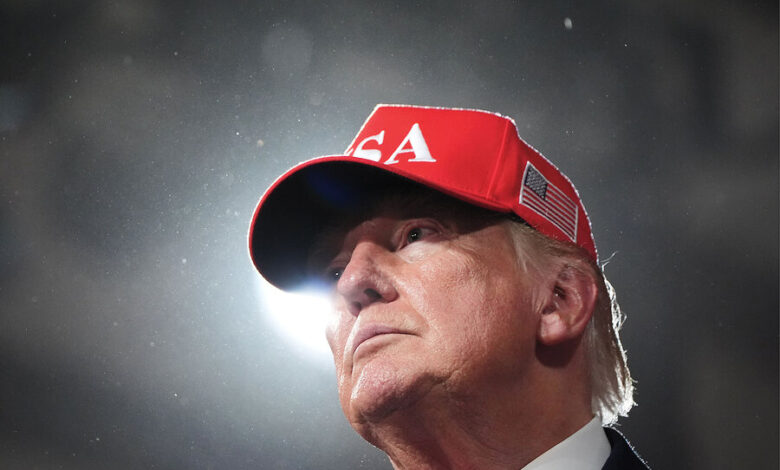
At his second inaugural, President Donald Trump reflected on surviving an assassination months earlier in Butler, Pennsylvania, framing his survival in providential terms. Since taking the oath on Jan. 20, 2025, his second term has featured an assertive use of executive power, a largely compliant Republican-led Congress, and an accumulation of personal wealth rare for a sitting president.
Now, with average job approval hovering around a second-term low of roughly 36 percent, Mr. Trump faces a pivotal test in the Nov. 3 midterm elections. The vote will decide control of Congress and set the stage for the burgeoning 2028 presidential campaign cycle. Historically, the party holding the White House loses congressional seats during midterms, and Democrats need a net gain of just three seats to reclaim the House, while polls indicate they could potentially capture the Senate as well.
A shift in congressional control would fundamentally alter the political landscape in Washington. Even if only the House flips, Mr. Trump and his associates, including family members, would face immediate congressional investigations, subpoenas, and potential impeachment proceedings. House Democrats are already laying groundwork to probe various matters, including Trump family business dealings, the U.S. military engagements involving Iran and Venezuela, and the files related to Jeffrey Epstein. A Democratic Senate majority would similarly deny the president the necessary votes for executive branch and judicial confirmations, including future Supreme Court vacancies.
Internal party friction has also surfaced this autumn. Some congressional Republicans have publicly broken with the administration on immigration policy, Ukraine, and reports of a Russian oligarch helping finance wedding expenses for Donald Trump Jr. These disagreements could multiply as lawmakers increasingly eye the post-Trump political landscape for 2028.
Despite potential legislative gridlock, observers across the political spectrum suggest the remainder of Mr. Trump’s term will not conform to traditional lame-duck behavior. Freed from the pressure of running for future office, analysts argue the president may feel unconstrained. Republican strategist Doug Heye noted that the president retains full executive authority until noon on Jan. 20, 2029, and is expected to utilize it.
Throughout his presidency, Mr. Trump has frequently bypassed the legislative branch, a strategy expected to intensify if Democrats control one or both chambers. William Galston, a senior fellow at the Brookings Institution and former domestic policy adviser, noted that the president continues to test executive limits by challenging judicial boundaries. Previous examples include aggressive tariff implementations, the redirection of approved funds, and the White House ballroom construction project.

Following the midterms, attention will inevitably center on the 2028 presidential nomination races. While Mr. Trump has occasionally joked about defying the 22nd Amendment to seek a third term and worn “2028” campaign caps, speculation continues regarding his potential role as kingmaker for potential contenders such as Vice President JD Vance and Secretary of State Marco Rubio.
Jordan Cash, a political science associate professor at Michigan State University who studies lame-duck presidencies, suggests the president will continue pursuing his own agenda regardless of electoral implications. Assuming a departure date of Jan. 20, 2029, the ten-week post-election window between the November 2028 selection of his successor and Inauguration Day could prove particularly volatile or consequential if unilateral actions are deployed to express frustration over election outcomes.
Unlike traditional second-term executives mired in declining polls and potential scandals, Mr. Trump has maintained a distinct focus on physical legacies in Washington, including the new ballroom, a proposed triumphal arch, and renovation plans for the John F. Kennedy Center for the Performing Arts, alongside encouraging his name’s association with public infrastructure like the West Palm Beach airport and the U.S. Institute of Peace.

Matthew Dickinson, a political scientist at Middlebury College, observed that second-term presidential fixations on legacy projects often result in overreach. If Democrats secure part of Congress, Dickinson expects the administration to lean heavily on administrative authority—such as impounding funds and declaring national emergencies, akin to the 20-19 southern border wall funding maneuver—while shifting greater focus toward foreign policy initiatives where unilateral action faces fewer domestic hurdles.
Meanwhile, the foundational support of the MAGA base remains a crucial factor. In Weare, New Hampshire, retired tech worker and military veteran Joe Hollen expressed strong approval for administration actions ranging from the conflict with Iran to proposed voter identification requirements under the SAVE America Act, though he drew the line at proposals to rename geographic landmarks like Lake Ontario and the Gulf of Mexico.
In Effingham County, Georgia, retired paper-mill worker David Christian voiced unwavering support for mass deportations, crime initiatives, and military actions in the Middle East despite elevated gas prices. Conversely, nearby in Savannah, young welder Kai Maria described disillusionment with the administration, citing reservations over the conflict with Iran, handling of the Epstein files, and tariff impacts on consumer costs, noting he might sit out the November midterms entirely.
As Democrats weigh potential legislative strategies, debates persist over whether to pursue impeachment against figures like Defense Secretary Pete Hegseth or the president himself. While some argue that unauthorized executive actions warrant formal sanctions regardless of a distant two-thirds Senate conviction threshold, other strategists like Alex Conant caution that partisan impeachment battles often backfire by failing to address voter concerns over economic pressures.