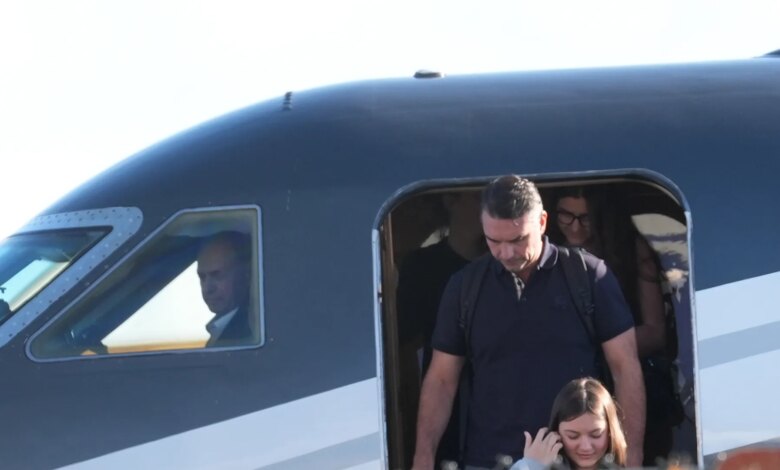
Far-right Brazilian Senator Flavio Bolsonaro, accompanied by his wife and two daughters, arrived in Miami, Florida, on Wednesday following his defeat in Brazil’s presidential runoff election. The departure occurred shortly after Supreme Court Justice Alexandre de Moraes issued an order late Sunday night requiring Bolsonaro to surrender his regular and diplomatic passports over concerns that he presented a flight risk.
The passport order was linked to an ongoing money laundering and currency evasion investigation involving the senator and his associate Willer Tomaz. According to local press reports, Tomaz had already departed Brazil for Miami two weeks prior.
Argentine immigration authorities reported that Flavio Bolsonaro and his family crossed the border into Argentina late Tuesday night via a land route. Less than an hour later, they boarded a private aircraft operated by Baires Fly, traveling first to Guayaquil, Ecuador, and subsequently continuing on to Florida. The aircraft landed at Opa-Locka Executive Airport near Miami on Wednesday morning, following confirmation from the U.S. State Department on Tuesday that visas would be issued to the family.
The international travel unfolded in the shadow of a closely watched presidential contest in which centre-left incumbent Luiz Inacio Lula da Silva secured a re-election victory. Official results showed Lula capturing 51.8 percent of the vote compared to Bolsonaro’s 48.2 percent, representing a margin of more than 4.4 million votes. While U.S. President Donald Trump and Argentine President Javier Milei withheld immediate congratulations—with Trump asserting without evidence on Monday that the election appeared rigged—Brazil’s Liberal Party formally recognized the outcome.
Flavio Bolsonaro initially refused to concede, holding a press conference on Sunday to announce plans to petition for an election annulment. His challenge focused on a last-minute Supreme Court decision that extended voting hours by two hours due to adverse weather and transportation challenges. Official records, however, indicated that fewer than 35,000 votes were cast during the extension period.
The senator’s abrupt departure drew sharp criticism from voters in Sao Paulo. Cristiana Cunha, 36, characterized the move as an unwillingness to face the consequences of his actions, while psychoanalyst Priscila Cardoso described the exit in harsher terms.
Political analysts suggest the electoral loss and subsequent departure could reshape Brazil’s conservative movement. Paulo Roberto de Souza of the Democracy in Check Institute noted that the defeat marks a historic setback for the family, following former President Jair Bolsonaro’s 2022 loss and Flavio’s failure to convert a first-round lead into a runoff victory.
De Souza observed that the absence may spark internal competition among conservatives to inherit the political influence previously held by the Bolsonaro family. Sao Paulo Governor Tarcisio de Freitas, who secured a first-round re-election victory, is viewed by analysts as a central figure in any potential conservative reorganization, though he faces the challenge of maintaining support among hardline loyalists while pursuing a pragmatic path forward. Despite the shifting dynamics, some voters remain convinced that the family’s political footprint will persist through other elected relatives ahead of the 2030 elections.