US Stocks Edge Higher as Federal Reserve Holds Rates Steady Amid Big Tech Earnings

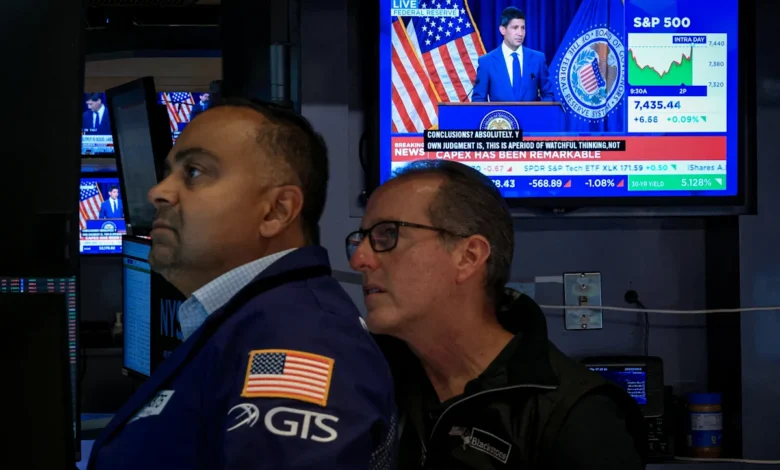
U.S. stocks edged higher on Wednesday as investors digested the Federal Reserve’s decision to hold benchmark interest rates steady in a 10-2 vote, while market attention shifted toward high-stakes quarterly earnings and guidance from major cloud and software providers.
The Dow Jones Industrial Average and the S&P 500 gained roughly 0.2% and 0.3%, respectively, while the tech-heavy Nasdaq Composite climbed about 0.3%. The Federal Open Market Committee voted to keep its funds rate unchanged in the 3.75% to 4% range following its two-day policy meeting, despite elevated inflation readings. Cleveland Fed President Beth Hammack and Fed Governor Lisa Cook dissented from the decision, favoring a rate hike.
Federal Reserve Chairman Kevin Warsh also announced structural changes to the central bank’s meeting schedule beginning next fall, stating that the FOMC will reduce its policy-setting meetings to eight per year while dedicating specific sessions exclusively to broad monetary strategy without rate votes or policy statements.
Bond market participants continued to price in further tightening. Futures contracts indicated an estimated 85% probability that the central bank will raise its benchmark rate by a quarter point at its upcoming Dec. 9 meeting, with traders projecting rates to climb from roughly 3.9% to nearly 4.7% by September 2027.

Corporate earnings drove significant individual stock movements. Microsoft shares jumped 4% in after-hours trading after reporting first-quarter earnings that beat Wall Street expectations on both the top and bottom lines. Microsoft posted earnings per share of $4.89 on revenue of $92.28 billion, topping analyst projections of $4.73 per share and $90.63 billion in revenue. Cloud revenue accelerated to $63.9 billion, outperforming consensus estimates of $61.62 billion. The report followed Microsoft’s recent offering of buyouts to up to 60,000 employees as part of operational streamlining efforts during its ongoing artificial intelligence build-out.
In contrast, Alphabet shares tumbled in after-hours trading following a rare quarterly miss. Google’s parent company reported third-quarter revenue, excluding payments to distribution partners, of $111.2 billion, missing the $111.3 billion consensus estimate. Earnings per share came to $2.12, falling short of the $2.99 analyst forecast. Alphabet’s net income contracted sharply to $26.17 billion from $34.90 billion in the third quarter of 2025, even as total revenue climbed 25% to $127.6 billion. The company reported that its Gemini application reached 1 billion users, while its free cash flow deficit widened to $9.06 billion from $5.85 billion in the previous quarter.
Oracle shares surged 12% after the software and cloud computing giant issued an ambitious fiscal 2030 revenue projection of at least $225 billion, implying annualized growth of more than 35% from fiscal 2026 levels. Oracle expects capital spending to peak in fiscal 2027 and 2028 to build capacity for its cloud and AI operations before declining in fiscal 2029, with positive free cash flow anticipated during the second half of fiscal 2028 and a target exceeding $30 billion for fiscal 2029.
Sentiment across the broader technology sector benefited from stellar results overseas. South Korean memory chipmaker SK Hynix reported a 632% year-over-year surge in operating profit to roughly $62.7 billion and a 328% jump in quarterly revenue to about $78.7 billion, driven by surging data center demand and early shipments of HBM4 memory chips. U.S.-listed shares of SK Hynix rose 8% in premarket trading, while domestic peers Samsung Electronics and Micron Technology also posted gains.
Elsewhere in the corporate sector, retail and financial disclosures drew investor attention. Billionaire investor Nelson Peltz’s Trian Partners reportedly offered $1.4 billion to acquire struggling restaurant chain Wendy’s, sending the company’s shares up 15% in premarket trading amid broader industry pressures from leveraged balance sheets and rising commodity and labor costs. Meanwhile, online trading platform Robinhood warned in its regulatory filing that its new artificial intelligence agents could execute unauthorized trades and expose the company to heightened regulatory, legal, and reputational risks.