A rose-colored meteorite discovered in the Sahara Desert three years ago is a 4.1-billion-year-old fragment of Mars, according to findings detailed in a NASA study. Weighing nearly two pounds, the specimen was recovered in Mali and designated Teghaza 001 after the salt plain where it was located. NASA officials noted that the object ranks as one of roughly 435 confirmed meteorites originating from the Red Planet.
Scientists verified its Martian origin by matching its chemical and mineral composition against data and physical samples gathered by previous Martian missions. Age-dating analysis established that the rock is approximately 4.1 billion years old, placing it among the three most ancient Martian meteorites ever recovered on Earth. According to the space agency, the discovery offers a rare snapshot of the planet’s early crust and planetary formation.

“It was only after we started looking closely that we realized this meteorite is really unique,” said Yang Liu, lead author of a research paper detailing the age-dating findings. Liu is a researcher at NASA’s Jet Propulsion Laboratory in Southern California, noting that one reviewer of the study described the specimen as a Rosetta Stone for Mars.
While previous ancient Martian meteorites offered narrower windows into the planet’s past, Teghaza 001 illustrates how the Martian crust developed from cooling magma before being altered by surface water. The rock comprises a distinctive blend of volcanic minerals, including zircon crystals that correspond with samples previously detected by the Mars Reconnaissance Orbiter in the planet’s southern highlands.
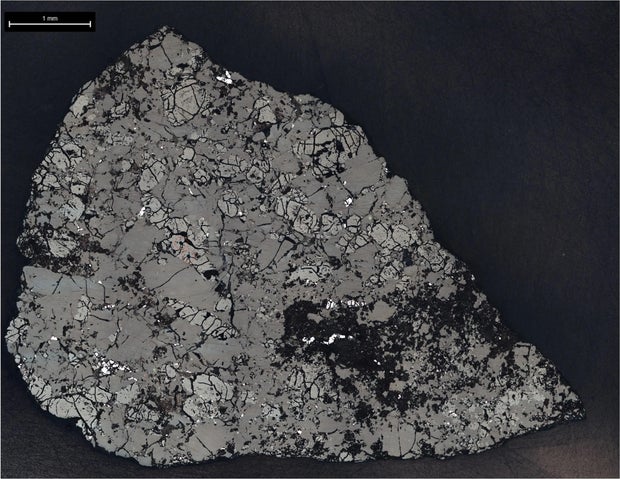
Francis Tissot, a geochemistry professor at Caltech, collaborated with the research team to apply a pioneering age-dating technique on a fragment smaller than a fingernail. This precision method enabled scientists to analyze individual mineral grains, revealing that the material experienced water alteration approximately 4.1 billion years ago, while the rock itself may have formed even earlier.
Co-author Lee Saper, a scientist at NASA’s Ames Research Center, explained that the meteorite captures interactions between water and rock, potentially retaining an imprint of the Martian atmosphere during a period when the planet was losing water. A separate study published in June examined the rock’s water content to evaluate how moisture may have shaped early Martian topography.
“This is really our first piece of Martian crust from a part of Mars we’ve never had a sample of before,” Saper said. With analysis still ongoing, Liu indicated that researchers have only begun to explore the scientific potential of the unique stone.