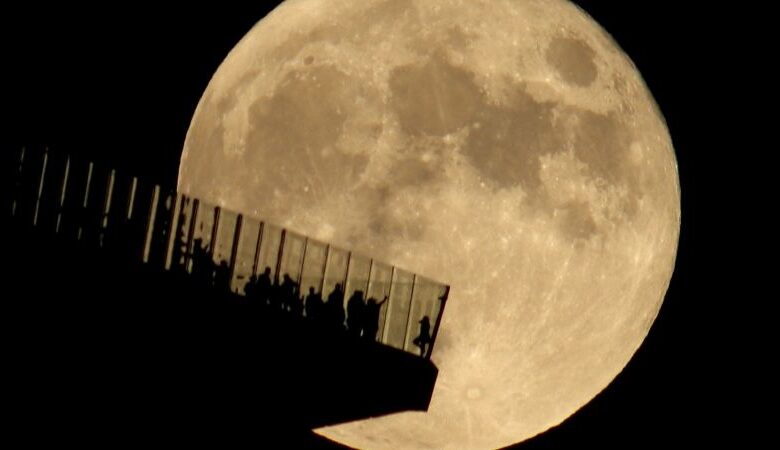
Skywatchers across the globe are turning their eyes upward this weekend as October’s full hunter’s moon makes its annual appearance, accompanied by a close visual approach from Saturn and followed by an upcoming occultation of the Pleiades star cluster.
The lunar event arrives just a month after the fall equinox, featuring an unusually early rise as dusk settles. Peak illumination is scheduled for 12:12 a.m. Eastern Time on Monday, October 26, according to data from EarthSky. As night falls on Sunday, observers who look closely will also spot Saturn glowing with a distinct golden hue just a few degrees south of the lunar orb.
Low on the horizon, the moon frequently takes on a pronounced orange or reddish cast. This atmospheric phenomenon occurs because moonlight must travel through a denser layer of air near the horizon, which scatters shorter blue and violet wavelengths and allows warmer orange and red tones to dominate, mirroring the mechanics of a sunset.
Historically, the hunter’s moon served a vital practical purpose. Native American tribes traditionally utilized the extended evening illumination to hunt active wildlife and stockpile provisions ahead of the approaching winter months. Falling immediately after September’s harvest moon—which guided agricultural reaping—the hunter’s moon carries deep seasonal roots.
Noah Petro, chief of NASA’s Planetary Geology, Geophysics and Geochemistry Lab at Goddard Space Flight Center, noted that these traditional titles reflect the intimate relationship past communities maintained with the night sky. Indigenous groups also designated the lunar cycle with names reflecting local ecology, including the drying rice moon, the falling leaves moon, the migrating moon, and the blood moon.
Petro, who serves as project scientist for the upcoming Artemis III mission scheduled for June 2027, points out that attentive viewers can discern subtle variations across the lunar surface as the moon rotates. These shifts in gradation stem from differences in geological age and surface composition. Petro’s team plans to further investigate these compositional variations during future Artemis operations to better understand the moon’s complex history.
For optimal viewing conditions, astronomers recommend seeking out locations free from structural and arboreal obstructions, such as open fields. Petro emphasizes that observers do not require sophisticated optical equipment to enjoy the spectacle, noting that clear eyes and clear skies are sufficient. Furthermore, crisp autumn and winter air often provides superior clarity because cooler temperatures generate less atmospheric turbulence than the rising heat of summer days.
Those who miss peak illumination on Sunday night will still find the moon appearing full on both Saturday and Monday evenings. The current lunar alignment concludes a multi-day period during which the moon has approached and passed Saturn, though the planet’s rings and subtle glow may prove challenging to spot against the intense luminescence of the full moon.
The weekend’s celestial schedule does not end with Saturn. Beginning Monday and running through Wednesday, the waning moon will approach, eclipse, and pass the Pleiades star cluster, frequently called the Seven Sisters. Visible to the naked eye as a compact, hazy grouping of six to seven distinct stars, the Pleiades stands as one of the most recognizable and celebrated stellar clusters globally.
Looking ahead at the remainder of the calendar, the hunter’s moon marks the 11th of 13 full moons scheduled throughout 2026. The final two full moons of the year will be supermoons, appearing noticeably brighter and larger as the lunar orbit brings the satellite to its closest point to Earth, culminating with the beaver moon on November 24 and the cold moon on December 23.