RAMAT GAN, Israel — For Yona Roizman, participating in civic life in her new home carries profound significance. Born just as Vladimir Putin rose to power in Russia in 1999, she grew up in an environment where democratic competition existed only in name. Following the full-scale invasion of Ukraine in early 2022, she left Moscow for Tel Aviv. Now an Israeli citizen, Ms. Roizman describes her first opportunity to cast a free ballot as a vital chance to counter what she views as democratic backsliding under the far-right government of Prime Minister Benjamin Netanyahu.
“I moved to Israel because I don’t want to live in a dictatorship, and I would like to live in a country that is at peace,” Ms. Roizman said. “And we are moving further from there.”
Ms. Roizman is part of a substantial demographic shift. According to Israeli government statistics, nearly a quarter-million Russians and Ukrainians have immigrated to Israel since 2014, when Russia seized Crimea. Approximately half of that total arrived following the February 2022 outbreak of war in Ukraine. While the exact number of those who have since departed remains difficult to quantify, those who stayed form a distinct political block, with many preparing to vote in Israeli elections for the first time.
These recent arrivals join a much larger, established community of former Soviet Union immigrants. Between 1989 and 2001, more than 900,000 people arrived in Israel, historically serving as a reliable voting base for right-wing political parties. However, polling data demonstrates a stark ideological divide between older and newer generations of Russian-speaking Israelis.
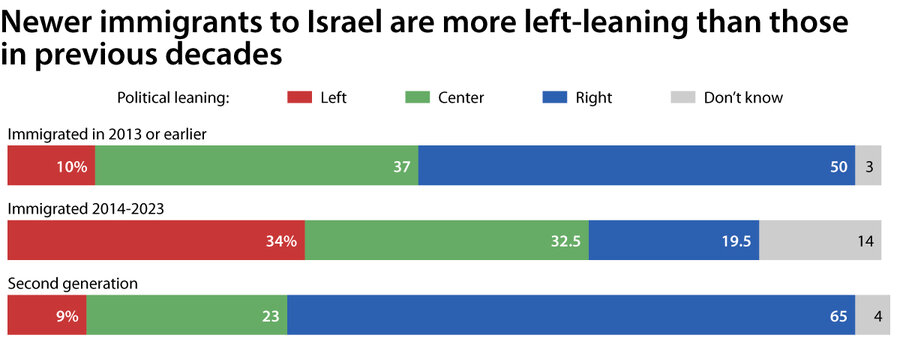
A survey published in 2024 by the Israel Democracy Institute revealed that among former Soviet Union immigrants who arrived between 2014 and 2023, one-third identified as left-leaning, one-third as centrist, and slightly under 20% as right-wing. By contrast, among those who emigrated prior to 2013, half described themselves as right-wing, while only 10% considered themselves leftists.
“There are definitely more politically active people, and people who oppose an anti-democratic regime,” said Inna Orly Sapozhnikova, a researcher at the Jerusalem-based Israel Democracy Institute. Zeev Khanin, a political studies professor at Bar-Ilan University, noted that his recent research confirms substantial generational differences within the community.
The cultural and economic divergence between the waves has even generated distinct monikers. The earlier wave is often referred to as the “Sausage Aliyah”—referencing the Hebrew term for Jewish immigration—due to the severe economic hardships they fled. Conversely, the newer wave acquired the nickname “Pumpkin Aliyah” after a 2022 immigrant inquired on a Russian-language chat group about finding a pumpkin spice latte in Israel. While initially used derisively by older immigrants, the moniker was embraced by the newcomers, with one recent arrival naming his Carmiel-based marketing firm Pumpkin People Marketing.
Dr. Khanin noted that most of the Pumpkin Aliyah arrived as middle-class professionals, whereas the Sausage Aliyah typically started their careers in Israel from scratch. He estimates that a majority of the newer cohort lean toward opposition parties, particularly Yisrael Beytenu, the right-leaning, anti-Netanyahu party led by Avigdor Liberman.
Sergei Zhurkovskii, who relocated to Israel from Russia in November 2022 to distance himself from the actions of the Russian regime, plans to vote for Gadi Eisenkot, a former army general allied with the opposition against Prime Minister Netanyahu. Mr. Zhurkovskii expressed concern that current leadership is steering the nation toward authoritarianism.
“I always participated in elections in Russia,” Mr. Zhurkovskii said, noting that those contests never felt genuine. “So, for me, these will truly be my first real elections.”
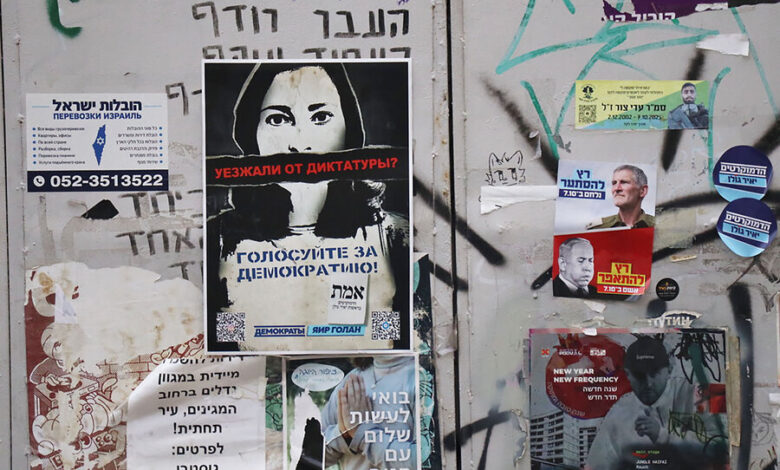
Similarly, Ms. Roizman has engaged actively in the political process, campaigning for The Democrats, a center-left opposition party led by former general Yair Golan. In the lead-up to elections, she participated in a panel discussion in Ramat Gan organized by Israel Shelanu, an NGO promoting civic engagement among Russian-speaking immigrants. The event featured representatives from five political parties addressing dozens of Russian speakers on issues including religion, state affairs, relations with Likud, and the Israeli-Palestinian conflict.
“I already had one home. Now, I have my second home,” Ms. Roizman said. “I don’t really know if I have it in me to have a third home.”