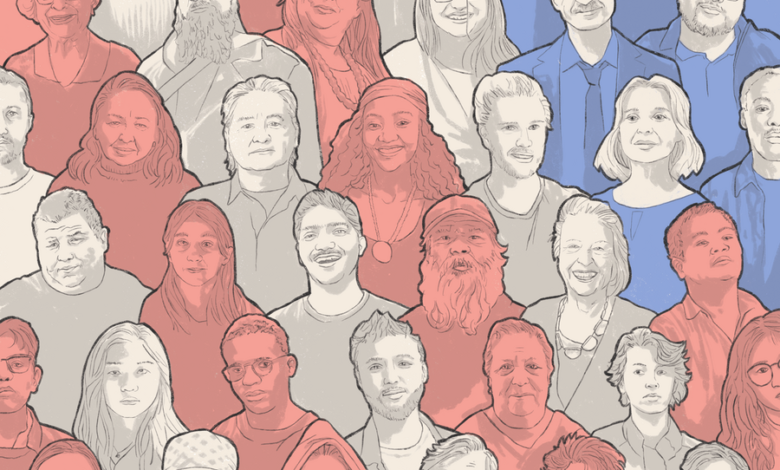
In early 2026, everyday residents across Minnesota captured public attention by organizing neighborly support networks in response to what they viewed as the excessive conduct of federal immigration enforcement agents. Minnesotans from diverse backgrounds brought food to families whose primary earners feared working, transported students to school, used whistles and cellphones to alert neighborhoods to enforcement actions, and gathered peacefully by the thousands to share grief and foster community trust. While some critics viewed these demonstrations as destabilizing to law enforcement, participants and local organizers saw them as constructive acts of solidarity that bridged partisan and cultural divides.
Writing from personal observation in the Twin Cities, civic scholars and community advocates point to these grassroots efforts as modern examples of an older, broader definition of citizenship. They argue that conceiving citizenship purely as a government-issued legal status or cultural inheritance reduces everyday people to powerless subjects of distant political, economic, and technological elites. Instead, they trace a rich American tradition that defines citizenship as the active aspiration and practice of governing and building a shared public life alongside one’s neighbors.
This expansive view of citizenship echoes the nation’s founding era. Archival discoveries at the Library of Congress reveal that in his working draft of the Declaration of Independence on July 2, 1776, Thomas Jefferson initially addressed his fellow “subjects” before crossing out the term and replacing it with “citizens.” This revision signaled that individuals in a new democracy must not rely on the benevolence of an arbitrary sovereign, but must actively sustain their emerging polity. Decades later, French observer Alexis de Tocqueville noted that American citizens frequently banded together in voluntary associations, driven by “self-interest rightly understood”—the recognition that personal well-being is inextricably linked to the welfare of one’s neighbors.
Throughout American history, excluded groups have repeatedly mobilized this agentic ideal of citizenship to expand civil rights and build community power. During the 19th and early 20th centuries, working people established mutual aid societies, cooperatives, and labor organizations. Similarly, in the post-Reconstruction American South, African American educators and activists built power across racial and religious divides. Beginning in the 1910s, thousands of Black female teachers organized communities to build schools and libraries with support from Sears, Roebuck and Co. President Julius Rosenwald. By the 1950s and 1960s, institutions such as the Highlander Folk School and the Southern Christian Leadership Conference—co-founded by Martin Luther King Jr.—helped establish hundreds of informal citizenship schools in church basements and beauty parlors across the South. These schools trained local leaders in voter registration and community organization, forming what former U.N. Ambassador Andrew Young described as the foundation of the nonviolent civil rights movement.
Despite this historical legacy, public discourse in recent decades has increasingly narrowed citizenship to a strictly legal framework. Under successive political administrations, the legal definition has often been deployed in partisan debates and restrictive immigration policies, carrying an ethno-latinate hostility toward newcomers from the Global South regardless of their local contributions. Concurrently, many progressive organizations, municipal governments, and educational institutions have distanced themselves from the term “citizen” out of concern that its exclusionary political connotations alienate the communities they serve. Seattle’s government banned the word in official statements in 2013, and academic style guides and school district mission statements have increasingly replaced it with phrases like “community member” or “global citizen.”
This linguistic shift, scholars argue, inadvertently erases the historical efforts of marginalized groups—including undocumented Latin American residents—who practice citizenship by participating in local civic life, volunteering, and advocating for rights commensurate with their contributions. As the United States approaches the 250th anniversary of the Declaration of Independence, various organizations are working to revitalize civic engagement. The National Civic League tracks thousands of community initiatives, while groups like Braver Angels promote what they term “courageous citizenship” across partisan divides.
Reflecting on these traditions, advocates emphasize that citizenship has never been solely a legal administrative tool for dividing populations. As future Supreme Court Justice Louis D. Brandeis observed in a 1903 address, the most important office in a democracy is that of the private citizen, calling upon everyday people to meet common challenges and improve public life together.