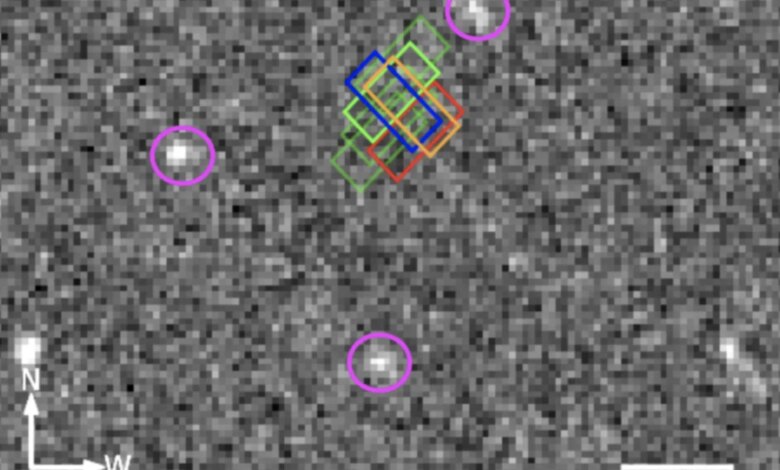
A team of astronomers scouring the distant universe for ancient objects that formed shortly after the Big Bang has stumbled upon an unexpected astronomical anomaly: a single emission line originating from an unidentified source. Utilizing the James Webb Space Telescope, scientists detected the unusual glow in a seemingly empty patch of the sky located in the southern constellation of Fornax.
The mysterious light appeared twice over a span of three months, despite earlier observations by both the Webb and Hubble space telescopes showing no visible object at that specific location. The exact origin of the emission remains a mystery, and researchers note that the potential candidates defy standard classification for known celestial objects. The findings detailing the discovery have been published in The Astrophysical Journal.
The detection occurred while astrophysicist Mason Huberty of the University of Minnesota and his research team were searching for previously undetected cosmic objects. Using Webb’s Near InfraRed Spectrograph, the team systematically blocked light from known objects, such as galaxies that had been previously cataloged by Hubble. They then analyzed the remaining data specifically for emission lines.
Out of seven detections made during the investigation, six could be successfully matched to distant galaxies. However, the seventh detection left the research team entirely puzzled. It manifested as a single bright line observed during two distinct windows carried out 88 days apart in August and November 2023.
The team subsequently compared the emission line to possible sources in earlier Webb images but could not pinpoint its origin. Both Hubble and Webb had previously targeted that specific sector of the sky, yet nothing was visible there. Emission lines are bright spikes of light emitted by atoms or molecules when they release energy, which astronomers typically use to determine the composition, distance, and motion of distant objects.
This particular emission line, however, stood out because it arrived unaccompanied by any other emission lines. On its own merits, the signal would have been bright enough to appear in earlier imaging sweeps.
While the astronomers behind the discovery have ruled out several known sources for the emission line, they have not yet been able to identify its source. Determining the origin requires establishing how far away the object is from Earth.
As the universe expands, it stretches light traveling through space, pushing it toward longer wavelengths and making it appear redder. An infrared photon might have started out as high-energy light from a distant object and stretched as the universe expanded, or it could have been emitted at a lower energy by a much closer object. To determine where the light came from and what produced it, astronomers require additional clues beyond its wavelength alone.
The research team notes that the emission lines could theoretically originate from a galaxy—possibly a primitive one that formed just a few hundred million years after the Big Bang—though such a celestial body should have been visible in earlier observations. Another possibility is an active galactic nucleus, representing the bright center of a galaxy powered by a black hole that is currently in its dying phase. If that scenario were accurate, however, the astronomers should have detected other accompanying emission lines from the source.
Alternatively, the light might be the result of a short-lived transient event, such as a star being shredded by a black hole, which could explain why nothing appeared in images taken approximately a year earlier. Yet all of these working explanations come with significant contradictions and unresolved problems.
Regardless of its true nature, the researchers emphasized in their study that the object is highly unusual and probes extreme physical conditions.