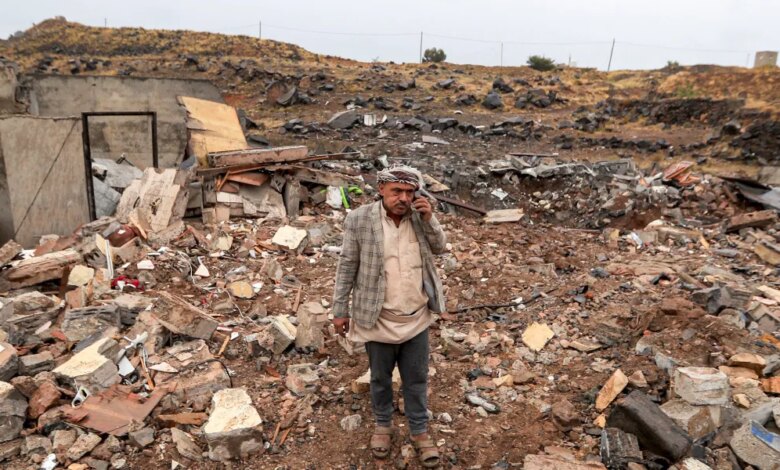
The failure of Washington and Tel Aviv to achieve their objectives in recent conflicts with Iran has precipitated the most significant American military retreat from the Middle East since the U.S. departure from Vietnam in 1975. This drawdown comes amid a resurgence of fighting between Saudi Arabia and northern Yemen’s Ansarullah movement, widely known as the Houthis. While U.S. officials have declined to intervene directly on behalf of Riyadh, the expanding hostilities have cast a sharp light on the vulnerabilities of regional infrastructure and the diminished posture of American forces across the region.
The renewed hostilities heated up in July 2026, when Saudi Arabia struck Sanaa International Airport to prevent a Houthi delegation from landing after returning from the funeral of slain Ayatollah Ali Khamenei in Iran. In response, Ansarullah forces launched retaliatory strikes, briefly closing Saudi Arabia’s own airport in October. The conflict has since drawn diplomatic and defense commitments from Pakistan, Türkiye, and Egypt to protect the kingdom, though none of these powers have deployed forces to Yemen itself.
For decades, the United States maintained regional dominance through a network of approximately 20 major bases, including the Fifth Fleet headquarters in Manama, Bahrain, and the expansive al-Udeid Air Base in Qatar, which housed 10,000 personnel. However, subsequent military engagements and retaliatory actions severely damaged this posture. The Pentagon acknowledged that Iranian strikes during the conflict destroyed or damaged hundreds of buildings across U.S. bases in Kuwait, Bahrain, Qatar, the United Arab Emirates, Saudi Arabia, Iraq, Oman, and Jordan, alongside numerous aircraft.
Acting Navy Secretary Hung Cao stated last month that strikes severely damaged the naval base in Bahrain, while the CIA offices at the U.S. Embassy in Riyadh were also destroyed. Furthermore, al-Udeid’s Combined Air Operations Center in Qatar was rendered inoperable, and all U.S. troops were withdrawn from Iraq as missile interceptors struggled against attacks from Iran and allied militias.
Iran’s deployment of Shahed drone swarms depleted expensive U.S. and Israeli interceptor stockpiles, with basic drones costing a fraction of interceptors like the $4 million Patriot. This supply strain, combined with the loss of operational air facilities, left the Pentagon with limited capacity to secure skies or rescue pilots over Yemen, contributing to Washington’s reluctance to intervene.
The broader regional friction is rooted in long-standing geopolitical divisions. Saudi Arabia launched a military campaign against Ansarullah in 2015 following the movement’s coup in Sanaa. While a United Nations-brokered truce in April 2022 largely quieted the front, underlying tensions persisted. The Ansarullah movement, drawing on Zaidi Shiism and local nationalist sentiment, rules roughly 80 percent of Yemen’s population. Although Western officials frequently characterize the group as an Iran-backed militia, analysts note the movement possesses independent local objectives, even as it receives technical support from Tehran.
In the wake of the joint U.S.-Israeli military actions against Iran earlier this year, Tehran responded by targeting energy infrastructure and shipping lanes. Iranian strikes hit Kuwait’s petroleum facilities and disrupted 17 percent of the production capacity at Qatar’s Ras Laffan natural gas installation, while attacks on vessels in the Strait of Hormuz caused maritime insurers to withdraw coverage. The resulting disruptions triggered global energy concerns, compounded by helium supply restrictions affecting computer chip manufacturing.
Sensing an opening following the strains placed on Gulf Arab states, Ansarullah launched a maritime and air campaign against Saudi targets to counter what it viewed as an economic strangulation of Yemen. Deploying missiles and drones built by engineers trained under former President Ali Abdullah Saleh’s government, Ansarullah forces struck oil installations, including Saudi Aramco headquarters in Dhahran, and advanced toward the strategic port of Mocha and the inland city of Taiz.
In late October, following a wave of Ansarullah attacks on King Fahd International Airport in Dammam, the Saudi defense ministry in Riyadh, and Aramco sites in Yanbu and Abha, the U.S. State Department ordered non-emergency government employees and their families to leave Saudi Arabia. State Department spokesperson Tommy Pigott noted the rising hostilities against civilian airports and critical infrastructure, underscoring the broader withdrawal of American influence across the Arabian Peninsula.