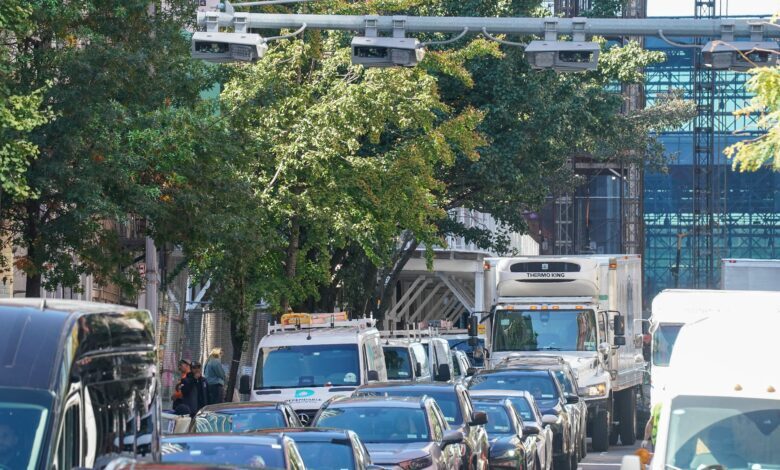
Congestion pricing in Manhattan has emerged as a financial windfall for the Metropolitan Transportation Authority while largely missing its primary environmental and traffic-flow objectives. Despite official praise from Gov. Kathy Hochul and transportation administrators, vehicular movement remains unaccelerated and air quality shows no measurable improvement since tolls were implemented across large parts of the borough.
Instead of alleviating gridlock, the program has generated approximately $750 million this year. That revenue stream nearly offsets the financial losses incurred by bus and subway fare evasion, leading critics to characterize the initiative as a revenue-raising measure directed at working-class commuters rather than an effective traffic management tool.

This tolling effort runs parallel to broader municipal initiatives aimed at discouraging driving through infrastructure redesigns. Although bicycle commuting accounts for roughly one percent of all trips in the city, urban planners continue to expand protected bike lanes, reducing available parking and driving space. A recent City Council proposal seeks to establish low-traffic neighborhoods across the city using physical barriers, speed bumps, and widened sidewalks designed to divert vehicles.
Proponents view these measures as preliminary steps toward total pedestrianization, a vision that would eliminate automobiles in favor of pedestrian plazas and cafes. Additional municipal projects, such as planned transformations for Park Avenue that include a two-way bike lane, a widened median, and the removal of two parking lanes, further demonstrate the ongoing effort to restrict vehicular access.
While mass transit remains essential to the region and cycling serves as a viable option for commuters, automobiles continue to provide individual mobility. Critics contend that pursuing a car-free urban model through tolls, busways, and traffic-calming infrastructure ultimately penalizes drivers without achieving genuine transit improvements.