Lawyers for Luigi Mangione pressed forward Friday with their bid to dismiss his state court murder and weapons prosecution, arguing that his guilty plea in a federal case two months ago bars the state from putting him on trial again.
Mangione, who admitted to killing UnitedHealthcare CEO Brian Thompson, pleaded guilty in Manhattan federal court in August. That plea triggered an ongoing legal dispute over the viability of a separate state prosecution for second-degree murder and weapons possession. The state trial, initially scheduled to begin Sept. 18, was postponed indefinitely to allow the court to weigh whether double jeopardy applies. New York Supreme Court Justice Gregory Carro is expected to issue a decision on the dismissal motion on Dec. 10.
Manhattan District Attorney Alvin Bragg’s office maintains that the state case can legally move forward because its charges differ significantly from those handled in federal court. The federal proceedings centered on stalking, crossing state lines, and cyberstalking via interstate facilities, each resulting in death. Prosecutors argue that the state indictment represents a traditional murder case and that murder is generally not defined by federal statutes.
Defense attorneys countered in a court filing Friday that the underlying offenses in both jurisdictions are materially identical. They told Justice Carro that the federal crimes to which Mangione pleaded guilty—interstate stalking resulting in death—involve overlapping legal elements with the state charges.

“Here, Mangione was charged by the federal grand jury with possession of the same firearm at the same time and at the same location as the People are charging here,” defense attorneys Karen Friedman Agnifilo, Marc Agnifilo, and Jacob Kaplan wrote in a letter to the court. “There is and was no other gun.”
Under New York state double jeopardy law, prosecutors must demonstrate distinct “evils” or separate harms between two cases for a state prosecution to proceed following a federal action. Mangione’s legal team contends that the harms addressed by both prosecutions are identical, writing that “there is no basis to find such a difference, much less a sufficiently great difference as to fit within the narrow statutory exception.”

Earlier in the month, District Attorney Bragg’s office pointed to a double jeopardy exception that could provide a legal pathway if Justice Carro determines the state case involves unique elements. Lead prosecutor Joel Seidemann argued in a court filing that earlier rulings in the federal proceedings demonstrate that the state charges are substantially different.
Specifically, U.S. District Judge Margaret Garnett previously ruled that the stalking conduct could not be classified as violent under the law, a decision that resulted in the dismissal of two counts that would have subjected Mangione to the death penalty. The Justice Department had initially announced its intention to seek capital punishment prior to Judge Garnett’s ruling.

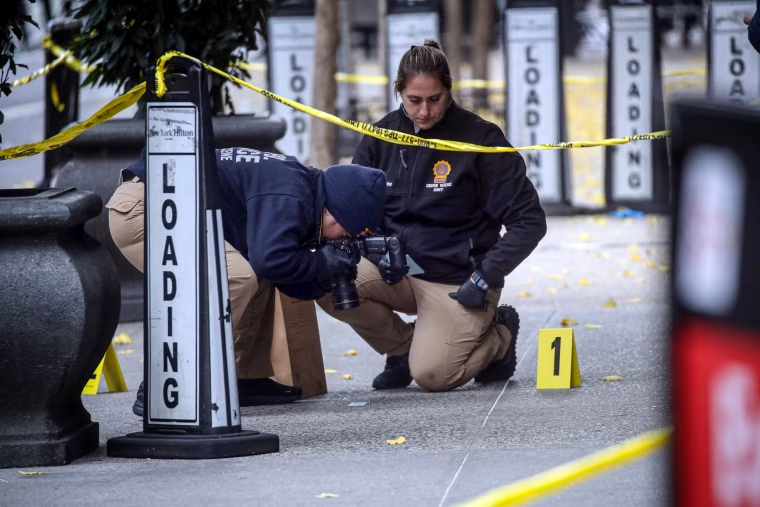
Mangione admitted to using a 3D-printed firearm to shoot Thompson outside a midtown Manhattan Hilton early on Dec. 4, 2024, as the executive walked from his hotel to a company investor conference. The gunman ambushed Thompson, a Minnesota father of two, firing multiple times before fleeing and sparking a five-day interstate manhunt. He was eventually arrested in Altoona, Pennsylvania, after patrons recognized him from NYPD photographs at a McDonald’s.
During his federal proceedings, Mangione—an Ivy League-educated Maryland native from a prominent family—stated that he was motivated by a personal grievance against the health insurance industry, though investigators have noted he was never a UnitedHealthcare policyholder. His defense team has argued that the case’s high profile has resulted in overprosecution, with both state and federal authorities seeking to secure separate convictions for the same criminal act.

Mangione faces a potential life sentence when he appears in federal court on Dec. 18. If the state murder case is allowed to proceed, he faces a maximum sentence of 25 years to life in prison.