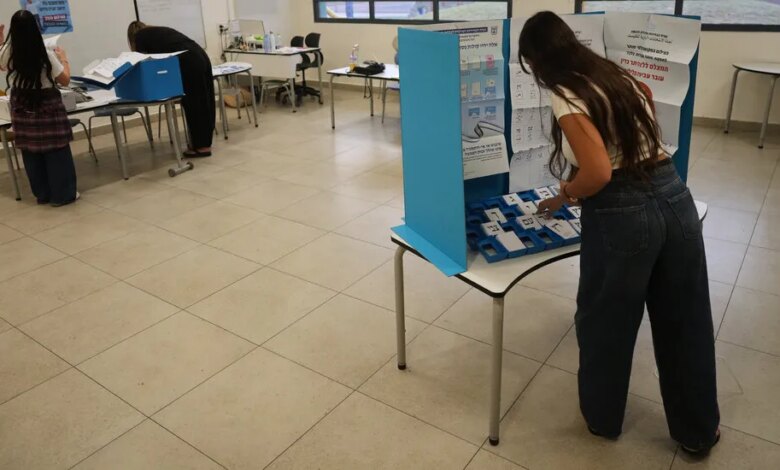
Israel’s political parties have finalized their candidate slates ahead of a general election scheduled for Oct. 27, setting the stage for what many Israelis consider to be the most consequential vote in the country’s history. The campaign is dominated by a high-stakes contest between incumbent Prime Minister Benjamin Netanyahu and Gadi Eisenkot, a former military chief of staff who leads the largest opposition party. Opinion polls indicate that neither man’s political bloc has secured a decisive majority of voter support, leaving the race unpredictable and carrying profound implications for regional stability, international relations, and millions of Palestinians living under Israeli occupation.
Approximately a dozen parties are projected to clear the electoral threshold required to enter Israel’s 120-seat parliament, the Knesset. The definitive political maneuvering will unfold after the election, when party leaders attempt to forge a governing coalition of at least 61 lawmakers.
At the center of the conservative field is Likud, historically the largest conservative party and increasingly populist. Led by 77-year-old Benjamin Netanyahu, Israel’s longest-serving prime minister, Likud has governed the country for more than 34 of the past 49 years, including 19 under Mr. Netanyahu’s leadership. Many observers view the upcoming election as a referendum on his tenure. Critics point to his failure to deliver on promises of total victory in ongoing conflicts and his refusal to accept responsibility for security failures leading up to the Oct. 7, 2023, attack by Hamas. Mr. Netanyahu also faces intense backlash over military draft exemptions for ultra-Orthodox Israeli Jews and a divisive push for judicial reforms aimed at reducing the powers of the Supreme Court. Facing corruption charges and an international arrest warrant related to the Gaza war, Mr. Netanyahu has vowed to complete ongoing military operations and block the creation of a Palestinian state.
Challenging Mr. Netanyahu from the center and center-right is Yashar!, a party formed a year ago by Gadi Eisenkot, 66. A former military chief of staff who served in Mr. Netanyahu’s war cabinet, Mr. Eisenkot experienced personal tragedy during the conflict when one of his sons and two nephews were killed. His platform targets Mr. Netanyahu’s vulnerabilities by supporting investigations into the security lapses preceding the Oct. 7 attack. While he has rejected near-term Palestinian statehood, Mr. Eisenkot has endorsed a more restrained expansion of West Bank settlements and promised to curb settler violence.
Other significant opposition forces include B’Yachad, a partnership between centrist leader Yair Lapid, 62, and right-wing nationalist Naftali Bennett, 54, who previously allied in 2021 to temporarily oust Mr. Netanyahu. The alliance is emphasizing unity and calling for an expanded draft of ultra-Orthodox citizens alongside an inquiry into the Oct. 7 attack. Yisrael Beiteinu, led by 68-year-old Avigdor Liberman, operates as a secular Jewish party that maintains hardline security views while fiercely defending Israel’s secular character against the rising influence of ultra-Orthodox rabbis. Meanwhile, The Democrats, formed in 2024 by 64-year-old Yair Golan from the remnants of the Labor and Meretz parties, advocates for a two-state solution and the preservation of a liberal, secular Jewish state.
On the right and far-right of the political spectrum, pro-Netanyahu factions are campaigning aggressively. Otzma Yehudit, led by 50-year-old Itamar Ben-Gvir, has seen growing support among Jewish Israelis since the Oct. 7 attacks. Mr. Ben-Gvir has called for the removal of Palestinians from Gaza through voluntary emigration and has drawn international sanctions for his anti-Arab rhetoric during his tenure as national security minister. Religious Zionism, led by 46-year-old Finance Minister Bezalel Smotrich, focuses heavily on expanding Israeli settlements in the West Bank and crippling the Palestinian Authority, with Mr. Smotrich openly advocating for the permanent occupation and resettlement of Gaza. Amcha Yisrael, a right-wing party formed in August by former brigadier general Ofer Winter, 55, supports Mr. Netanyahu while opposing draft exemptions for the ultra-Orthodox.
Traditional ultra-Orthodox parties include Shas, led by 67-year-old Aryeh Deri, whose political base consists largely of Jews from the Middle East and North Africa. United Torah Judaism, led by 61-year-old Yaakov Asher, represents Eastern European ultra-Orthodox streams focused on protecting traditional religious lifestyles and state subsidies, though its long-standing alliance with Mr. Netanyahu has grown increasingly strained.
Arab-led parties also occupy a critical position in the parliamentary landscape. Raam, led by 52-year-old Mansour Abbas, advocates for coexistence and pragmatic political participation, having made history in 2021 by joining a governing coalition. If mainstream Jewish opposition parties drop their resistance to partnering with an Arab faction, Mr. Abbas could play a pivotal role in government formation. Additionally, The Joint List, led by 54-year-old Yousef Jabareen, unites communist and Palestinian nationalist platforms to encourage higher voter turnout among Palestinian citizens of Israel.