Across the peaks, mid-hills, and foothills of the Hindu Kush and Himalayan mountain regions, communities are confronting an unprecedented climate emergency as the earth’s largest expanse of ice outside the polar regions rapidly thaws. Scientists report that the Himalayas are losing glacier mass 65% faster than a decade ago, threatening the water security of 2 billion people across 12 major downstream river basins by 2050. Projections indicate that up to 80% of the region’s glacier mass could vanish by 2100.
While international climate talks proceed slowly, local populations across eight countries are taking survival into their own hands. In Nepal, where a massive 55 million-ton ice-rock avalanche killed more than 1,400 people and left thousands missing on Aug. 26 near the Tibet border, the government is preparing to drain four massive glacial lakes to avert further disasters. Meanwhile, Nepal secured over $21.6 million on Oct. 22 as the first country approved for a provisional payout from the United Nations’ Loss and Damage Fund.
To combat erratic monsoon rains and shrinking perennial springs known as mool, Nepali communities are restoring historic infrastructure. Local governments in the Kathmandu Valley are actively rehabilitating ancient underground terracotta canal networks and sunken stone spouts, or hiti, originally built by the Licchavi and Malla dynasties as early as the 6th century. These systems rely on adjacent ponds to absorb monsoon rains and recharge the groundwater table, keeping spouts flowing during the dry season.

Hydrometeorologist Ngamindra Dahal, chairperson of the Nepal Water Conservation Foundation, is working alongside intergovernmental organizations to map drying springs and establish a new baseline for water availability. By tracking seasonal flow rates, elevations, and water quality, Dahal helps villages design localized water-sharing agreements and household rainwater harvesting systems. “A community may have adequate water in its landscape but lack the investment to bring it to households,” Dahal notes. “Conversely, a community may have taps everywhere but an increasingly unreliable source.”
In remote high-alpine areas like Nepal’s Limi Valley, the threats extend to sudden and overlooked hazards. Activist Tashi Lhazom witnessed her ancestral community devastated by floods that destroyed generational livelihoods, including hundreds of yaks. After urging scientists to investigate, Lhazom and a research team discovered that the disaster was caused by thawing permafrost draining underground thermokarst lakes rather than a traditional glacial lake outburst flood. Their findings, published in a September 2025 comment paper in Communications Earth and Environment, led to the formal recognition of a new hazard category: Small Alpine Lake Outbursts, which now threaten high-alpine environments from Peru to China. Lhazom is currently working to secure government funds to permanently resettle displaced villagers away from dangerous, destabilized mountainsides.
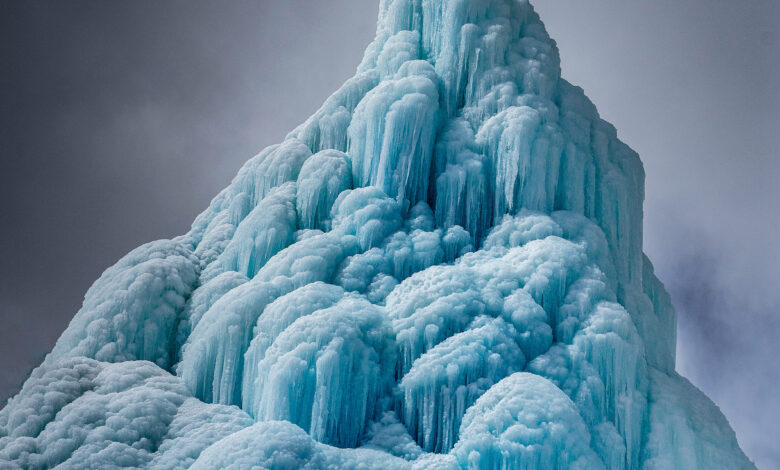
Further northwest in the high-altitude desert of Ladakh, India, mechanical engineer and activist Sonam Wangchuk is tackling severe water scarcity by engineering artificial glaciers known as ice stupas. Inspired by ancestral traditions, Wangchuk built systems that channel glacial spring water through high-pressure pipes into freezing winter air, creating multistory ice cones that store millions of gallons of water and release it during the spring planting season when farmers need it most. To overcome freezing pipes, Wangchuk collaborated with researcher Surya Balasubramanian, who launched Acres of Ice in 2023, to integrate solar-powered automated valves and sensor networks.
Today, roughly 160 ice stupas stand across regions including Ladakh, Nepal, Mongolia, Kyrgyzstan, Chile, and Pakistan. Wangchuk is now testing applications to draw water from dangerous glacial lakes to prevent catastrophic collapses. Despite these grassroots innovations, experts emphasize that local adaptation strategies have limits against accelerating global warming. “There’s very little that can be done at this point to protect against glaciers in vulnerable places in the Himalayas, so these communities suffer and pay the price for what the rest of the world does,” Wangchuk says.