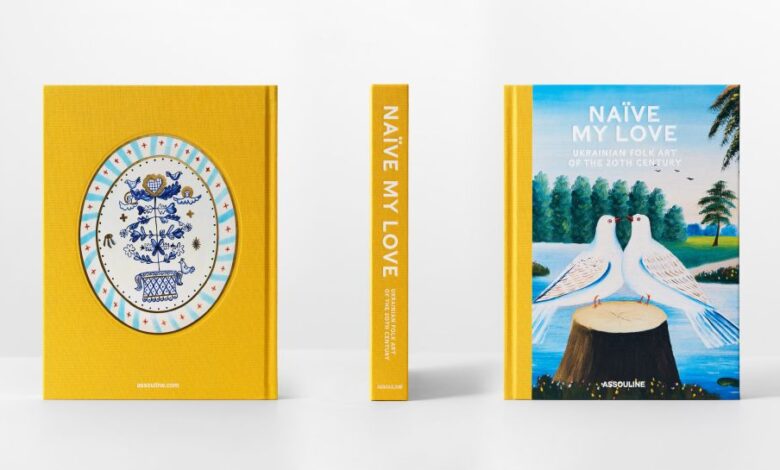
For centuries, Ukraine’s artistic identity has been shaped by external forces seeking control. Long before the full-scale Russian invasion, the country endured imperial restrictions on its language and institutions, followed by a Soviet apparatus that sought to dictate not only artistic production but how that work was circulated and preserved. Despite these pressures, generations of self-taught painters, weavers, and craftspeople maintained a vibrant vernacular tradition. Now, a new publication titled Naïve My Love: Ukrainian Folk Art of the 20th Century, produced in collaboration between publisher Assouline and the Kyiv-based design brand GUNIA Project, seeks to place this overlooked heritage into international focus.
Launched in Kyiv in 2019 by co-founders Maria Gavryliuk and Natalia Kamenska, GUNIA Project works to preserve and reinterpret traditional Ukrainian craftsmanship through contemporary design. Their partnership with Assouline extends that mission into art-historical research, bringing global attention to self-taught artists whose contributions have remained largely absent from international art histories. Gavryliuk explained that the project stemmed from a long-held ambition to share Ukrainian naïve art with a worldwide readership beyond domestic borders.

The volume explores how village traditions of the late 19th and early 20th centuries formed a rich cradle of creativity. Women preserved family skills in weaving, painting, and embroidering ritual cloths known as rushnyks, while men specialized in woodcarving and painting household items. These vernacular practices profoundly influenced prominent modernists who spent their formative years in the region. Avant-garde pioneer Kazimir Malevich recalled helping villagers smear clay on floors and paint patterns on stoves, noting in his autobiography how deeply peasant art shaped his sympathies and artistic path. Art historian and book editor Lidia Lykhach pointed out that internationally celebrated names like Malevich, Sonia Delaunay, and Alexandra Exter worked alongside village artists, drawing inspiration from visual traditions that are rarely acknowledged in standard art narratives. Delaunay frequently credited the bright colors and festive village rituals of her Ukrainian childhood with nurturing her foundational sense of rhythm and color.
Documenting this history required painstaking research, made difficult by decades of political suppression and loss. Many works survived only because they were kept privately in homes as ordinary objects rather than preserved in institutional collections. Journalist Anna Lodygina noted that during the Soviet era, academic art communities largely ignored naïve art because Socialist Realism was the only officially sanctioned method. When authorities did acknowledge folk art, they selectively framed practitioners like Maria Prymachenko and Kateryna Bilokur as idyllic rural hobbyists, obscuring the deeper symbolic dimensions and archetypal forms of their work.

Much of this fragile heritage faces acute danger amid the ongoing conflict in Ukraine. The volume documents poignant examples such as the painted house of Polina Raiko in Oleshky, whose murals were severely damaged in June 2023 when flooding from the destruction of the Kakhovka Dam inundated her property. Raiko began painting her home in high-gloss house paint at age 69 following a succession of family tragedies, transforming her living space into a personal memorial. With hostilities continuing into their fifth year of full-scale escalation and over a dozen years of broader conflict, cultural sites and museum collections have been placed at severe risk, prompting emergency relocations of artworks to western Ukraine for safekeeping.
By capturing these works in print, the new volume serves as a vital repository against loss, documenting both what has been destroyed and the enduring richness of Ukrainian culture. The creators hope the publication will prompt international curators, collectors, and readers to look past wartime headlines and recognize the unique artistic contributions of figures who have long deserved a place in global art history.