Investors across the euro area are increasingly debating the risk of a fresh debt crisis, with market attention shifting decisively from past Mediterranean flashpoints to France. A key gauge of French sovereign bond risk climbed this month to levels unseen since late 2011, during the height of Greece’s historic fiscal travails. Combined with violent street protests on Oct. 17 and a polarized parliament obstructing government debt-cutting measures, an upcoming election just six months away has cemented France as a central pressure point in European markets.
Financial analysts and market participants emphasize that France’s current struggles bear little direct resemblance to the Greek crisis that once threatened the viability of the entire monetary union. Nevertheless, bearish investors warn that France represents a far larger systemic stress test for the European Union. As the bloc’s second-largest economy carrying a €3.6 trillion or $4.0 trillion debt load backed by extensive international ownership, its financial health carries global ramifications.

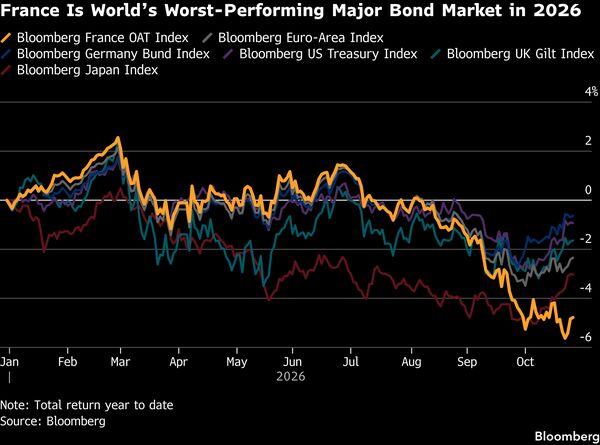
French government debt has faced severe downward pressure, generating wider losses for investors this year than any other major sovereign bond market. The yield on 10-year French OATs touched 5% this month for the first time since 2002. While these movements stem partly from broader energy shocks that forced the European Central Bank to raise interest rates, they also reflect deteriorating market sentiment toward French fiscal management.
Despite the selloff, the current environment remains far removed from the depths of Greece’s crisis. The yield premium demanded by investors to hold French bonds over German securities widened to 1.78 percentage points this month, a sharp contrast to Greece’s spread, which peaked above 35 percentage points. Furthermore, while Greece was effectively locked out of bond markets as buyers vanished, France maintains full access to issue new debt.
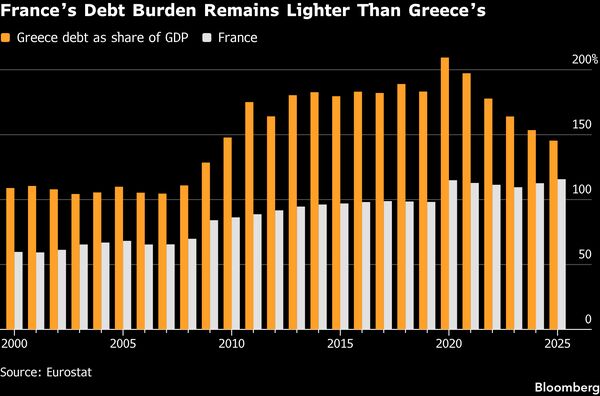
Structural metrics underscore fundamental differences between the two nations. France’s debt load is smaller relative to the size of its economy. When Greece’s crisis began in 2009, its debt-to-GDP ratio stood at approximately 129%, eventually surging past 200% during the coronavirus pandemic before falling back. France’s debt-to-GDP ratio sits at 119%, which remains well above the euro area average of 87% but is currently on an upward trajectory.
The sheer volume of debt at stake distinguishes the two cases. France’s €3.6 trillion debt footprint is roughly 10 times larger than Greece’s was in 2011. Because roughly 60% of French sovereign bonds are held outside the country, any acute market disruption would trigger international ripple effects, prompting concerns from major asset managers such as Franklin Templeton Inc.
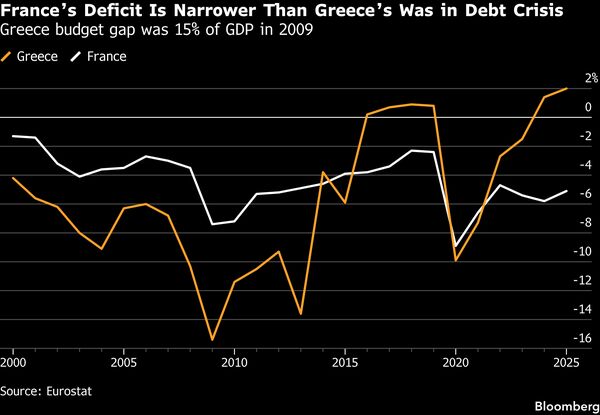
Fiscal deficits and revenue structures also diverge. Greece entered its crisis with a vastly wider, misreported budget gap that shattered investor confidence. France’s deficit is narrower, though successive governments have repeatedly missed public finance targets amid slowing economic growth, disappointing tax receipts, and minority government paralysis.
Paris abandoned its target of narrowing this year’s deficit to 5% of economic output from 5.1% in 2025, with officials now projecting a gap of roughly 5.4%. Unlike Greece, which suffered from widespread and systemic tax evasion that offered significant room for revenue expansion through compliance overhauls, France already registers tax revenues among the highest in Europe relative to national output. Consequently, further tax increases risk damaging economic growth.
With tax capacity constrained, France’s fiscal adjustment centers on public spending, which accounts for 57% of economic output, ranking second highest in Europe behind Finland. Controlling expenditures proves difficult amid structural upward pressures from an aging population and rising healthcare costs. Attempts to rein in welfare spending face steep political resistance; last year’s social security budget barely cleared parliament with an expanded deficit after the government suspended a planned retirement age increase.
Rodrigo Valdes, head of the International Monetary Fund’s fiscal affairs department, noted this month that France ultimately requires a comprehensive debate regarding pension reform and the broader scope of public service provisions.
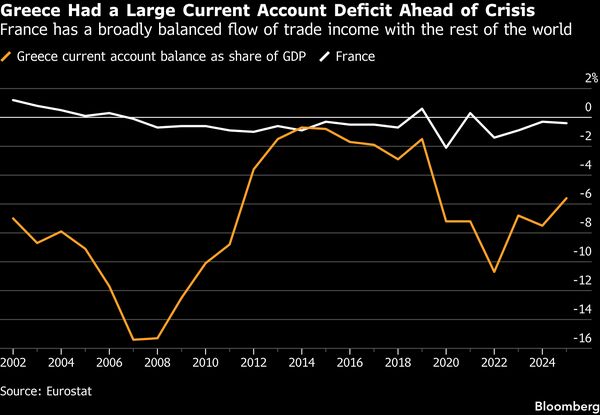
Underlying economic fundamentals provide further contrast. At the onset of its crisis, Greece relied heavily on tourism, shipping, and agriculture. France boasts a significantly larger, diversified economy anchored by luxury goods, aerospace, finance, logistics, and technology, maintaining a surplus in services trade according to BNP Paribas SA.
France’s current account, measuring broad trade and income flows globally, remains close to balance, whereas Greece registered a deficit of roughly 12% of GDP in 2009. Additionally, France exhibits lower dependence on fossil fuels due to extensive nuclear energy and renewable generation. The IMF projects French economic growth to stabilize near 1% over the long term, cushioning fiscal adjustments.
Concerns regarding French sovereign risk have inevitably sparked questions over the stability of domestic banks, which hold substantial quantities of government debt. Falling bond prices can erode lender solvency and capital buffers. However, French financial institutions operate with diversified, resilient, and heavily regulated balance sheets featuring substantial capital cushions, contrasting sharply with the Greek “doom loop.”
During the Greek crisis, local banks holding heavy concentrations of sovereign debt saw their capital bases wiped out during debt restructuring. This crippled their capacity to lend to businesses and households, fueling a deep recession and soaring non-performing loans that necessitated massive recapitalization.
The broader European financial architecture has also evolved significantly since the sovereign debt crisis. European governments previously established dedicated bailout facilities, including the European Stability Mechanism, which remains operational to provide loans tied to economic reforms for euro area members.
Additional backstops include the ECB. Following Mario Draghi’s historic 2012 pledge to do “whatever it takes” to preserve the euro, the central bank established the Outright Monetary Transactions framework, though it remains unused and subject to strict conditions. Following pandemic-era market turbulence, the ECB introduced the Transmission Protection Instrument, empowering officials to purchase sovereign debt when market adjustments disconnect from economic fundamentals and obstruct monetary policy transmission.
To date, the ECB has dismissed speculation of an imminent intervention, emphasizing that domestic authorities in France bear the primary responsibility for resolving their fiscal challenges.
Political parallels exist despite chronological differences. Both France in 2026 and Greece in 2009 experienced fiscal strains amid the fracturing of traditional establishment political parties and the rise of populist movements.
In Greece, the center-right governing party was eventually unseated by left-wing leader Alexis Tsipras in 2015, whose protracted negotiations with European creditors nearly forced Athens out of the euro before accepting harsh austerity measures under a third bailout. In France, President Emmanuel Macron disrupted traditional politics in 2017 by displacing the two parties that had governed since the inception of the Fifth Republic. Opinion polls indicate that far-right nationalist Marine Le Pen is favored to succeed him in upcoming elections, with far-left leader Jean-Luc Mélenchon frequently placing second.