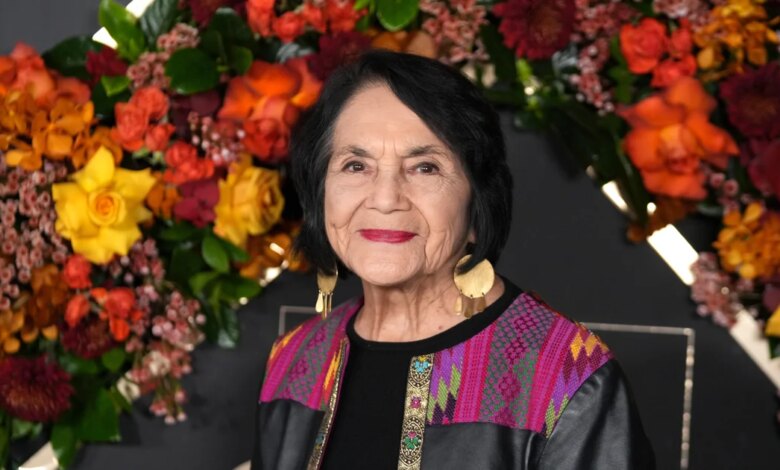
Dolores Huerta, whose tenacious organizing and historic labor battles reshaped American civil rights and helped establish collective bargaining rights for agricultural workers, has died. She was 96.
Her family announced her death Wednesday in a statement released through her foundation, noting she passed away at her home. “As you can imagine, this is an incredibly difficult time for us, and we ask for privacy as we grieve this incredible loss to our family,” the statement read. “We know that many of you around the world share in our mourning.”
Huerta maintained an active public schedule well into her 90s, traveling the country to speak on race, poverty, LGBTQ+ rights, and women’s equality on behalf of her Bakersfield, California-based foundation. Her enduring legacy rests on decades of labor organizing and her co-founding of the group that became the United Farm Workers (UFW) alongside Cesar Chavez. Her famous three-word Spanish-language slogan, “Sí se puede”—translating to “Yes, it can be done”—became a rallying cry grounded in the conviction that everyday people could drive systemic change.
Born Dolores Clara Fernandez in Dawson, New Mexico, in 1930, Huerta was the daughter of a miner and union activist who later served in the state Legislature. Following her parents’ divorce when she was 3, her mother moved her and her brothers to California. Growing up in a diverse working-class community in the San Joaquin Valley alongside Mexican, Filipino, African American, Japanese, and Chinese families, she absorbed lessons in independence and activism from her mother, who operated a local restaurant and hotel.
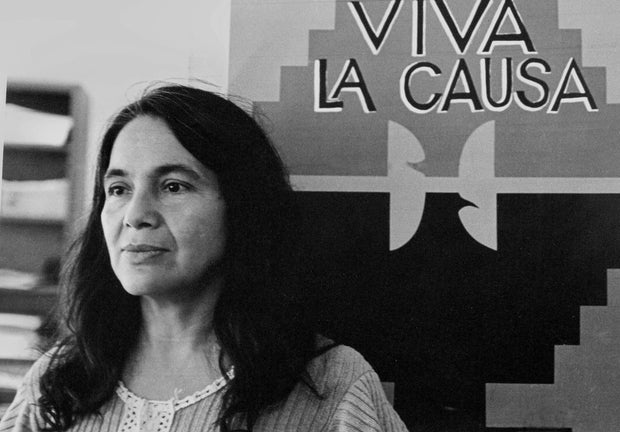
Initially working as an elementary school teacher, Huerta grew disillusioned after witnessing her young students arrive at class hungry and without proper shoes. Deciding that grassroots organization could achieve more than classroom teaching, she shifted her focus to farmworkers. Her early civil rights work in Stockton brought her into contact with Chavez. Sharing a deep concern for the plight of agricultural laborers, the pair established the National Farm Workers Association in 1962, which later evolved into the United Farm Workers of America.
As a central leader and chief negotiator for the union, Huerta participated in the five-year “Delano Grape Strike” alongside Filipino grape pickers. She and Chavez successfully negotiated landmark collective bargaining agreements with major agricultural growers, securing the first health and benefit plans for farmworkers. Chavez, who died in 1993, frequently praised her fearlessness and formidable negotiating skills.
Huerta’s activism extended into national politics. She campaigned for U.S. Sen. Robert Kennedy of Massachusetts during his 1968 presidential bid after meeting him in Delano, registering Mexican American voters in California. She stood onstage with Kennedy and received his public thanks moments before he was assassinated—a tragedy that deeply affected her but did not halt her activism.
Her dedication to the cause carried heavy personal and physical costs. Huerta was jailed 22 times for union demonstrations. In 1988, while protesting the UFW grape boycott during a San Francisco visit by Republican presidential candidate George H.W. Bush, she was struck by a police officer’s baton amid a crowd. She suffered three broken ribs and a pulverized spleen, requiring more than a dozen blood transfusions. She later resolved her claims through a legal settlement with the city.
Following a lengthy recovery, Huerta broadened her advocacy to promote women’s rights and encourage Latinas to seek public office, while continuing to campaign for Democratic presidential nominees including Bill Clinton, Barack Obama, and Joe Biden. In 2012, President Obama presented her with the Presidential Medal of Freedom, the nation’s highest civilian honor, joking that he had adopted her famous slogan for his 2008 campaign. Her work also earned her the distinction of being the first Latina inducted into the National Women’s Hall of Fame, alongside nine honorary university doctorates and numerous schools, streets, and murals named in her honor.
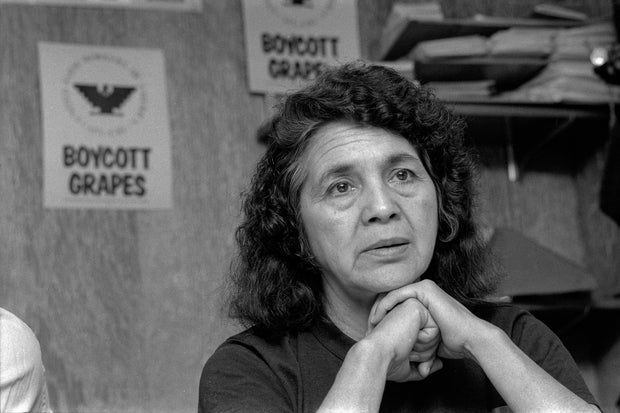
Throughout her life, Huerta secured crucial legislative gains, including financial aid for unemployed workers and disability insurance for California farmworkers. She lobbied against toxic pesticides, advocated for amnesty for undocumented immigrants, and opposed federal guest worker programs. By spearheading nationwide boycotts of grapes and lettuce in the early 1970s, she helped generate the economic and political momentum necessary for California to enact the nation’s first state law recognizing farmworkers’ right to collective bargaining.
In her later years, Huerta shared her experiences in documentaries, including the 2025 film “Seeds of Change: The Life and Legacy of Dolores Huerta.” Reflecting on her decades of struggle against injustice, she emphasized the enduring value of her work. “I hope that my legacy will be one of an organizer that organized to fight injustice,” she said in the film. “We want to give our children an inheritance of justice, right, not jewels or property or money because they’ll just fight over it. So the main thing to do is to give them this love for justice — and that is the greatest gift I think that any of us can have.”