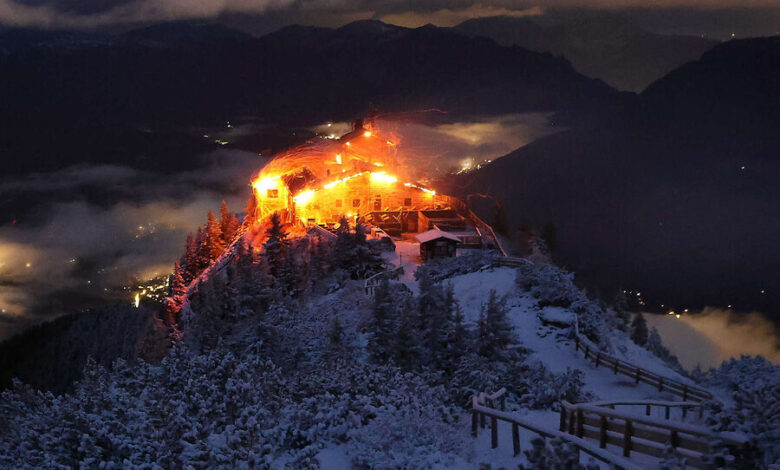
The arson-fueled destruction of the Eagle’s Nest, a historic mountain guest house in southern Germany, has reignited a complex national debate over how the country should handle architectural relics of the Nazi regime. Authorities in the state of Bavaria have arrested a man in connection with the blaze, pointing to a recorded history of mental illness while noting that investigators have not yet established a definitive motive.
The Eagle’s Nest, perched atop a peak offering sweeping views of the Alps, once served as a backdrop for Nazi propaganda films and was visited several times by Adolf Hitler. In the decades following World War II, the location transformed into a major tourist attraction, drawing visitors from around the world. Following the fire, Bavarian Interior Minister Joachim Herrmann addressed reporters at a news conference, stating that officials were considering rebuilding the structure because leaving a ruin in place was not a viable option.
The incident thrusts Germany back into a familiar dilemma that has spanned more than eight decades: deciding the fate of physical sites tied to dictatorship, war, and genocide. Different municipalities and regions have adopted contrasting strategies over the years. In Nuremberg, officials chose to renovate massive structures like the Nazi Parade Grounds and Congress Hall to keep historical lessons visible while repurposing the Congress Hall as a space for art and theater. In Austria, the town of Braunau am Inn converted Hitler’s birthplace into a police station.
Conversely, preservation has not always been the default approach. Almost nothing remains of the Berlin Wall today, as sections had to be rescued by local residents. Following World War II, the German government razed Hitler’s war bunkers in Berlin out of concern that they might attract white supremacists as sites of pilgrimage. Plans are currently underway to demolish the last remaining remnants of that underground complex to make way for a new apartment block, a decision that has drawn criticism from some tourism operators who argue that the city should confront its history rather than erase it.
Experts note that while Germany is frequently viewed internationally as a model for addressing the darkest chapters of its past, the practical management of physical structures remains an ongoing and difficult struggle. As Bavarian authorities weigh the future of the charred mountaintop site, the country faces yet another test in balancing historical remembrance against the risk of glorifying a destructive legacy.