In the final stretch of the 2026 midterm elections, the Democratic Party is projecting a united front against President Donald Trump’s aggressive second-term tariff regime. Across the country, from New Hampshire to California, campaign advertisements are saturating the airwaves with warnings that sweeping trade barriers are driving up consumer prices and strangling local businesses. Yet beneath this surface-level consensus, a significant internal rift is forming over how the party should handle trade policy if it regains power in Congress or the White House.
The tension pits traditional union allies and Rust Belt populists against a re-emerging wing of trade-friendly moderates and officials from export-dependent states. This struggle is not merely a debate over midterm tactics but a high-stakes competition for the soul of the party’s economic platform ahead of the 2028 presidential primary. The core of the disagreement rests on whether to maintain some level of protective tariffs to bolster domestic manufacturing or to abandon them entirely to lower costs for families and small businesses.
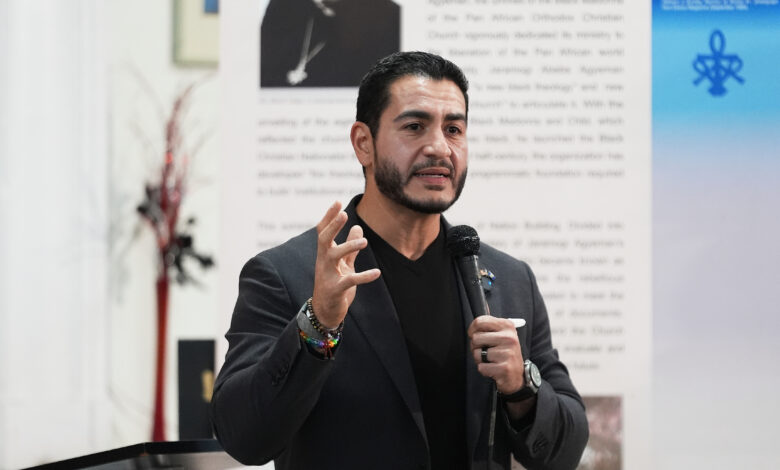
In Michigan, the strategic complexities are on full display. Democratic Senate nominee Abdul El-Sayed has spent the autumn attempting to navigate this divide. During an October 14 campaign event in Detroit and a subsequent speech at the Detroit Economic Club, El-Sayed focused on how trade volatility with Canada threatens the state’s vital automotive sector. However, he stopped short of calling for a return to 1990s-style free trade. Instead, his campaign has aired advertisements attacking his Republican opponent, Mike Rogers, for past support of the North American Free Trade Agreement (NAFTA). El-Sayed told attendees in Detroit that he believes in a “system of tariffs that is hooked to an industrial policy that actually makes sense,” specifically to protect the growing electric vehicle market.
This “thread-the-needle” approach contrasts sharply with the situation in New Hampshire. There, Democratic Senate candidate Chris Pappas has anchored his campaign on the damage trade wars have inflicted on his state’s service-oriented economy. Pappas has made high-profile stops at a local winery in the lakes region, which saw a decline in Canadian tourism, and a manufacturing plant struggling with 50% tariffs on steel and aluminum. Unlike his colleagues in the Rust Belt, Pappas has emphasized legislation to exempt small businesses from trade duties and to secure export markets for hardwood lumber producers.
Public sentiment appears to be shifting toward the trade-friendly camp. An October 2026 poll conducted by the Council on Foreign Relations and Morning Consult revealed that Democrats are now significantly more likely than Republicans to believe that tariffs raise prices. More strikingly, Democratic voters are becoming less convinced that tariffs successfully protect manufacturing jobs—a shift that challenges the long-standing influence of union politics within the party. A separate poll found that nearly 70% of voters overall disapprove of the current administration’s use of tariffs.
Congressional leadership is already preparing for a possible legislative push to rein in executive trade authority. Senator Ron Wyden (D-Ore.), the ranking Democrat on the Senate Finance Committee, has signaled that his priorities include repealing certain duties and limiting the president’s power to set trade policy unilaterally. While some members, like Representative Chris Deluzio (D-Pa.), continue to urge the party not to abandon tariffs as a tool for workers, others like Representative Suzan DelBene (D-Wash.) are calling for a bipartisan approach that prioritizes national security and lower prices.
The internal debate is also serving as a litmus test for the 2028 presidential field. Potential candidates are already staking out territory. Georgia Senator Jon Ossoff and Kentucky Governor Andy Beshear have been vocal critics of the economic toll tariffs have taken on businesses in their states. Earlier this month, California Governor Gavin Newsom and former Transportation Secretary Pete Buttigieg used speeches in New Hampshire to frame the trade issue, with Buttigieg focusing on cost-of-living increases and Newsom highlighting the administration’s handling of trade negotiations.
As the midterms conclude, party strategists expect these ideological differences to sharpen. With the “Blue Wall” states of Michigan and Pennsylvania remaining critical to any path to the White House, the Democratic Party must decide if it will stick with the populist turn initiated a decade ago or return to a more traditional trade-positive stance to satisfy a base increasingly frustrated by the rising cost of living.