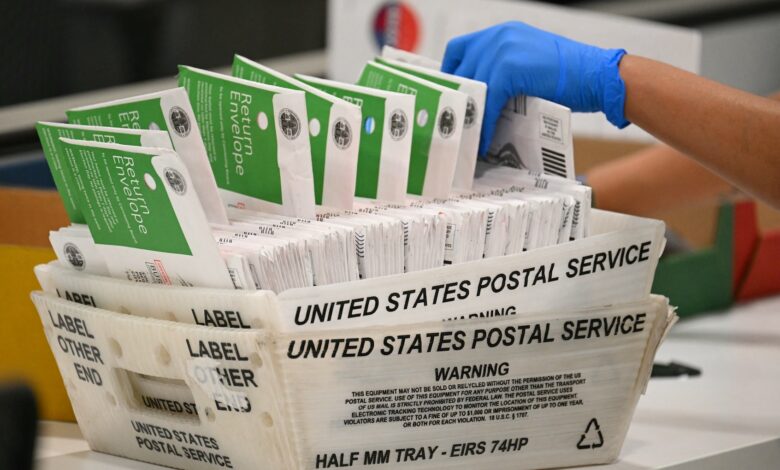
In early August, election workers in Stevens County, Washington, crossed the street to their local post office to collect what they expected would be a few dozen late mail-in ballots. It was three days after the primary election, and the flow of mail was expected to be a trickle. Instead, they discovered more than 500 envelopes—each representing a vote that, under state law, would no longer count.
Lori Larsen, the Republican Auditor who oversees voting in the county north of Spokane, described the sight of the overflowing mailbox as “jarring.” The incident was not an isolated anomaly. Across 11 predominately rural counties in eastern Washington, nearly 2,000 ballots arrived too late to be counted this year, a sharp increase from the roughly 600 late ballots recorded during the 2022 midterm primary.
While political debates over mail-in voting often focus on policy restrictions, a growing body of evidence suggests that the physical logistics of the U.S. Postal Service (USPS) are currently the primary threat to the validity of rural ballots. Data shows that recent cost-cutting measures implemented by the agency have significantly delayed the delivery and postmarking of mail in rural areas, leading to rejection rates that have doubled or tripled in some jurisdictions over the last four years.
The delays are a direct byproduct of a 10-year restructuring plan designed to address the agency’s multi-billion-dollar operating deficit. Under the “Regional Transportation Optimization” (RTO) initiative, the USPS has consolidated first-class mail processing at large regional plants, moving it away from smaller local hubs. For many post offices located 50 miles or more from these regional centers, mail pickup frequency was cut from twice daily to just once. These changes often add at least a full day to delivery times and, crucially for voters, delay the essential postmarking of ballots until they reach a distant regional facility.
The impact is most visible in states like Washington, California, Ohio, North Carolina, and Oregon, which allow ballots to be counted after Election Day as long as they are postmarked by a specific deadline. In these regions, counties affected by the service cuts saw a dramatic spike in rejections compared to urban centers. In Spokane, an urban hub where postal services remained more frequent, the number of ballots rejected for being late actually decreased this year. In contrast, the 30 mostly rural Washington counties most affected by the transportation cuts saw late postmark rates more than triple compared to the 2022 primary.
In Garfield County, located in southeastern Washington, nearly one in ten ballots cast—19 in total—were disqualified due to late postmarks this year. In 2022, only a single ballot in the entire county was rejected for that reason. Similarly, in Pend Oreille County, rejection rates for late arrival jumped from 1% to 6%. Marianne Nichols, the county’s longtime auditor, said voters were visibly upset to learn their votes were voided despite being placed in mailboxes on Election Day.
Washington Secretary of State Steve Hobbs, a Democrat, noted that the service changes appear to be disproportionately affecting rural Republican voters. He criticized the lack of transparency from the USPS regarding the logistics of the rollout, stating that election officials were only told the way postmarks were handled would change, without being warned of the resulting delays.
Postal Service leadership has defended the restructuring as a financial necessity. The agency reported that transportation cuts had saved approximately $2.8 billion by the end of fiscal year 2025, though that figure fell short of initial projections. A spokesperson for the USPS emphasized that the changes are part of a necessary adjustment to a marketplace where mail volume has dropped 50% since its peak in 2006.
To mitigate issues during the general election, the USPS has announced “extraordinary measures” for the 10 days leading up to the vote. Managers at more than 30,000 post offices have been instructed to separate completed ballots from general mail and deliver those intended for local election offices on the day they are received. Amber McReynolds, chair of the Postal Service board of governors, stated the agency is working to ensure ballots move swiftly and urged voters to mail their ballots at least one week before deadlines.
However, researchers and election consultants remain skeptical that the measures will be enough to prevent all rejections. A previous audit of a pilot version of the program found that agency staff sometimes failed to handle ballots correctly because instructions were not clearly communicated. Elena Patel, an analyst with the Brookings Institution, noted that the success of the general election plan depends on “flawless execution,” a difficult prospect given the scale of the recent service reductions.
The implications of these delays could extend to the national political map. At least seven closely contested congressional districts—including Washington’s 3rd, California’s 22nd, and North Carolina’s 11th—lie within areas heavily affected by the postal service changes. In states like North Carolina and Ohio, the challenge is compounded by the recent elimination of grace periods; in those states, ballots must now arrive at election offices by the time polls close, regardless of when they were postmarked.
With trust in the postal system wavering in rural corridors, local officials are pivoting their advice to voters. In Stevens County, Lori Larsen has increased the number of official ballot drop boxes from seven to 12 and is actively encouraging residents to bypass the mail altogether. In previous cycles, Larsen said she was hesitant to urge voters to cast ballots early, but the recent surge in rejections has changed her priorities. “Now we are more concerned that we get your ballot,” she said.