Defense Secretary Hegseth Dismisses Top Pentagon Military Planner Amid Iran Strike Deliberations

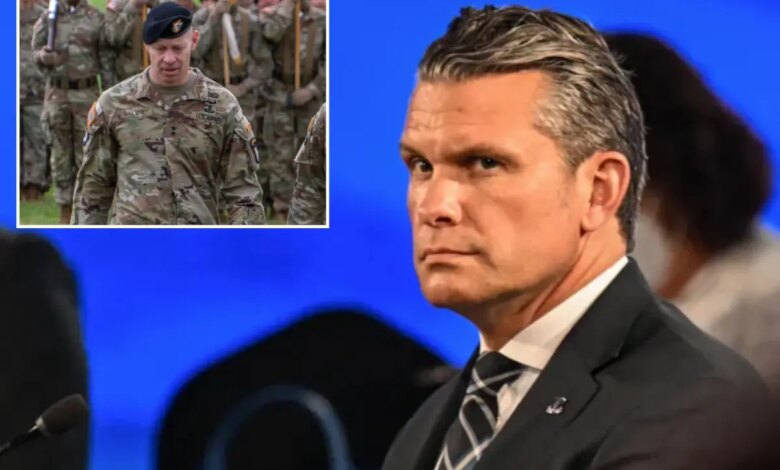
Defense Secretary Pete Hegseth has dismissed the Pentagon’s top military planner, removing Army Lt. Gen. Brett Sylvia from his position heading strategy, plans and policy on the Joint Chiefs of Staff, according to a defense official. The move on Wednesday represents the latest in a series of high-ranking military ousters under Hegseth’s tenure and coincides with presidential deliberations over potential renewed military strikes against Iran.
Sylvia, who previously commanded the 101st Airborne Division at Fort Campbell, Kentucky, until May 2025 and earlier served as vice director for the J5 office, is the second general to be removed from the top planning post under Hegseth. His predecessor, Lt. Gen. Joseph McGee, was forced to retire last October. The defense official, speaking on condition of anonymity due to the sensitivity of personnel matters, stated that no immediate replacement has been named and no official reason was provided for Sylvia’s removal.
A spokesperson for the Joint Staff acknowledged the departure, offering gratitude for Sylvia’s 32 years of distinguished service. The J5 director and staff play a central role in generating and coordinating military plans alongside the chairman of the Joint Chiefs and the president.
The timing of Sylvia’s removal intersects with an active eight-month-long conflict involving operations initiated with Israel. President Trump has repeatedly indicated that new military actions against Iran remain an option following the midterm elections, vowing to finish the ongoing campaign. Two diplomats briefed on the matter stated that U.S. officials have advised regional allies and Middle East countries to prepare for potential military action after Tuesday’s elections, as well as possible retaliatory measures from Iran, though a final decision on new strikes has not yet been reached. Meanwhile, a third U.S. aircraft carrier and thousands of additional troops are currently deploying to the region.
Sylvia’s departure adds to a broader personnel turnover that includes nearly two dozen generals, admirals, civilian secretaries of the Army and Navy, and top uniformed service officers who have been fired, forced to retire, or otherwise departed under Hegseth without public explanations from the Pentagon.
The ousters align with broader structural changes ordered by Hegseth last month, when he directed the military to double planned cuts to top officer ranks to achieve a 20% reduction by Jan. 1, 2027. The military currently maintains approximately 800 flag and general officer positions. Defending the reductions during a Sept. 30 address to junior officers and enlisted leaders at Marine Corps Base Quantico, Hegseth characterized the initiative as long-overdue accountability.
Congressional reaction to the military downsizing has been divided. Critics have characterized the dismissals as a damaging purge of experienced leadership. Sen. Mark Kelly, D-Ariz., a former Navy combat pilot, criticized the strategy last month, arguing that the removal of a generation of military leaders will take decades to recover from.