
In the winter of 2015, Dr. Tom Chiller received an alarming phone call from public health officials in Britain. A new fungus was causing severe infections at a large London hospital, spreading from patient to patient so aggressively that officials planned to shut down parts of the facility. At the time, Chiller served as chief of the fungal-diseases branch at the U.S. Centers for Disease Control and Prevention. While common yeasts like Candida cause conditions such as thrush, Chiller knew of no life-threatening fungus that could transmit so easily among people.
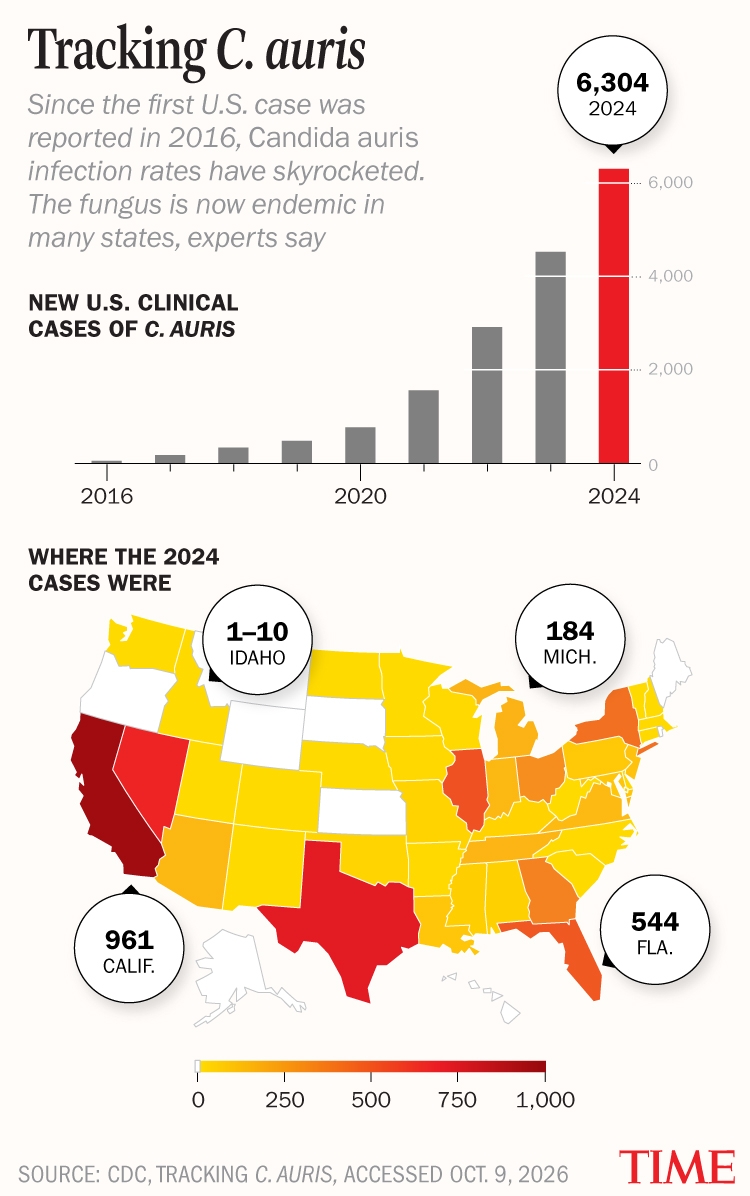
The pathogen was Candida auris, a yeast first discovered in 2009 in the ear of a patient in Japan. Unlike most fungi, Candida auris can survive in high temperatures up to 107°F and in salty environments, making human skin nooks ideal. It clings stubbornly to hair, skin, and hospital surfaces, resists standard disinfectants and antifungal drugs, and causes deadly illnesses. In the decade since that initial call, the fungus has infected tens of thousands of people across more than 80 countries and six continents, earning a designation as a high-priority threat from the World Health Organization. In the U.S., thousands of cases are reported annually, with the CDC noting over 3,000 infections across 27 states in a single year. Mortality rates for infected individuals can reach up to 60%.
Infectious-disease experts say the proliferation of Candida auris reflects a broader, troubling trend: dangerous fungi are finding new opportunities to infect humans, spurred by human activity. Rising global temperatures, changing weather patterns, and the overuse of antifungals in medicine, agriculture, and livestock farming have created an environment that favors pathogenic fungi and drug resistance. Humans inhale thousands of fungal spores daily, but are normally protected by high body temperatures and immune systems. As the planet warms, fungi are adapting to tolerate higher heat.
Other once-rare pathogens are also expanding their reach. A mold previously known only to damage trees has infected three people in the U.S. over the last five years, according to research. Meanwhile, CDC data shows that cases of a brain-attacking mold have quadrupled in the past two years, causing fatal brain abscesses in up to 70% of cases even among healthy individuals. Environmental fungi such as Histoplasma have expanded northward and eastward in the U.S., while valley fever now infects up to 360,000 Americans annually, spreading to states like Washington that were once considered too wet or cold.
At the same time, medical advancements have expanded the pool of vulnerable populations. Millions of people take immunosuppressive drugs to manage autoimmune conditions and cancer, while others rely on invasive life-support machinery like ventilators and heart-lung machines. These therapies create pathways for germs to enter the body.
Ryan Zwick, a healthy 22-year-old nurse from New Hampshire, nearly died from COVID-19 in December 2023, which severely damaged his heart. After being placed on a heart-lung machine in a Las Vegas intensive care unit and later airlifted to San Diego, Zwick developed a severe Candida auris infection that likely entered through chest tubes. Although treated aggressively, the fungus lingered, later causing osteomyelitis that required the removal of bone tissue. More than two years later, Zwick continues receiving weekly infusions of a potent antifungal drug and faces the prospect of lifelong treatment.

Candida auris is also manifesting in new ways. Experts have diagnosed vaginal yeast infections and urinary tract infections caused by the yeast in patients without major health complications or medical devices, requiring powerful intravenous medications due to the fungus’s high resistance to standard azole drugs. Additionally, a new species of contagious ringworm resistant to all antifungal drugs has been spreading from the Indian subcontinent to Europe, the Middle East, and the U.S.
In South America, a fungus called Sporothrix brasiliensis has caused widespread disease among cats, dogs, and humans since an outbreak began in Rio de Janeiro in 1998. Spread through scratches, bites, and sneezes from infected animals, the pathogen causes multiple lesions and, in up to 10% of cases, enters the bloodstream to cause severe systemic illness. Originally confined to a few cases a year, the disease now sickens thousands annually in Brazil and has appeared in Argentina, Paraguay, Chile, Uruguay, and Peru.

Diagnosing fungal infections early significantly improves survival rates, but doctors frequently miss fungal diseases due to a lack of awareness. Justin John, a 27-year-old software engineer from Arizona, was incorrectly diagnosed with COVID-19, the common cold, and irritable bowel syndrome for more than six months before doctors discovered he had valley fever. The fungus had eaten holes through his spine and skull, requiring two surgeries to insert a metal plate and replace a dissolved vertebra. Diagnostic tools are improving, with new rapid tests in development to reduce dangerous delays in treatment.