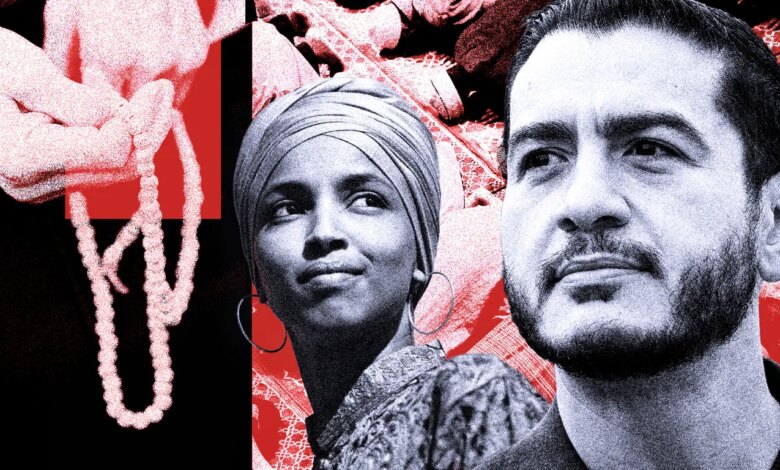
With the midterm elections approaching, President Trump has intensified his use of inflammatory language directed at Muslim communities and political figures, focusing specifically on Democratic candidates in key battleground states. During a recent campaign stop in Michigan to support Republican Senate candidate Mike Rogers, the President directed a series of pointed attacks at the Democratic nominee, Abdul El-Sayed, characterizing him as a security risk and an extremist.
Trump’s remarks at the rally suggested that El-Sayed’s potential presence in the Senate would require unprecedented security measures. “He would be the only senator that will have to go through a metal detector before he’s allowed to go into the Senate,” Trump told the crowd. The President went further by labeling El-Sayed a “jihadist” and baselessly alleging that the candidate intends to implement Sharia law within the state of Michigan. Additionally, Trump revived long-standing, unsubstantiated accusations that El-Sayed maintains connections with the Muslim Brotherhood.
El-Sayed has consistently denied any association with extremist organizations, and there has been no documented evidence to support the claims regarding the Muslim Brotherhood. While El-Sayed’s campaign did not immediately provide a formal response to the latest round of attacks, the candidate has previously dismissed such rhetoric as a distraction from substantive policy issues.
The White House has stood by the President’s comments. In a statement released following the rally, a spokesperson framed the rhetoric as a necessary confrontation with radicalism. The statement asserted that Trump is “calling out the radical extremists stoking division” and “perpetuating violence,” adding that the President will continue to “unapologetically fight for American greatness” and challenge candidates like El-Sayed without reservation.
However, advocacy groups view the shift in tone as a calculated electoral maneuver. Haris Tarin, vice president of policy and programming at the Muslim Public Affairs Council, characterized the strategy as a pivot toward “bigotry and racism.” Tarin suggested that some within the GOP are using these tactics “because there’s no other message they’re able to run on.” He argued that instead of debating the issues, they have chosen to “instill fear in people” and “promote lies.” Tarin predicted that the escalation might have an opposite effect, potentially galvanizing both Muslim voters and the broader electorate against such tactics.
Political analysts are weighing the potential impact of such rhetoric in a state as demographically significant as Michigan. Some Republican consultants suggest that while the language is familiar to Michigan voters and may not significantly alter existing opinions, it serves a primary function of “energizing and mobilizing” the core Republican base. The strategy is built on the premise that if a candidate can maximize turnout and margins in rural, deeply Republican areas, they can offset losses in urban centers and win a close statewide race.
Conversely, the rhetoric carries the risk of alienating specific voting blocs. There is concern among some strategists that these attacks could inadvertently discourage participation among segments of the Democratic base, such as Jewish and Black voters who may have supported different primary candidates and are now being targeted by a strategy designed to highlight internal divisions.
Recent polling data from a state university highlights the complex landscape facing candidates. According to the data, 38 percent of likely Michigan voters indicated they would be less likely to support a candidate based on their Muslim faith. However, a majority of 58 percent said a candidate’s religion would make no difference in their decision. Furthermore, the poll found that a Trump endorsement remains a polarizing factor, with 52 percent of respondents stating they would be less likely to support a politician backed by the President.
The focus on El-Sayed is part of a broader trend of anti-Muslim rhetoric within the current political cycle. Trump has previously targeted Representative Ilhan Omar and Somali American communities in Minnesota, occasionally using derogatory language to describe immigrants from predominantly Muslim nations. Other Republican lawmakers have also faced internal and public criticism for similar anti-Muslim social media posts and public statements throughout the year.
As the campaign enters its final weeks, the central question for both parties remains whether this brand of high-decibel rhetoric will successfully drive base turnout in rural districts or if it will ultimately alienate moderate and independent voters in the suburbs, potentially backfiring on the candidates the President seeks to support.