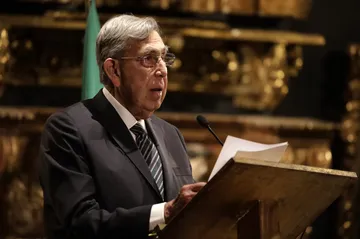
Cuauhtémoc Cárdenas Solórzano, a towering figure of the Mexican left whose political rebellion against a decades-long ruling monopoly helped propel the nation toward multi-party democracy, has died at the age of 92.
His death was confirmed by Mexican President Claudia Sheinbaum, who paid tribute to his legacy on social media. Writing on X on Wednesday, Sheinbaum hailed Cárdenas as a man of firm principles who fundamentally transformed the nation’s political life, noting that his role in contemporary Mexican history remains indispensable.
Born in Mexico City on May 1, 1934, Cárdenas carried a profound political lineage. His father, President Lázaro Cárdenas del Río, took office later that year and is celebrated for nationalizing Mexico’s oil industry in 1938, as well as enacting sweeping land reforms and opening the country to refugees fleeing the Spanish Civil War. The younger Cárdenas studied civil engineering at the National Autonomous University of Mexico before engaging with left-wing political groups and eventually joining the Institutional Revolutionary Party, the dominant political force that governed Mexico for over seven decades.
After holding several public offices, Cárdenas served as governor of the western state of Michoacán from 1980 to 1986. During his tenure, he began organizing a dissident movement within the PRI that pushed for democratic procedures in selecting political candidates. The internal rift culminated in 1988 when the party nominated Carlos Salinas de Gortari over Cárdenas, prompting him to break away entirely and run as the presidential candidate for the National Democratic Front, a coalition of leftist and opposition factions.
That 1988 election became a watershed moment in Mexican politics, characterized by widespread fraud allegations and public outcry after the official vote-counting system collapsed on election night. Though Salinas was declared the winner, the intense political upheaval forced structural reforms that eventually established an independent electoral authority and ushered in a more competitive democratic landscape.
Cárdenas mounted two subsequent presidential campaigns in 1994 and 2000. While conservative candidate Vicente Fox ultimately secured the 2000 victory that ended the PRI’s uninterrupted grip on the presidency, Cárdenas achieved a historic milestone three years earlier. In 1997, he won the inaugural election for head of government of Mexico City—a post equivalent to mayor and the most significant electoral triumph for the Mexican left at the time—establishing the capital as an enduring stronghold for progressive governance.
Throughout his career, Cárdenas remained a steadfast defender of state involvement in strategic public sectors, particularly the oil industry nationalized by his father. His progressive vision heavily influenced generations of subsequent Mexican leaders, including Sheinbaum and former President Andrés Manuel López Obrador. Although Cárdenas’s direct political influence eventually receded with the rise of López Obrador and the founding of the Morena party, he remained widely regarded as the foundational moral architect of Mexico’s modern democratic opposition.