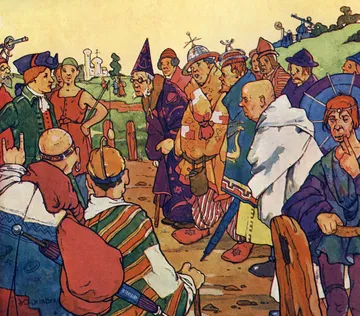
Three centuries after its October 1726 publication, Jonathan Swift’s “Gulliver’s Travels Into Remote Regions of the World” reads less like a period piece of powdered wigs and knee breeches and more like an uncanny blueprint for our current technology-dominated era. While Swift directed his particular wrath at the Royal Society—founded in 1660 and comparatively powerless against the Anglican Church—today’s scientists, technologists, and self-styled projectors rule the global future. Swift’s satire of 18th-century intellectual hubris has transformed into an acute dissection of the artificial intelligence age.
In his third voyage, Lemuel Gulliver visits Laputa, a flying island populated by philosophers who are heavily obsessed with abstract mathematics, astronomy, and music while remaining utterly incapable of navigating practical life. To cope with their chronic detachment, these abstract thinkers employ “flappers” to strike them with bladders filled with peas or pebbles to pull them out of their reveries. Modern counterparts are easy to spot among today’s elite knowledge economy. Tech billionaire Peter Thiel has championed “sea-steading” to establish offshore floating communities free from mainland regulation and populated by geniuses, while Mark Zuckerberg constructed a Hawaiian compound featuring an underground bunker. Meanwhile, top universities compete to hire scientific minds who float above mundane tasks, supported by teaching assistants acting as modern flappers to translate complex theories for regular students.
Moving downward to Laputa’s client kingdom of Balnibarbi, Gulliver tours the Grand Academy, encountering scientists attempting to extract sunbeams from cucumbers, soften marble for pillows, mix paint by smell, and reverse-engineer excrement into food. The academicians also boast a vast mechanical writing device that turns out books on any subject through randomized gear turns, requiring zero genius or study. While modern technology has moved beyond cucumber sunbeams, the tech sector has sunk hundreds of billions of dollars into ventures that struggle against reality. Examples include Google glasses, cumbersome virtual reality headsets that remain inferior to the physical world, and hyperloop concepts designed to propel passengers at 600 miles per hour through near-vacuum steel tubes. These projects grow increasingly costly and grandiose, with Zuckerberg investing at least $70 billion into a virtual universe that generated little public demand, and Elon Musk pouring vast fortunes into plans to colonize Mars despite its lethal radiation, airless environment, sub-zero temperatures, and toxic soil.
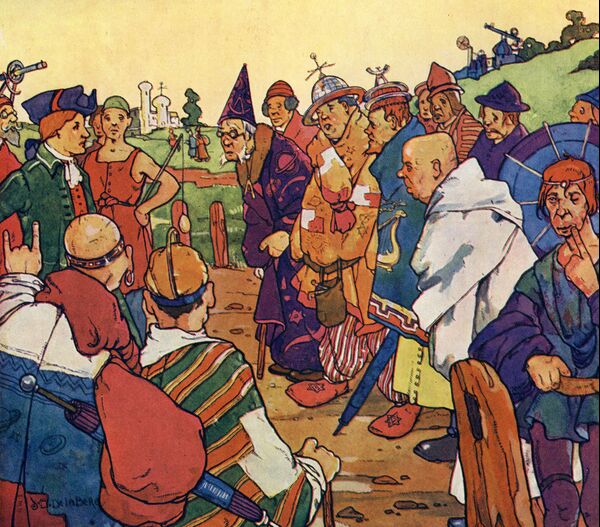
Gulliver’s subsequent journey to Luggnagg introduces the Struldbrugs, who achieved eternal life but were cursed with eternal old age rather than eternal youth. Burdened by ceaseless physical ailments, bad tempers, and a lack of natural affection, these citizens are legally treated as dead once they reach age 80. Swift thus anticipated the contemporary longevity movement within tech culture, where billionaires consume hundreds of daily pills, employ “blood boys,” submerge themselves in ice baths, and fund faddish anti-aging therapies that mistake the extension of infirmity for the preservation of youth.
Yet everyday citizens who ignore the eccentricities of tech billionaires cannot escape the algorithms governing modern institutions. During his time on Laputa, Gulliver receives a custom suit from a tailor who measures his altitude with a quadrant and dimensions with a compass, only to deliver a garment completely out of shape due to a single miscalculated figure. That misplaced precision is now a daily reality. Metrics frequently target the wrong outcomes while compelling people to distort their behavior simply to hit numerical targets—a phenomenon famously dramatized in the television series “The Wire,” where Baltimore police manipulated crime statistics while ignoring the root causes of urban violence.
As logician Carveth Read observed, it remains better to be vaguely right than exactly wrong. Yet the proliferation of algorithms turns humans into compliant servants through spurious precision and mindless determination, dictating everything from news feeds and entertainment choices to career promotions and medical care. Citizens routinely find themselves fitted with institutional suits that fit poorly and distort reality.
Swift earned a reputation as English literature’s towering misanthrope, yet his main shortcoming in depicting a tech-ruled society was that his vision was ultimately too benign. Modern workers spend their days staring at glass screens only to unwind by staring at others, grappling constantly with fourteen-digit passwords and two-factor authentication codes while systemic algorithm-driven threats loom. Numerous technologists have warned that uncontrolled artificial intelligence could threaten human survival if development proceeds without adequate pause or regulation, yet billions continue to flow into raw computing power while policymakers dither over basic oversight.