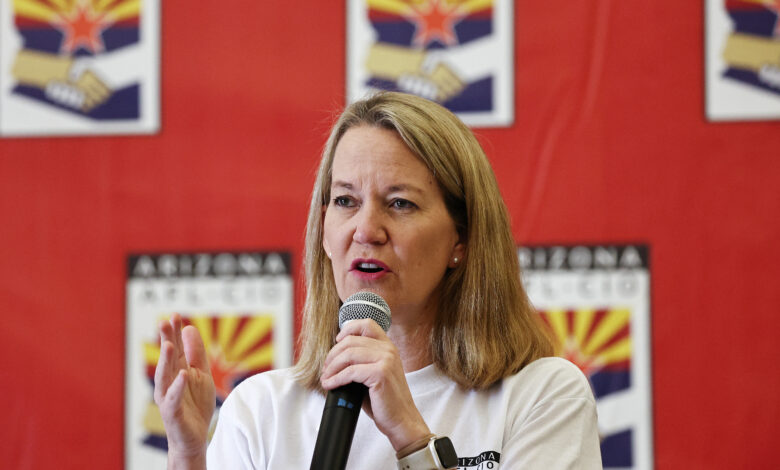
Arizona Attorney General Kris Mayes is drawing a hard line against the unchecked expansion of artificial intelligence data centers, setting up a high-stakes confrontation between the state’s high-tech ambitions and its increasingly precarious water resources. In a sharp departure from other Democratic leaders who have courted the technology industry, Mayes argues that the desert state can no longer afford the environmental or economic price of housing the massive computing hubs required for the AI boom.
At the heart of the dispute is a clash over the state’s identity. While Arizona officials have spent years positioning the region as a global hub for semiconductors, clean energy, and artificial intelligence, the realities of a multi-decade drought and a dwindling Colorado River are forcing a reckoning. Mayes, who is currently seeking reelection, contends that the state’s aspirations of being a technological superpower do not require a blank check for data center development.
According to research conducted by the Attorney General’s staff, there are currently approximately 50 data centers on the books for development in Arizona. Mayes has called for a moratorium on these new builds, a stance that has created a visible rift within her own party. Governor Katie Hobbs and Phoenix Mayor Kate Gallego have both pushed back against the idea of a temporary ban, with Hobbs emphasizing a need to find a balance between growth and sustainability rather than halting projects entirely.
Public sentiment, however, appears to be shifting in favor of restriction. Recent polling data indicates that 41 percent of respondents would oppose a data center being built within three miles of their home, a significant increase from 28 percent earlier this year. This growing public frustration is fueled by reports of facilities appearing in neighborhoods almost overnight, bringing with them noise pollution and contributing to rising local temperatures. Mayes noted that residents have appeared at town halls in tears over the sudden disruption to their quality of life.
Water consumption remains the most critical point of contention. Data centers require millions of gallons of water daily to cool the servers that power AI applications. Arizona’s primary water source, the Colorado River, is under severe strain due to climate change and over-allocation. The state and its downstream partners, Nevada and California, remain in a deadlock with upstream states including Utah and Colorado over how to manage the river’s flows. Mayes warned that without a breakthrough, Arizona is headed toward a legal standoff in front of the U.S. Supreme Court over the 1922 Colorado River Compact.
In addition to water concerns, Mayes is targeting the financial impact these facilities have on local residents. She has formally opposed efforts by major utilities, including Tucson Electric Power and Arizona Public Service, to implement rate hikes of 13 percent and 14 percent, respectively. Mayes argues that these increases are intended to recover capital spending for infrastructure that primarily serves data centers. She maintains that the costs of new transmission lines, substations, and power plants should be shouldered by the technology companies themselves rather than being subsidized by local consumers.
Mayes has also sought to distinguish between different types of tech investments. She pointed to the $265 billion facility built by Taiwan Semiconductor Manufacturing (TSMC) in Phoenix as a more sustainable model. While TSMC’s products may eventually power AI servers, Mayes argues that manufacturing plants provide significantly more jobs and long-term economic value per gallon of water used compared to data centers, which are often sparsely staffed once construction is complete.
Legal and political developments in the coming weeks will likely determine the fate of these expansion projects. Mayes has already used her office to crack down on illegal groundwater pumping to protect aquifers that take decades to refill. She expressed optimism that if the state House of Representatives flips control in the upcoming November election—an outcome that would end six decades of Republican control—legislative efforts to curtail data centers and protect groundwater would likely follow. For now, the Attorney General continues to pursue nuisance lawsuits against specific projects, while calling on the tech industry to exercise more humanity regarding their impact on Arizona’s communities.