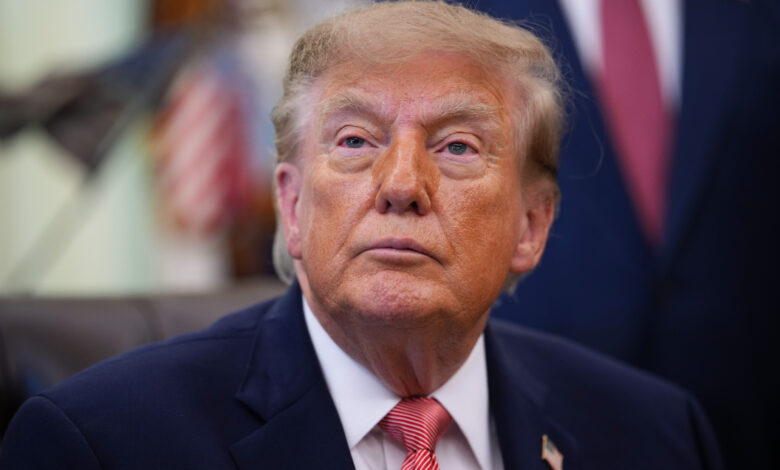
Several prominent Catholic leaders are publicly distancing themselves from the White House ahead of the midterm elections following the publication of a video showing a group of archbishops and bishops praying over President Donald Trump in the Oval Office.
The footage, posted to social media on October 22 by White House special assistant and communications adviser Margo Martin, immediately drew sharp backlash online and private criticism from the religious community. The gathering itself had taken place on October 20 in Washington.
Milwaukee Archbishop Jeffrey Grob issued a public statement on Sunday addressing the controversy. Grob stated that he and 11 other bishops had originally been invited to the White House for a policy discussion and an opportunity to pray privately with the president. Instead, according to Grob, the religious leaders were directed to stand behind the Oval Office desk to pray while being recorded without their prior knowledge or consent.
“The meeting was in no way an endorsement of the president, his policies, or his party,” Grob wrote, expressing deep regret over the incident. “I feel a heavy sadness, not only over the pain I caused, but also for the fact that something so sacred to a group of religious leaders, prayer to our Heavenly Father, would be manipulated in that way. We should never have been put in that position by the White House.”
Des Moines Bishop William Joensen also expressed remorse in a statement released Saturday, emphasizing that the meeting was never intended to signal political support for any candidate or party. Joensen noted that various administration policies conflict with Catholic teachings and expressed regret over falling victim to partisan exploitation.
Denver Archbishop James Golka, who led the prayer during the meeting, acknowledged the widespread public reaction in remarks to Denver Catholic. He confirmed that the video’s release just 12 days before an election led many to interpret the gathering as a political endorsement, which he stated was never his intention. Golka noted that the discussion with the administration covered substantive policy topics, including immigration, religious worker visas, religious freedom, and school choice.
When asked about the controversy, White House spokesperson Taylor Rogers defended President Trump’s record regarding Catholic Americans, pointing to actions on religious rights, pardons for anti-abortion activists, and parental rights, but did not directly address allegations that the prayer moment was used for political gain.
The episode underscores existing friction between Catholic officials and the administration. Earlier in October, Archbishop Timothy Broglio, who oversees Catholic military ministry, publicly condemned plans to livestream the execution of Nidal Hasan by firing squad, urging Catholic soldiers assigned to the duty to seek exemptions because the action conflicted with church teachings. Furthermore, tensions surfaced in April when Trump traded public criticisms with Pope Leo XIV over the war in Iran, after the pontiff denounced threats to annihilate Iranian civilization and rejected religious justifications for warfare.