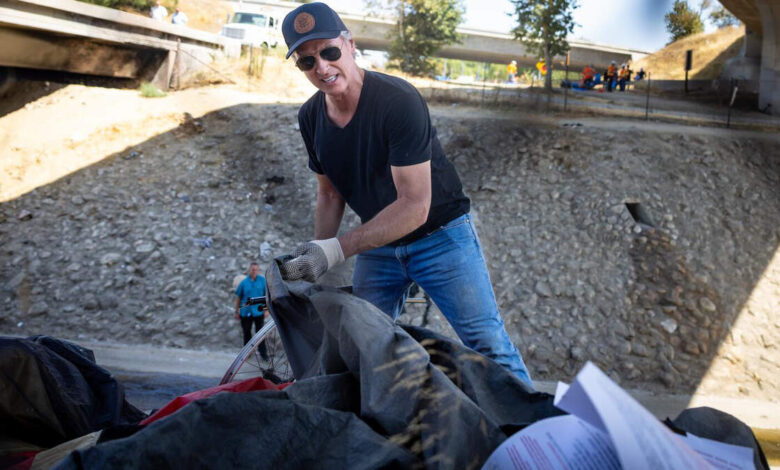
Outgoing California Governor Gavin Newsom announced Wednesday that the number of people experiencing unsheltered homelessness across the state has decreased by nearly 13% since 2024. The figures offer a notable political boost to the outgoing Democratic governor, whose administration has faced prolonged scrutiny over its handling of the state’s housing and homelessness crises.
According to data released by the governor’s office, the statewide count of unsheltered homeless individuals fell from 123,974 in 2024 to an estimated 108,125 in 2026. Simultaneously, the broader overall homeless population declined by approximately 6% over the same period.
The statistics remain preliminary, as they rely on figures reported by communities throughout California to the U.S. Department of Housing and Urban Development. The unsheltered population—which encompasses individuals sleeping outdoors in tents, vehicles, or other makeshift environments—accounted for roughly 62% of all homeless Californians in 2026.
Complete reporting remains pending, as several jurisdictions, including Santa Clara, Butte, and Mendocino counties, have yet to submit their unsheltered population counts for the current year, leaving room for the final data to shift. Furthermore, the 2026 figure sits only slightly below the 108,423 individuals recorded sleeping outside in 2019, the year Newsom assumed office.
Over the course of Newsom’s tenure, a review of housing department reports from 2019 to 2026 indicates a 16.2% overall increase in the state’s homeless population. California’s total homeless count reached its second-highest modern peak in 2024 at 187,084 people, coinciding with a broader national surge in homelessness that pushed U.S. numbers to historic highs. Historically, California’s highest recorded homeless population occurred in 2005 under then-Republican Governor Arnold Schwarzenegger, when 188,299 people were counted. That total fell to 123,480 by the time Schwarzenegger left office in 2010 and remained relatively steady under former Governor Jerry Brown.
Homelessness has shadowed Newsom’s political career since his tenure as a San Francisco city supervisor and mayor, a period during which he successfully altered cash assistance policies for unhoused individuals in favor of expanding in-kind shelter and food programs. He later dedicated his entire 2020 State of the State address to the issue, frequently describing homelessness as the state’s original sin.

As Newsom prepares to leave office due to term limits early next year, reports indicate he is laying the groundwork for a 2028 presidential campaign, where his executive record on homelessness is expected to face intense scrutiny.
“California is proving that homelessness is not inevitable,” Newsom said in a written statement. “We’re making progress because we’re building housing, expanding treatment and shelter, and holding ourselves and local governments accountable. We’re not backing down — and we’re not done.”
In recent years, as local and national pressures mounted, the governor’s office has highlighted several smaller downward trends, pointing to a 9% statewide reduction in unsheltered individuals between 2024 and 2025, alongside an 8% drop in veteran homelessness during the same window. Newsom has also embraced federal shifts, including a 2024 U.S. Supreme Court ruling affirming that local governments may enforce public camping bans without violating constitutional protections against cruel and unusual punishment.