Balad Leader Condemns Exclusion of Arab Parties as Record Poll Results Leave Israel Deadlocked

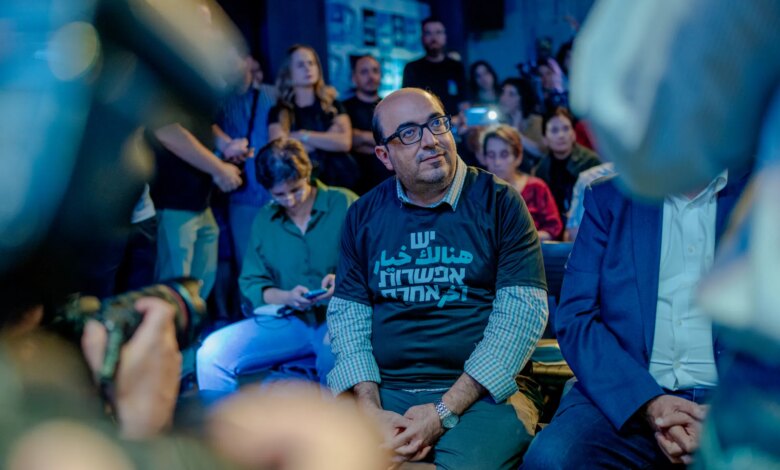
The leader of Israel’s Balad party has sharply condemned the country’s main political figures for refusing to form a coalition with Arab parties, describing the exclusion as racist despite a record-breaking electoral showing that could position the factions as crucial kingmakers in the next parliament.
Sami Abu Shehadeh stated that Palestinian citizens of Israel—who comprise approximately one-fifth of the population—continue to be treated as illegitimate political partners regardless of their robust voter turnout. Speaking following an election that yielded no clear winner, Abu Shehadeh emphasized that Arab factions represent the legitimate elected leadership of the national minority. He criticized both major political blocs for shunning potential alliances.
With 85 percent of the vote counted, Israel’s Central Elections Committee indicated that Prime Minister Benjamin Netanyahu’s bloc holds a narrow lead with at least 53 seats, while the opposition bloc led by Gadi Eisenkot stands at 48 seats. Both totals fall short of the 61 seats required to form a governing majority. While Netanyahu asserted that voters chose a strong right-wing government, Eisenkot maintained that the public voted for change.
Arab parties are on track to secure a record 19 seats, granting them potentially decisive leverage over the major political factions. However, opposition figures have resisted partnering with Arab lists. Reporting from Ramallah in the occupied West Bank, correspondent Nour Odeh noted that Netanyahu has successfully deterred political actors from engaging with Palestinian Israeli parties, leaving him well-positioned to direct events, while Eisenkot and his allies have signaled a preference for a strictly Zionist government.

Danny Ayalon, a former Israeli ambassador to the United States, observed that unprecedented Arab voter turnout provides the parties with significant political clout. Mathematically, Ayalon suggested that Eisenkot’s bloc could combine forces with the two Arab parties to cross the governing threshold, though achieving such a coalition would require extraordinary political maneuvering. Yousef Jabareen, leader of the Joint List, confirmed that his alliance’s hands remain extended in an effort to oust Netanyahu.
Abu Shehadeh himself was barred from running in the election after the Central Elections Committee voted to disqualify him over petitions alleging he supported armed struggle and contested Israel’s Jewish and democratic character. Although he withdrew from the race in October after a Supreme Court panel indicated willingness to uphold the disqualification, Abu Shehadeh rejected the underlying accusations. He argued that the court proceedings demonstrated the existence of two distinct judicial systems operating separately for Jewish and Arab citizens.
Reflecting on the election results, Abu Shehadeh expressed pride in the high voter turnout among the Arab Palestinian minority. He reiterated that a primary objective for the community was preventing what he termed a gang of criminals from returning to power, specifically naming Netanyahu alongside far-right ministers Bezalel Smotrich and Itamar Ben-Gvir. Outlining the broader political vision shared by Palestinian citizens, Abu Shehadeh stated opposition to genocide and apartheid, calling instead for an alternative political framework rooted in freedom, justice, and equality for all inhabitants living between the river and the sea. He further characterized Prime Minister Netanyahu as a war criminal.