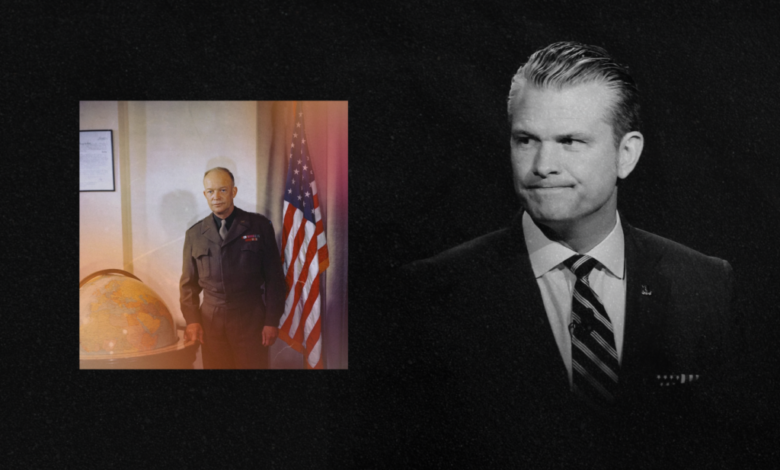
The physical remnants of the world General Dwight D. Eisenhower built are reportedly being dismantled—both figuratively and literally—within the walls of the Pentagon. As Defense Secretary Pete Hegseth moves to redefine the American military, a symbolic accident involving a historic artifact has become a focal point for critics of the current administration’s approach to national security and institutional tradition.
Shortly after assuming office, Hegseth reportedly took an interest in a handmade globe that once belonged to Eisenhower. The artifact, which the 34th president used during World War II and which bore his own markings, was sought by the new secretary for his personal office. However, because professional handlers were furloughed during a partial government shutdown over immigration, Hegseth reportedly dispatched aides to retrieve the historic object. Lacking experience in transporting delicate artifacts, the crew dropped the globe, leaving it with a significant hole where it fell.
The incident serves as a stark metaphor for a broader shift in U.S. defense policy. For seven decades, the American military establishment has operated under the shadow of the ‘Eisenhower order’—a system built on strategic patience, logistics, international alliances like NATO, and a cautious recognition of the dangers posed by the military-industrial complex. Hegseth, a former National Guard platoon leader and media personality, has moved aggressively to replace that framework with what he calls a ‘warrior ethos.’
This new philosophy prioritizes physical toughness and a ‘central casting’ aesthetic over the traditional values of coalition management and diplomatic strategy. Hegseth has become a visible figure on the front lines of the administration’s internal culture wars, vowing to vanquish diversity, equity, and inclusion (DEI) policies. Reports indicate he has overseen the removal of several women and people of color from leadership positions, replacing them with individuals who align with his vision of a more aggressive, traditionalist military hierarchy.
The secretary’s hands-on approach to leadership often involves public displays of physical fitness. Hegseth has frequently been observed leading enlisted men in calisthenics, jumping jacks, and jogging, framing physical brawn as the ultimate test of military leadership. This stands in sharp contrast to Eisenhower, who rose through the ranks as a master of strategy and diplomacy despite never serving in direct combat.
On the policy front, the shift has been equally dramatic. Hegseth has reportedly ordered the military to engage in summary lethal action against suspected drug runners on small boats in the Caribbean and Western Pacific. Critics have characterized the policy as ‘murder on the high seas,’ conducted without traditional judicial or international oversight. Simultaneously, the Pentagon is navigating a difficult and ongoing conflict in Iran, even as Hegseth remains focused on internal mandates such as prayer meetings and the implementation of compulsory testosterone testing for service members.
In a move that signals a desire to return to a pre-1949 era, the Hegseth-led Pentagon has also attempted to reverse the name change of the War Department, which Eisenhower had supported transitioning to the Department of Defense. This symbolic push accompanies a massive fiscal demand: a requested ‘generational investment’ of $1.5 trillion for the Pentagon budget in 2027. This scale of spending directly mirrors the concerns Eisenhower raised in his 1961 farewell address, when he warned that the military-industrial complex could eventually sap public resources and threaten democratic governance.
The administration’s reliance on private actors, such as Elon Musk and his Starlink satellite system, has further complicated the global security landscape. While Eisenhower’s era was defined by state-to-state diplomacy and institutional bulwarks, the current environment is increasingly shaped by individuals and private entities operating outside traditional government controls.
The breaking of Eisenhower’s globe, once a tool for planning the liberation of Europe, underscores a deepening divide between the strategic past and a future defined by a more unilateral, aggressive projection of strength. As the world order established following World War II faces unprecedented pressure, the current leadership at the Pentagon appears less concerned with preserving that legacy than with forging a new, more volatile path forward.