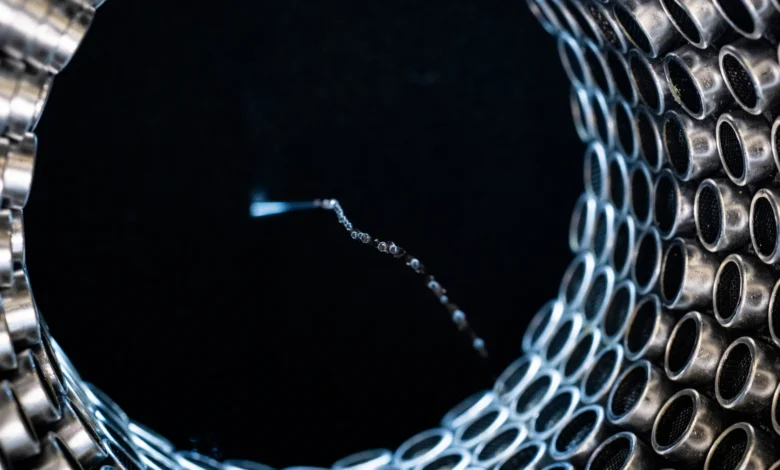
An international research team has unveiled a novel technology that uses focused ultrasound waves to construct invisible, mass-free conduits capable of steering continuous streams of liquids, powders, gases, and even plasma through open air. Operating entirely inaudibly, the system relies on an array of 256 miniature speakers arranged in a cylindrical structure to suspend and transport matter along adjustable pathways without any physical contact.
Project leader Ari Salmi, a professor of electronics at the University of Helsinki, described the setup as remarkable.
“In all the experimental devices I’ve seen, this one is perhaps the closest to magic,” Salmi said.
The concept originated from a previous project where researchers used ultrasound to clean residues adhering to the interior walls of traditional physical pipes. Pursuing that line of inquiry, the team wondered whether removing the solid walls altogether would eliminate pipe-clogging and accumulation issues at their root.
To translate the idea into hardware, the researchers conducted multiple rounds of experimentation testing various speaker configurations. The resulting prototype positions 256 micro-acoustic transducers around a cylindrical framework, emitting sound waves at a frequency of approximately 40 kilohertz. By precisely controlling the timing of these waves, the system shapes a localized acoustic field that exerts force on passing substances, constraining them to a designated route.
Altering the trajectory requires no moving physical parts; operators simply adjust the operation of the speakers to reshape the invisible conduit’s geometry. In laboratory demonstrations, the system successfully guided flowing water, directed powders into specific containers, manipulated mists and air currents, and even controlled the path of electrical discharges.
The current prototype measures just 8 centimeters in length and consumes roughly 50 watts of power, which is comparable to an old-fashioned incandescent bulb. While prior acoustic manipulation systems have largely been restricted to suspending or moving isolated particles and droplets, the new configuration demonstrates that sound alone can continuously guide flowing matter through the air.
Potential applications focus on the non-contact transport of challenging substances, including corrosive or sticky materials that degrade standard piping, as well as sensitive materials highly susceptible to contamination. The ability to alter flow directions electronically in real time also offers new precision for delivering materials to specific destinations.
Significant hurdles remain before the technology moves beyond the prototype stage. A primary limitation is the high hardware complexity and cost relative to scale: constructing a conduit only 8 centimeters long requires 256 individual transducers. Researchers suggest that connecting multiple identical modules in series could eventually extend the overall length of the conduits.
Another major challenge involves acoustic intensity. The sound pressure level at the center of the pipeline is comparable to someone continuously firing a gun near the ear, while the intensity outside the device matches standing next to a jet engine. Because the operating frequency of 40 kilohertz is well above the human hearing threshold, the intense acoustic energy remains completely inaudible to people, though researchers note that operators must ensure animals are kept away from the equipment.
The findings have been published in the Proceedings of the National Academy of Sciences.