For much of the journey through the American West on Route 66, the historic highway offers a sense of boundless freedom characterized by long horizons and the steady rhythm of asphalt stretching toward the desert. However, that tranquility vanishes abruptly in the Black Mountains of western Arizona. Here, the road known as the “Arizona Sidewinder” tightens into a series of punishing hairpin turns and steep grades wrapped around mountain slopes with little room for error. The speed limit drops to 20 mph, and guardrails are a rare sight.
This stretch over Sitgreaves Pass is one of the most notorious surviving sections of the original “Mother Road.” In the early days of motoring, the path was so intimidating that some travelers hired local drivers to navigate the mountains for them. Today, while the Bureau of Land Management (BLM) still issues warnings about the tight switchbacks, modern drivers face a different kind of obstacle: the wild burro.
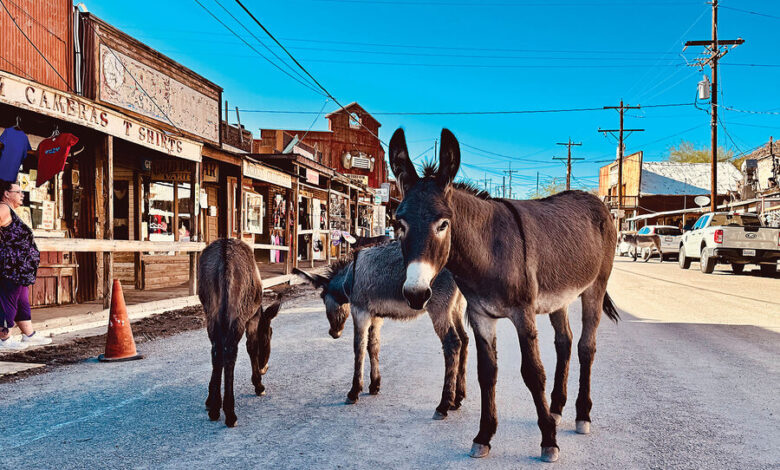
In and around the town of Oatman, Arizona, these donkeys are the undisputed masters of the pavement. They stand in the middle of the road, nudging tourists for feed and posing for photographs with the unhurried confidence of animals that have long since concluded the highway belongs to them. While they are the town’s primary economic engine, their presence has become a flashpoint for federal land managers struggling with a population explosion in the surrounding desert.
Oatman itself is a compact, theatrical relic of the Old West, featuring weathered storefronts and businesses that lean heavily into donkey-themed puns and souvenirs. The town began at the turn of the last century as a mining camp called Vivian. By 1909, it was renamed Oatman, a tribute to Olive Oatman, a young woman whose family was attacked on the Gila River trail in 1851. Though she spent five years in captivity hundreds of miles away, the mining camp adopted her name for reasons that remain historically unsettled.
By 1916, local mines had made Oatman one of the wealthiest camps in the state. Miners relied on pack burros to haul ore and water through the rugged terrain. When the gold was exhausted by the mid-1920s and the mines closed, the miners moved on, but the burros were left behind to fend for themselves in the Black Mountains. For decades, the town was sustained by Route 66 traffic until a flatter bypass was opened through Yucca in 1952, nearly turning Oatman into a ghost town.
Oatman was eventually saved by the rise of road-trip nostalgia. As travelers began seeking out the old highway for its own sake, the descendants of the original mining burros wandered back down from the hills to meet them. Today, these animals carry the weight of the town’s tourism industry, but federal officials warn the situation is becoming unsustainable.
Oatman sits within the 1.1 million-acre Black Mountain Herd Management Area. According to BLM estimates from March 2026, roughly 3,900 wild burros roam this territory—a figure nearly nine times higher than the agency’s management target of 450 animals. Officials say the desert’s limited water and forage cannot support such a dense population without causing permanent damage to the ecosystem. The animals have also been reported damaging residential fences and gardens in the area.
Public safety on the road remains a primary concern. While a donkey standing in the street during a sunny afternoon is a photo opportunity, the same animal on the road at night is a significant traffic hazard. The BLM has cited increasing collision reports as the herd continues to grow. In an effort to mitigate these risks, federal workers captured nearly 500 burros this spring using bait-and-water traps. The majority of these animals were transported for eventual adoption.
As evening falls on Oatman, the dynamic shifts. The gift shops close, and the crowds of tourists—who often outnumber the burros ten to one during peak hours—begin to dissipate. Some motorists continue west toward California, while others turn back to face the 20 mph climb over the pass. In the lengthening shadows of the Black Mountains, the donkeys remain, lingering on the asphalt of a road that has changed significantly since their ancestors first worked these hills.