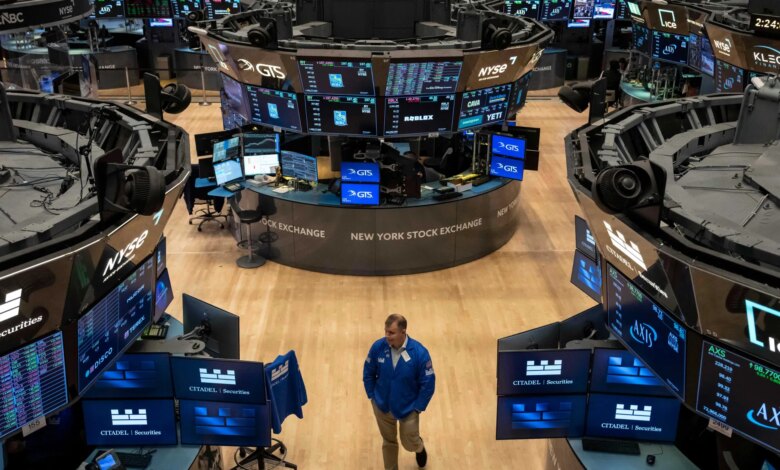
United States technology stocks dropped sharply as market jitters intensified over the long-term sustainability of corporate capital investments in artificial intelligence. The Nasdaq Composite, heavily weighted with technology firms driving the ongoing AI boom, fell 2.6 percent on Thursday. The drop marked the index’s steepest single-day decline since June 5, when it tumbled 4.2 percent.
The broader market also felt the pressure. The benchmark S&P 500 slid 1.21 percent, marking its largest drop since a 1.52 percent decline recorded on July 29. Outside of Apple, which managed a 1.2 percent gain, every member of the influential “Magnificent 7” group of tech giants—which collectively accounts for more than one-third of the overall market—suffered substantial losses.
Meta experienced the sharpest decline among the group, dropping nearly 7 percent. The Facebook parent company’s stock fell after it raised its projected capital spending for the year to a range between $135 billion and $145 billion in its latest earnings report, even as its net profit fell short of Wall Street expectations. Other major sector players followed suit, with Amazon falling 4.6 percent and chip designer Nvidia dropping 4.4 percent. Electric vehicle manufacturer Tesla and Google parent Alphabet both declined 3.1 percent, while software giant Microsoft dropped 2.2 percent.
The sell-off extended broadly across the semiconductor and hardware sectors. Both Intel and Advanced Micro Devices fell by approximately 8 percent, while Broadcom slid 4.3 percent. Following Thursday’s losses, the Nasdaq stands approximately 5.8 percent below its all-time high, which was reached on October 6.
Market sentiment was further weighed down by rising energy costs. Brent crude futures rose 4 percent on Thursday and continued climbing into Friday morning, pushing the international benchmark above $114.20 a barrel to reach its highest level since May. The sustained rise in oil prices has been driven by the ongoing fallout from the conflict involving the United States, Israel, and Iran.
The downward pressure quickly crossed international borders, prompting major stock markets in Asia to open lower during Friday trading sessions. Japan’s benchmark Nikkei 225 fell more than 2 percent in morning trading before recovering a portion of its losses, while South Korea’s KOSPI dropped as much as 3.5 percent. In Hong Kong, the Hang Seng Index declined by about 0.5 percent.
The turbulence has reignited fierce debates across financial markets regarding whether current capital outlays for artificial intelligence represent an unsustainable market bubble reminiscent of the dot-com crash of 2000. While some analysts view the massive capital expenditures directed toward datacentres and graphics processing units with skepticism, proponents argue that the technology’s transformative potential justifies the expenditures.
Global investments in artificial intelligence are projected to reach $2.7 trillion in 2026, and climb further to $3.6 trillion in 2027, according to forecasts from technology insights firm Gartner. Market observers noted that the recent sell-off reflects fluctuating confidence rather than a sudden shift in corporate fundamentals.
Jay Goldberg, a senior analyst at Seaport Research Partners in San Francisco, suggested that the market swings are primarily driven by shifting sentiment. Nothing fundamental has changed, Goldberg noted, describing the market reaction as a giant wall of worry fueled by investor anxiety rather than tangible economic shifts.