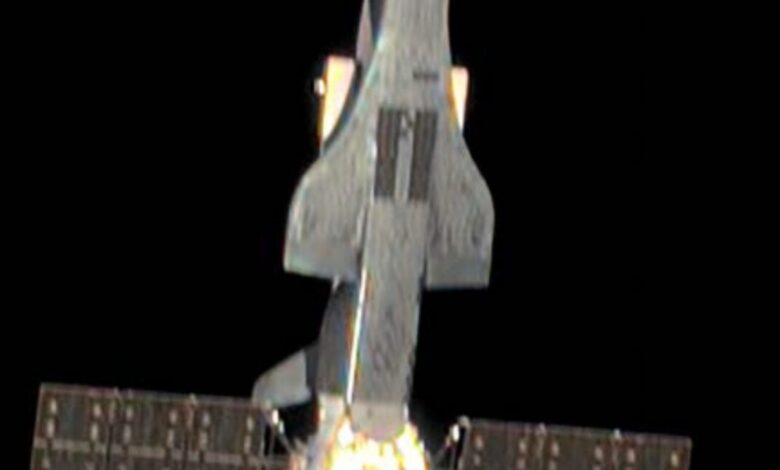
Global military powers are accelerating the development and deployment of counterspace technologies, with intelligence assessments revealing new details regarding orbital weaponry, directed-energy systems, and high-stakes maneuvering in Earth orbit. The capabilities span ground- and space-based platforms designed to monitor, disrupt, or neutralize adversary satellites as reliance on orbital infrastructure continues to intensify.
Commercial non-Earth imaging firms, including Maxar, have demonstrated advanced tracking capabilities through chance encounters at high speeds. These commercial observations differ fundamentally from active military operations, such as recent maneuvers by Russia’s Kosmos 2612, which deliberately approached a United States-registered radar imaging satellite earlier this month.
According to Defense Intelligence Agency assessments, the Chinese military views directed-energy weapons as ideal counterspace systems capable of either permanently or temporarily disabling satellites. Ground-based laser weapons in China currently utilize varying power levels to disrupt, degrade, or damage satellites operating in low-Earth orbit. Furthermore, intelligence reports indicate that China may field space-based directed-energy systems alongside higher-powered ground-based equivalents by the late 2020s, which would pose threats to satellites in higher orbits.
China’s counterspace portfolio extends beyond lasers to include ground-based anti-satellite missile testing and advanced orbital maneuvering. Last year, China demonstrated satellite refueling in geosynchronous orbit—a region approximately 22,000 miles, or 36,000 kilometers, above the equator—marking an achievement no other nation has demonstrated above low-Earth orbit. China has also tested a robotic arm capable of capturing spacecraft and currently operates a growing constellation of TJS satellites that routinely execute close approaches to foreign spacecraft.
In response to these developments, the United States has expanded its own orbital capabilities. The U.S. Space Force maintains a constellation of inspector satellites in geosynchronous orbit and has recently procured additional refuelable units to overcome traditional maneuverability limitations. Air Force Secretary Troy Meink revealed last month that the Pentagon has fielded weapons in space, establishing the United States as the first nation to officially acknowledge the deployment of orbital weaponry.
Meanwhile, Russia continues to pursue an extensive orbital combat program. U.S. intelligence officials report that Moscow harbors ambitions to deploy a nuclear weapon in space. A more conventional Russian weapons system, designated Nivelir, is engineered to launch projectiles from one satellite to impact another, an attack simulation of which was conducted by the Russian military in 2020.
Additional friction points involve recent Russian satellite deployments near commercial reconnaissance assets. In April, Russia launched a fleet of small satellites into orbits closely tracking a commercial radar remote sensing satellite owned by ICEYE, which supplies reconnaissance imagery to Ukraine. U.S. officials reported that one of these Russian satellites moved within tens of meters of the ICEYE spacecraft earlier this month before subsequently retreating.