Repair specialists and teardown analysts are pointing toward the internal hinge mechanism as a potential culprit behind early screen failures affecting Apple’s newly introduced foldable smartphone, the iPhone Duo. While the device maker has acknowledged that a limited number of users have experienced internal screen issues and has offered replacements through AppleCare, the company has not yet released exact failure statistics or officially confirmed the root cause of the damage.
Reports shared by users detailing the hardware failures reveal distinct patterns. Several owners observed black spots forming near the central folding area of the inner display, which were subsequently followed by bright pixel lines extending toward the right edge of the screen. Other users reported feeling a mechanical obstruction near the hinge during normal unfolding, which culminated in a distinct cracking sound and immediate display failure when the phone was opened further. These concentrated damage points have led technical researchers to investigate whether the underlying mechanical structures are placing undue stress on the flexible display panels.
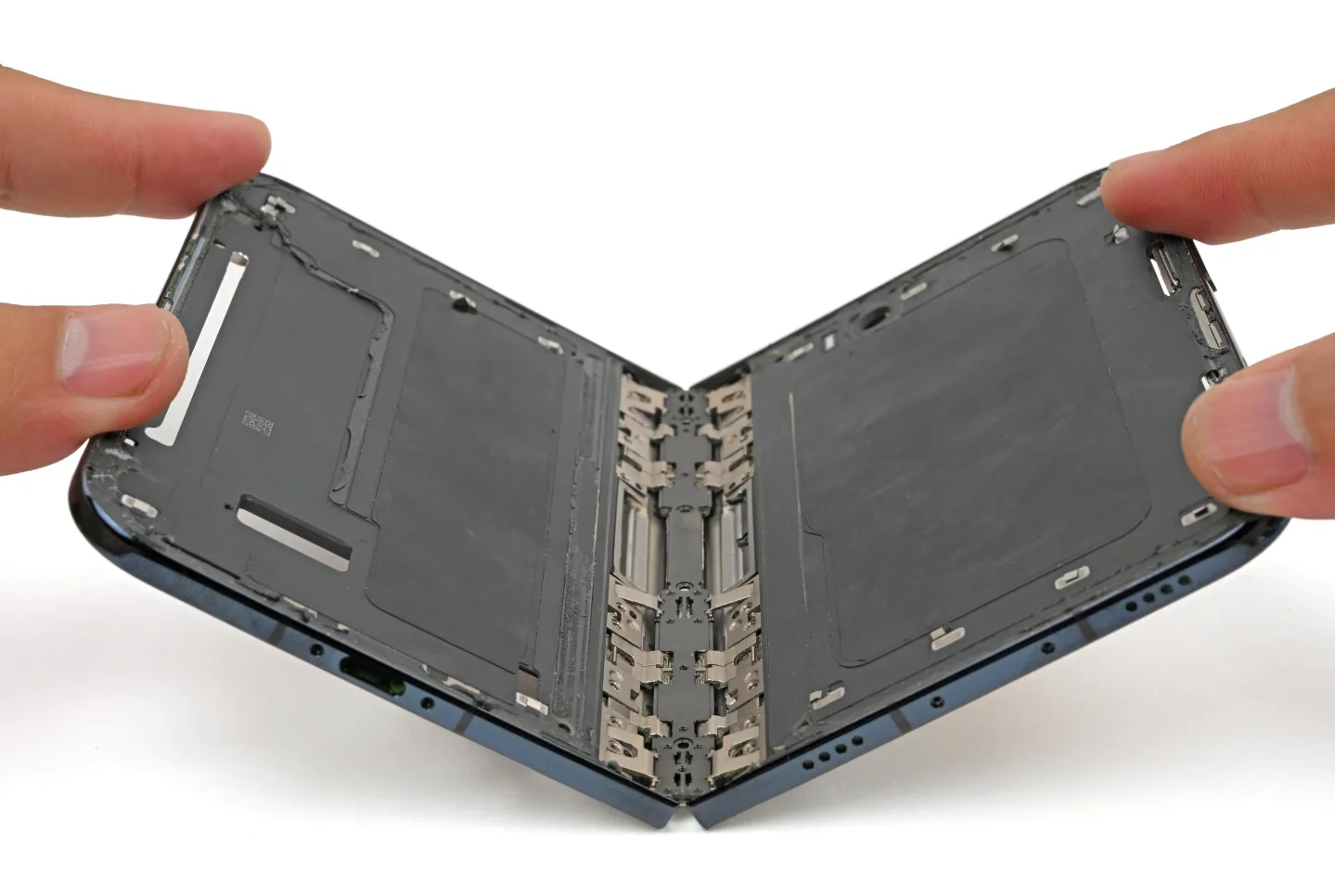
The engineering behind the iPhone Duo hinge relies on a complex coordination of gears, springs, connectors, and support structures designed to ensure the device closes flat while leaving adequate bend radius for the flexible screen. According to teardown evaluations conducted by iFixit, the central hinge support architecture must also accommodate flexible ribbon cables passing through the assembly, creating multiple structural junctions and edges that may act as vulnerable stress points.
Shahram Mokhtari, lead teardown technician at iFixit, suggested that the issue may originate from a central support bar within the hinge mechanism. Under standard operation, this support component is engineered to retract fully downward to clear space for the curving screen as the device folds. However, if the bar fails to clear the display under certain conditions, the metal component could make direct contact with the bent flexible panel, concentrating mechanical force into a small area rather than distributing it evenly.
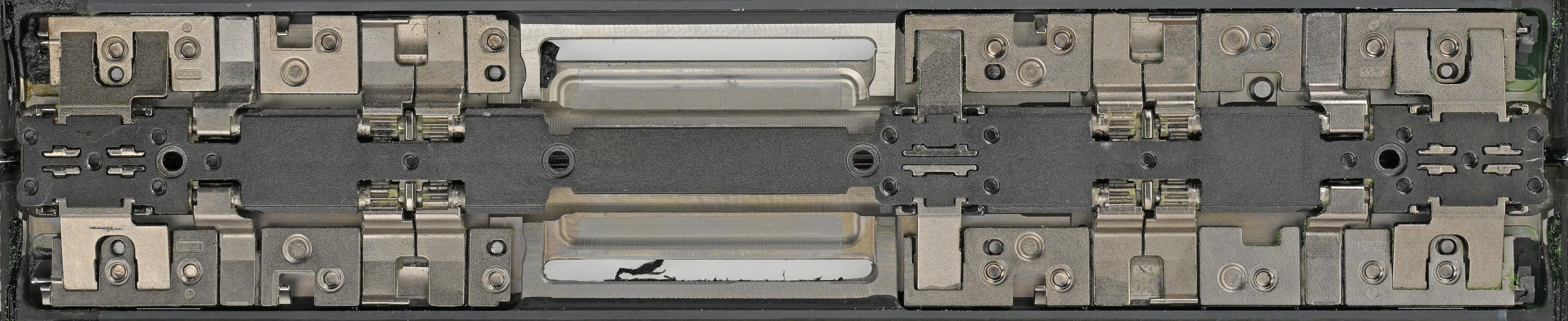
Researchers describe this localized contact point as a stress hotspot. Repeated application of this force, or a sudden spike in pressure during unfolding, could damage the internal structure of the flexible display and produce the characteristic black spots, bright lines, and structural fractures reported by consumers. This mechanical hypothesis aligns with sudden failure accounts, including one user who felt an irregularity inside the hinge while showing the device to a friend immediately before hearing the screen crack.
Additional evidence emerged from endurance testing conducted by YouTube creator CuriousHagi, who captured a screen failure in the folding zone during stress testing. Subsequent disassembly of that test unit revealed a fractured component connected to the central hinge support bar, mirroring the damage zones noted in consumer reports. However, analysts emphasize that these findings remain preliminary. Endurance tests subject hardware to severe environmental and mechanical stresses that do not replicate normal daily use, and isolated teardown samples cannot prove that every reported screen failure stems from a single mechanical flaw.

Apple has characterized the problem as affecting a small percentage of devices and continues to direct affected customers to contact support services for replacements. The company has not announced a product recall or outlined a definitive repair or redesign plan. Repair analysts note that foldable displays and articulated hinges represent highly complex components operating in extremely tight tolerances, making some initial failure rate unsurprising for a first-generation product launch.
If identical fractures continue to surface over the coming months, however, industry observers suggest the incidents may point to broader manufacturing or design challenges rather than isolated defects. Whether the issue stems from dimensional variations in parts, assembly tolerances, or movement restrictions in the hinge assembly, the situation highlights the intricate reliability challenges manufacturers face in balancing physical thinness with long-term mechanical durability in foldable consumer hardware.