Ukraine has announced the restoration of critical Starlink satellite services for its military operations, signaling an end to more than a week of connectivity disruptions that had severely limited drone capabilities on the front lines. The restoration comes at a pivotal moment, as diplomatic efforts appear to be intensifying with a major round of negotiations scheduled to take place in Abu Dhabi next month.
Ukrainian Defence Minister Yevhenii Khmara confirmed on Saturday that both Starlink and the military-grade Starshield connections have returned to stability. Significantly, the equipment is now maintaining reliable connectivity even when traveling at speeds exceeding 400 kilometers per hour (250 miles per hour), a technical threshold vital for the operation of high-speed aerial and maritime drones. Khmara attributed the resolution to a combination of direct diplomacy by President Volodymyr Zelenskyy and ongoing discussions with officials in Washington.
The disruption had become a point of significant friction between Kyiv and the current U.S. administration. While Ukraine relies heavily on the satellite network operated by Elon Musk’s SpaceX, the origin of the recent restrictions remains a subject of intense speculation. U.S. President Donald Trump has denied any personal role in ordering the service cuts, though he has publicly defended Musk’s management of the platform. The incident added further strain to a relationship already tested by the White House’s decision to temporarily ease sanctions on Russian diesel and permit certain U.S. imports.
These technical and political hurdles follow a period of open hostility between the two leaders, including a public confrontation at the White House in February 2025. President Trump has recently escalated his rhetoric, calling for a change in Ukrainian leadership and suggesting earlier this week that a representative other than Zelenskyy should lead future negotiations for Kyiv.
Despite the political tension, a diplomatic path appears to be forming. Negotiators from Ukraine, Russia, and the United States are expected to convene in Abu Dhabi during the first half of November. This would mark a significant attempt to revive peace talks more than four years after the full-scale invasion began in February 2022. Kremlin spokesman Dmitry Peskov confirmed the planned summit on Friday, and President Zelenskyy noted that preliminary agreements for technical-level meetings have been reached.
In a localized development, a small-scale ceasefire has reportedly been brokered for the occupied town of Oleshky in the southern Kherson region. President Trump credited his wife, Melania Trump, with facilitating the arrangement. According to statements from both Ukrainian and Russian officials, the ceasefire is slated to begin on October 27, with a humanitarian operation scheduled for October 29 to assist residents in the occupied territory.
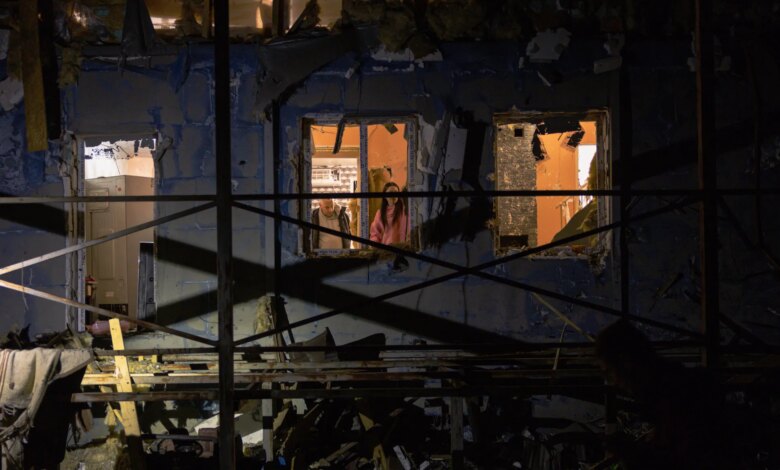
While diplomatic channels open, the violence on the ground remains relentless. In Ukraine’s northeastern Kharkiv region, Governor Oleh Syniehubov reported that a Russian missile strike on Lozova killed one man and injured two others on Saturday. A separate attack on Chernihiv on Friday resulted in one death and at least 25 injuries. In the Donetsk region, shelling in Kramatorsk killed one person and wounded six, including three children, while an attack in nearby Sloviansk killed a 62-year-old woman and wounded four others, according to Mayor Vadym Lyakh.
Ukraine has also conducted several strikes deep into Russian territory. Ukrainian forces reportedly targeted the Togliattikauchuk petrochemical plant in Togliatti, a major producer of synthetic rubber. While Mayor Ilya Sukhikh confirmed damage to the industrial facility, no casualties were reported. In Oryol, an attack on the Proton electronics plant—which Ukraine identifies as a manufacturer of missile components—resulted in three fatalities, according to regional Governor Andrei Klychkov. Additionally, authorities in Russian-occupied Crimea reported widespread power outages following a series of overnight drone strikes.
Russia’s Defence Ministry claimed that its air defense systems intercepted a SCALP cruise missile, four Neptune missiles, and nearly 1,300 Ukrainian fixed-wing drones over the past 24 hours. These figures, like many battlefield reports from the conflict zone, have not been independently verified as both sides continue to trade heavy blows ahead of the November summit.