Researchers have uncovered a hidden mechanism within the ocean’s “marine snow” that could fundamentally alter how scientists calculate the Earth’s carbon budget. A study published on October 8, 2026, in the journal Science reveals that the microscopic physical structure of these sinking organic particles—specifically their stickiness—determines how much carbon is successfully transported to the deep sea rather than being recycled in the shallows. According to findings from the University of California San Diego’s Scripps Institution of Oceanography and the University of Lincoln, particles with high viscosity can transport more than six times the amount of carbon to the deep ocean compared to less sticky counterparts.
Marine snow is a critical component of the global carbon cycle. It begins in the sunlit upper layers of the ocean, where plankton absorb carbon dioxide through photosynthesis to create organic matter. When these organisms die or aggregate with other organic debris, they form particles that slowly drift toward the seafloor. Carbon that reaches the deep ocean can remain sequestered for hundreds or even thousands of years, effectively isolating it from the atmosphere and making the ocean one of the planet’s most vital natural carbon sinks.
However, the journey to the deep is perilous for these particles. While researchers estimate that over 10 billion tons of carbon leave the ocean’s surface as marine snow every year, only about 2 billion tons actually reach the depths required for long-term storage. The vast majority is intercepted and decomposed by bacteria in shallower waters. Until now, the factors determining which particles survived this descent remained poorly understood.
The research team focused on the internal microstructures of these particles, discovering that marine snow is not a uniform mass. Instead, it possesses a complex architecture with varying levels of viscosity. The outer regions of a particle are often softer and less sticky, making them easy targets for bacteria to attach to and break down. In contrast, the interior sections can be much stickier and more resistant. The researchers compared this to a worm eating an apple: the softer flesh is easily consumed, but the tougher, denser portions provide a physical barrier that slows the bacteria’s progress.
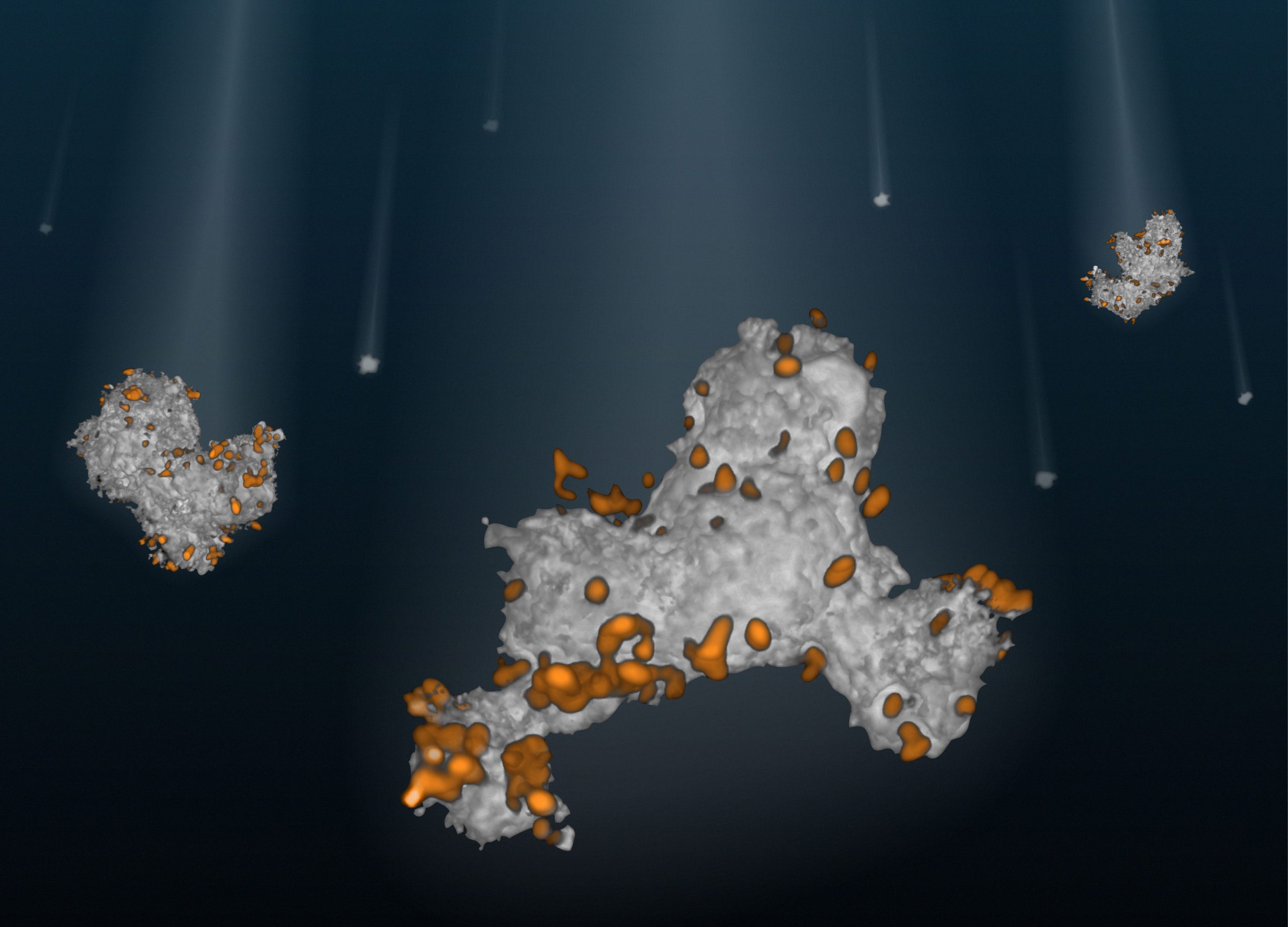
To observe these microscopic interactions, the team developed a groundbreaking imaging method. After years of development, the researchers established a protocol in 2025 that combined three-dimensional confocal microscopy with specialized fluorescent molecules. This allowed them to map the complex physical interior of marine snow and track the movement of individual live bacteria as they navigated the sticky environment. Previously, scientists could see the surface of these particles but could not determine how bacteria moved or attached within the mucus-like internal structures.
Experimental data showed that stickier particles took significantly longer for bacteria to degrade and fragment. Computer simulations based on these observations suggested that because these sticky particles resist breakdown, they remain intact long enough to sink into much deeper water. This longevity is the key to the six-fold increase in carbon transport efficiency observed in the study.
These findings have immediate implications for climate forecasting. Current models of the ocean carbon cycle estimate how much carbon is absorbed and how long it stays submerged. If these models do not account for the structural variations and stickiness of marine snow, they may be underestimating the ocean’s true carbon-sequestering capacity. However, the researchers cautioned that this discovery does not mean the ocean’s carbon storage will suddenly increase or that global warming will slow. The carbon cycle is influenced by a myriad of factors, including water temperature, seawater flow, and plankton productivity, all of which must be integrated with these new structural findings.
The utility of the new imaging technology likely extends far beyond oceanography. Complex mucus-based environments are found in coral reefs, kelp forests, plant root systems, and even the human digestive tract. Like marine snow, these environments are not uniform gels but contain various sticky zones and physical hurdles that dictate how bacteria survive and move. By applying these tools to other fields, scientists hope to gain new insights into coral reef restoration, plant-microbe relationships, and human gut health. For now, the study underscores how the smallest, stickiest particles in the sea play a massive role in regulating the planet’s climate.