A new exhibition at Stanford University’s Cantor Arts Center explores the 19th-century origins of 3D likeness production, tracing how an ambitious Victorian imaging technique mirrors modern technological cycles. Titled “Solid Pictures: Photosculpture and the Making of Modern Likeness,” the exhibition marks the first major museum showcase devoted to the photosculpture process invented by French artist and photographer François Willème.
Willème unveiled his invention to Paris in 1861, promising a mechanized method for capturing three-dimensional form. His process required a subject to stand on a platform inside a glass-domed rotunda measuring 10 meters across. Cued by a whistle, 24 cameras positioned in the walls fired simultaneously. Assistants then projected the resulting negatives onto frosted glass, traced the silhouettes, and fed each profile through a pantograph that carved into a block of clay mounted on a rotating turntable. The method allowed a 10-second posing session to yield a completed bust within 48 hours, available in materials including plaster, bisque porcelain, terracotta, and bronze.
Despite initial enthusiasm and royal patronage—including commissions from Queen Isabella II of Spain, who summoned Willème to Madrid to image the royal family and subsequently awarded him a knighthood in the Order of Charles III—the enterprise struggled commercially. The commercial firm established to exploit the invention underwent two corporate reorganizations before shareholders pushed Willème out in May 1867. Willème eventually retreated to his hometown of Sedan to operate a standard photography studio.
Curator Patrick R. Crowley has assembled 26 surviving photosculptures for the exhibition, including 12 from the Cantor’s permanent collection, alongside historical patents, prints, glass negatives, and contemporary works by artists such as Oliver Laric, Aria Dean, and Charles Ray. Crowley frames the historical failure as an early precursor to contemporary technologies like CT scans and 3D printers, presenting the enterprise as a Victorian-era cautionary tale of an overleveraged startup.

Among the historical items on display is Willème’s circa 1863 “Self-Portrait,” which captures the inventor leaning back with arms folded tight. The displayed object is a 1924 copy cast by a former employee seeking to preserve Willème’s legacy. Another striking historical piece, a circa 1860 mechanically produced bust of a woman’s head, is constructed from 100 wedge-shaped wooden sections bound with twine. Physicist Léon Foucault critiqued the method at the time, noting technical flaws that ultimately contributed to the company’s financial collapse.
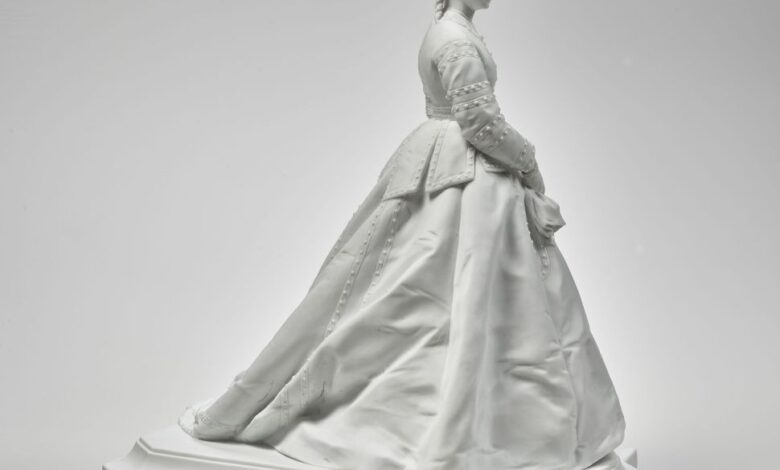
The exhibition also highlights the limits of mechanical automation during the Victorian era. A photosculpture of Spanish aristocrat Matilde de Aguilera y Gamboa, sister of the Marqués de Cerralbo, executed around 1865 in bisque porcelain, demonstrates the refined output possible for wealthy patrons. Yet historical examination reveals that the most intricate details of such works—including folded taffeta, crumpled gloves, and complex hairstyles—relied heavily on final hand-carving by artisans rather than purely automated production.
Contemporary responses in the exhibition engage directly with Willème’s legacy. Artist Oliver Laric contributes “Self-Portrait” (2026), featuring a 3D-printed rendering of Willème executed three times in aluminum at diminishing scales, echoing the scaling capabilities of the original pantograph.
“Solid Pictures: Photosculpture and the Making of Modern Likeness” remains on view at the Cantor Arts Center, located at 328 Lomita Drive in Stanford, California, through January 18, 2027.