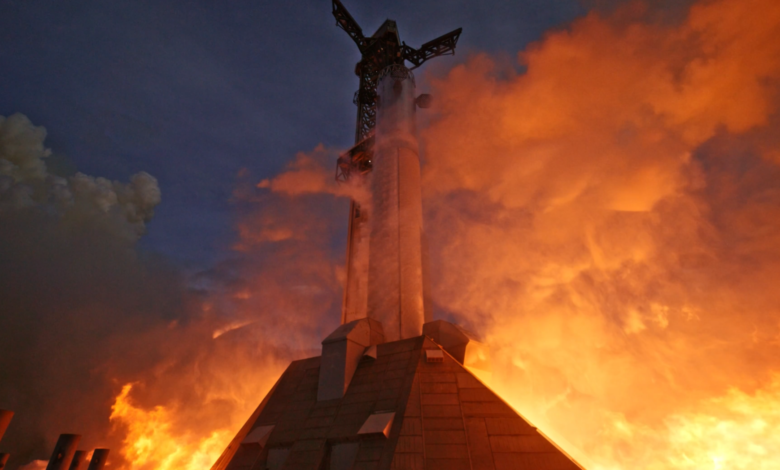
SpaceX has moved into the final preparation phase for its upcoming Starship test flight, conducting a critical static fire test of the first-stage vehicle at its Starbase facility in South Texas.
The Super Heavy booster designated for Flight Test 15, known as Booster 22, underwent a full-duration static test fire on October 25, igniting all 33 of its Raptor 3 engines for approximately 15 seconds. Company officials confirmed the test in a public statement, describing it as a full-duration run for the booster as it prepares for the upcoming mission.
The static fire marks the beginning of final evaluations for the first-stage vehicle before it is mated with the Flight 15 upper stage, Ship 42. Before the two stages are combined, Ship 42 must also complete its own series of pre-launch assessments, including a static engine fire and comprehensive final systems checks.
Company leadership has indicated that Flight 15 will feature a daring operational objective: an attempt to catch the ship upper stage using the launch tower for the first time. A successful tower catch would represent a major technical stride toward achieving full reusability for the entire Starship system, mirroring the catch techniques already demonstrated with the booster stage.
Testing momentum has intensified following a busy operational cadence in 2026, which has seen three Starship missions to date. The most recent flight, designated Flight 14 on September 28, achieved orbit for the first time and successfully deployed 26 next-generation Starlink V3 satellites. That mission marked the initial delivery of operational payloads by the spacecraft, as the V3 satellites are too large to fit inside the payload fairing of the company’s Falcon 9 rocket.
Flight 14 encountered minor difficulties during ascent when an upper-stage Raptor engine shut down prematurely. The anomaly prompted mission controllers to curtail the planned 10-hour flight, though the upper stage still executed a controlled reentry and splashed down in the Pacific Ocean approximately three hours after liftoff.

While SpaceX has not yet officially confirmed whether Flight 15 will carry another batch of Starlink V3 satellites, bringing the high-capacity spacecraft into regular service remains a primary driver for the rapid flight campaign. Integrating the new satellites is essential for expanding the company’s global broadband network.
Beyond internal network upgrades, Starship’s development timeline directly impacts NASA’s Artemis lunar exploration architecture. SpaceX is under contract to provide a modified Ship upper stage to land astronauts on the lunar surface. NASA recently refreshed the milestone timeline that SpaceX must fulfill before the lander is cleared to carry human crews, pointing toward a significant demonstration mission scheduled for next summer alongside the Artemis III mission.
The Artemis III profile will involve launching astronauts into Earth orbit aboard NASA’s Orion spacecraft, which will subsequently dock with the lunar lander vehicles over a two-week period. NASA has contracted both SpaceX and Blue Origin to develop separate lunar lander systems for the program.
In addition to the crewed preparations, SpaceX is working toward an uncrewed lunar landing demonstration ahead of NASA’s targeted Artemis IV mission in 2028. Selection for the first crewed Artemis landing remains open, with both SpaceX and Blue Origin competing for the assignment.
Following the completion of Booster 22’s engine trials, SpaceX aims to accomplish further operational milestones before the conclusion of 2026. These goals include executing Starship’s first orbital-class launch from Florida and potentially demonstrating the first re-flight of an upgraded V3 Super Heavy booster. Based on typical campaign timelines following static fire milestones, Flight 15 is widely anticipated to lift off in mid-to-late November.