Sunday marks two years since a fatal structural collapse at a railway station in the Serbian city of Novi Sad took 16 lives, an accident that ignited a prolonged wave of civic unrest and ultimately reshaped the nation’s political landscape.
The disaster unfolded on November 1, 2024, when a concrete canopy on the newly renovated station building gave way. Fourteen people died at the scene, while three others were critically injured. Two of the critically injured victims succumbed to their wounds in November 2024 and March 2025, bringing the final death toll to 16 and sparking widespread public anger over questions of construction quality, transparency in public spending, and systemic corruption.
Within days, thousands gathered in Novi Sad to demand accountability, leading to clashes with police, property damage at City Hall, and a swift judicial response against demonstrators while the core investigation into the collapse remained sluggish. By mid-November, opposition politicians and citizens staged consecutive days of blockades outside the city’s court and prosecutor’s office, facing riot police before authorities announced the arrest of 11 individuals, including former Construction Minister Goran Vesic.
A turning point arrived in late November when students and professors faced attacks during a memorial service outside the University of Arts faculty of dramatic arts in Belgrade. The incident galvanized students to launch a university sit-in demanding justice for the victims, access to reconstruction documents, and the release of detained protesters. Under mounting pressure, authorities released partial documentation in December—eight binders containing 195 documents—though critics dismissed the release as inadequate.
Legal proceedings expanded on multiple fronts. On December 30, prosecutors indicted 13 people on charges including serious crimes against public security and abuse of office, though higher courts subsequently eased detention terms for Vesic and Serbia Railways Infrastructure acting General Director Jelena Tanaskovic to house arrest. In January 2025, a separate Belgrade-based investigation targeted financial fraud and money laundering related to the station’s reconstruction, involving Vesic, former Trade Minister Tomislav Momirovic, and 12 other individuals.
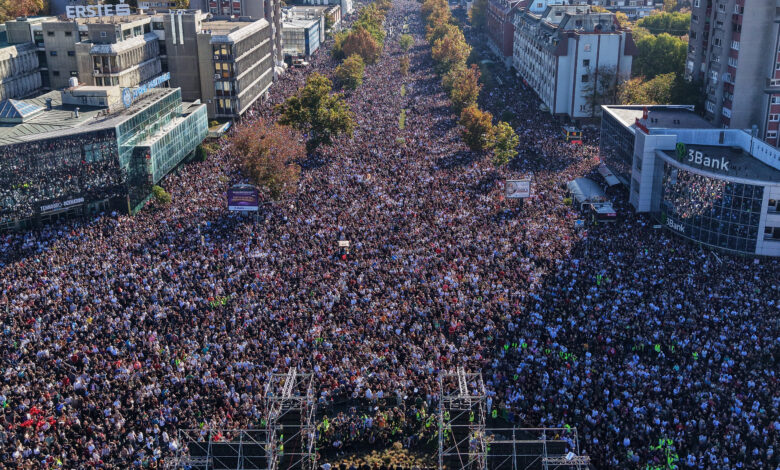
Political fallout intensified in late January 2025 after governing party activists assaulted students at the Academy of Arts in Novi Sad, prompting Prime Minister Milos Vucevic to resign. Despite the concession, protests persisted. In March, the arrest of 13 activists and students on charges of undermining the constitutional order triggered mass demonstrations, drawing hundreds of thousands of people to the streets of Belgrade by mid-March.
As legal pressures and court battles continued through mid-2025—including the easing of some student detentions and the departure of several accused activists to European Union nations—the movement underwent a structural transformation. In September 2026, ahead of snap parliamentary elections called for October, the informal student protest network reorganized into the Student List-Students Win political coalition, incorporating students, professors, and legal experts.
In a final pre-election maneuver on September 27, 2026, longtime leader Aleksandar Vucic resigned as president to helm his party’s electoral slate, pardoning all prosecuted students and activists on his final day in office to defuse social tensions and allow exiles to return safely. In the ensuing elections, which drew the highest voter turnout in over three decades, Vucic conceded defeat to the Student List, leaving the pursuit of full accountability for the Novi Sad tragedy as a central mandate for the new government.