A sense of urgency is gripping the Republican Party as internal polling and fundraising shifts suggest that the path to maintaining a Senate majority has grown increasingly precarious. National Republican strategists are now weighing a series of last-minute spending moves in states that were considered virtually untouchable only six months ago, signaling a defensive posture that few in the party anticipated.
The shifting landscape has forced party leadership to consider cash infusions for races in Mississippi, South Carolina, and Kansas—territories where Democratic victories have been historically rare. To find the last time Kansas elected a Democrat to the U.S. Senate, one has to look back 94 years. In Mississippi, that gap stands at 44 years, while South Carolina has not sent a Democrat to the Senate in 28 years. Yet, despite these decades-old streaks, party operatives describe a situation that has transitioned from confidence to what some characterize as a “hand-to-hand” struggle for control. One national Republican political operative warned that the defensive perimeter has been breached, suggesting that the party is now fighting to protect its own interior strongholds.
The Senate map, which initially appeared favorable for Senate Majority Leader John Thune (R-S.D.), is now riddled with unexpected vulnerabilities. Internal GOP data reportedly shows Democratic challengers within the margin of error in more than half a dozen states typically viewed as deep-red. This has prompted the Senate Leadership Fund (SLF), a super PAC closely aligned with party leadership, to pivot resources toward the most pressing threats.
Mississippi has emerged as a sudden point of concern. Republicans are currently reviewing the race to determine if they must spend significant sums to protect incumbent Senator Cindy Hyde-Smith. She faces a surprisingly competitive challenge from Scott Colom, a Democratic district attorney. The threat was validated on Tuesday when the Senate Majority PAC, the primary super PAC for Senate Democrats, announced a $1.2 million investment into the Mississippi race. While Republican leadership previously concluded that spending in Mississippi was unnecessary, the latest polling has forced a reevaluation of that strategy.
Similar defensive maneuvers are taking place in South Carolina and Kansas. Two weeks ago, the SLF initiated what was described as a $5 million “insurance policy” in South Carolina. That investment has since grown to $8.5 million as Republican nerves continue to fray. Additionally, a super PAC associated with Senator John Barrasso (R-Wyo.) has contributed another $500,000 to the state. In Kansas, the SLF has earmarked $14 million, having already spent nearly $12 million to shore up support.
This defensive spending is not limited to the deep south or the plains. The “red wall” in the Midwest has also required massive reinforcement. In Ohio, an initial $28 million television advertising reservation made in June has ballooned into a staggering $93 million commitment. Similarly, in Iowa, a $11 million initial investment has climbed to $53 million. These figures reflect a broader realization within the party that no Republican seat is entirely safe in the current cycle.
While some candidates, such as Ashley Moody in Florida and Mike Rounds in South Dakota, appear to be on stable ground, the overall financial picture for the GOP is complex. The National Republican Senatorial Committee (NRSC) reported raising $31.4 million last month, but the group’s cash reserves appear strained. To maintain its aggressive coordinated campaign strategy, the committee recently took out a $20 million loan. Meanwhile, the SLF remains better capitalized, ending September with $155 million in cash on hand. Since October 1, the group has spent or reserved approximately $169 million in video advertising.
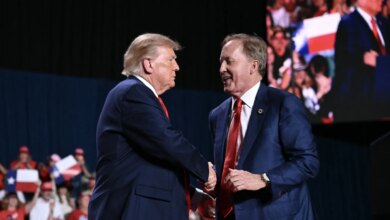
External support may also be on the way. On Tuesday, former President Donald Trump stated on social media that his super PACs intend to spend another $100 million before Election Day, which would bring his total involvement in the cycle to $400 million.
Despite the massive financial output, the outlook remains clouded by uncertainty. While Republicans still have a viable path to maintaining their Senate majority, the necessity of defending deep-red territory suggests a much tighter race than the party projected at the start of the year. Beyond the immediate concerns in Mississippi and Kansas, some operatives expressed lingering anxiety regarding races in Alaska and Michigan, though they remain hopeful that the party will ultimately retain control of the chamber.