Billionaire Rick Jackson Tests ‘Foster Care to Fortune’ Narrative in Georgia Gubernatorial Race


In the final stretch of Georgia’s gubernatorial race, Republican candidate Rick Jackson is attempting a delicate political maneuver: convincing a working-class electorate that a man who has spent nearly $200 million of his own fortune on a single election is one of them. The 72-year-old healthcare magnate has anchored his campaign in a narrative he calls “from foster care to billionaire,” a personal history he uses to bridge the gap between his current status as an elite investor and his early years of profound poverty.
Jackson’s background is a centerpiece of his appeal, particularly as he navigates the shadow of Donald Trump. Unlike the former president, whose wealth was inherited, Jackson’s story begins with abandonment. During the campaign’s only general election debate, Jackson recounted a childhood defined by instability, noting that his father left when he was nine months old and his mother, a waitress with a sixth-grade education and an alcohol addiction, struggled to provide. Jackson lived in five different foster homes, attended 13 different schools, and resided in public housing projects. By the time he was 12, he had seen seven different stepfathers pass through his life.
This history of hardship has become Jackson’s emotional currency. At a recent event in the conservative stronghold of Cleveland, Georgia, Jackson admitted to voters that his upbringing left him with “severe abandonment issues,” which he transformed into a political vow: “I will never abandon you.” This personal touch is designed to soften the image of a candidate whose company, Jackson Healthcare, has amassed a fortune through lucrative contracts, including taxpayer-funded work for hospitals and public health systems.
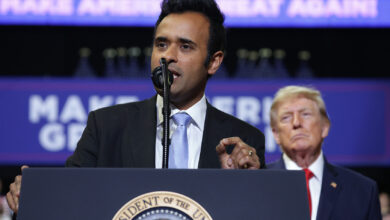
Politically, Jackson has spent the campaign walking a tightrope between total alignment with Trump and a more localized, “Southern” brand of conservatism. In the early stages of the race, Jackson promised to bring “business solutions” to Georgia and even described his platform as being “like Trump, but with a Southern tone.” This was despite the fact that Trump initially endorsed Lieutenant Governor Burt Jones in the primary. After defeating Jones in a runoff, Jackson has selectively leveraged Trump’s presence, appearing with him at rallies in Marietta and Dalton, though sometimes shifting his focus entirely to foster care advocacy rather than broader national grievances.
Jackson’s policy platform is a blend of traditional Republican priorities and bold, perhaps risky, promises. He has pledged to halve the state income tax within four years, vowing not to seek a second term if he fails to meet that goal. He also advocates for a balanced budget and full audits of state spending, though critics point out that these are already standard legal requirements in Georgia. On healthcare, Jackson remains a staunch opponent of expanding Medicaid under the Affordable Care Act. Instead, he proposes a system based on partnerships with private insurers, a move that would require unprecedented federal waivers and financial commitments that have not been granted to other states.
Democratic nominee Keisha Lance Bottoms, the former mayor of Atlanta, has consistently challenged Jackson’s everyman persona. Bottoms argues that Jackson is attempting to “buy this election” to serve as a surrogate for Trump’s interests. The Democratic campaign has also seized on a series of verbal slips by Jackson that they claim reveal a disconnect from everyday Georgians. During a town hall-style debate, Jackson referred to people feeling unsafe at “the gas store” and incorrectly cited the minimum wage as $7.50 an hour, when it is actually $7.25. When questioned by a citizen about the struggle to afford basic necessities on low wages, Jackson remarked, “Hopefully, you’re not the one that is getting the $7.50 an hour.”
Jackson has also undergone a visual and rhetorical shift. Early in the race, he ran hardline immigration ads promising that “criminal illegals” would be “deported or departed.” More recently, he pivoted to commercials featuring his grandchildren and young adults who benefited from his philanthropic work with foster children who age out of the state system. This softer imagery aims to appeal to centrist voters in metro Atlanta who may be wary of the more combative rhetoric often associated with the national Republican platform.
As the November 3 election approaches, Jackson’s massive self-funding—which puts him among the most prolific self-funders in U.S. election history—remains a double-edged sword. While it has allowed him to saturate the airwaves with his rags-to-riches story, it provides a persistent target for opponents who argue that his wealth insulates him from the realities of the voters he seeks to represent.