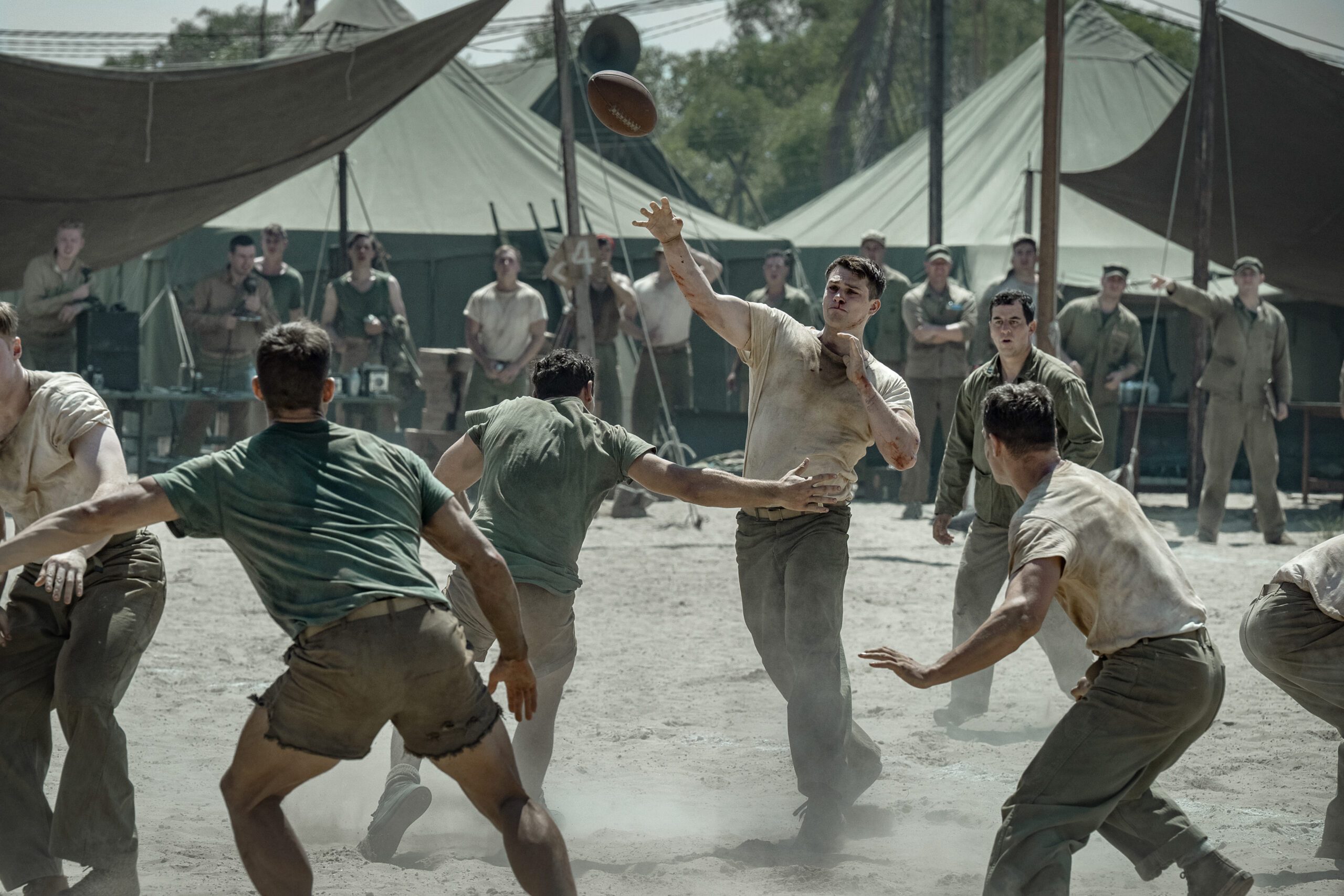
When you are a child, young men departing for war appear to be adults. When you reach adulthood, you recognize that they are essentially still boys. If The Mosquito Bowl captures any central truth, that is it. Directed by Peter Berg, the film retells the true story of collegiate football stars who left their athletic careers behind to fight in the Pacific theater during World War II.
The narrative centers on four real-life figures: Dave Schreiner and Bob Bauman, portrayed by Tom Francis and Bill Skarsgård respectively, as teammates and close friends from the University of Wisconsin; Tony Butkovich, played by Ray Nicholson, who served as a fullback for Purdue; and John McLaughry, played by Nicholas Galitzine, who graduated from Brown University and was drafted into the NFL before the conflict disrupted his career. In Berg’s framing, these young athletes initially believed they could navigate wartime combat with the same strategic execution and athletic discipline they applied on the gridiron, only to discover the brutal reality of armed conflict.
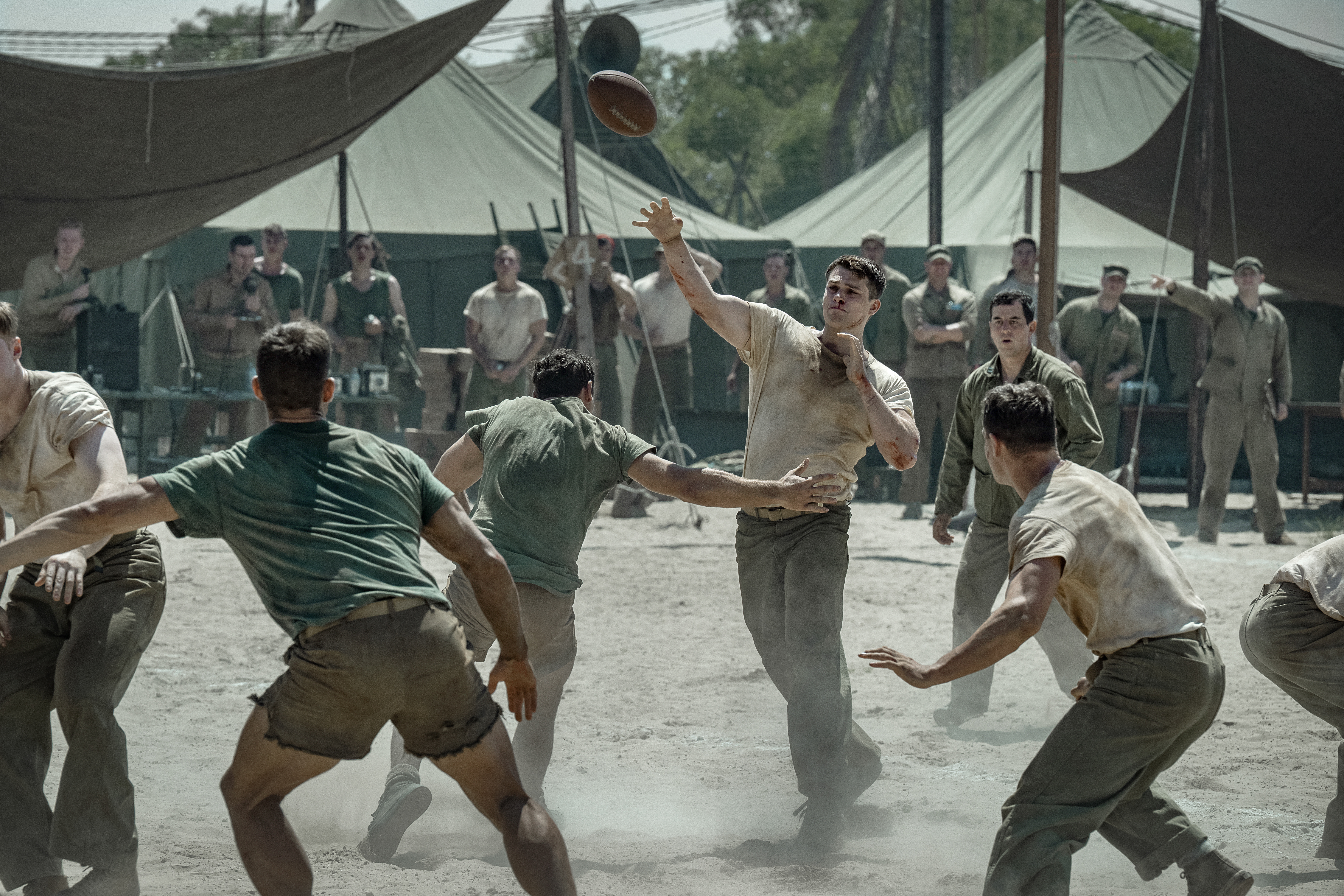
The film’s title derives from a legendary football game played between two Marine regiments at Guadalcanal on Christmas Eve in 1944. Tragically, of the 65 players who participated in that matchup, 15 lost their lives just months later during the fierce battle of Okinawa, including three of the four central subjects.
Berg, whose prior directing credits include Hancock, The Kingdom, and Friday Night Lights, builds considerable dramatic tension, introducing his main subjects with measured efficiency. Schreiner is portrayed as a grounded, introspective thinker who enters the film simmering with resentment following a loss to Purdue, where he faced Butkovich, a player characterized as a hothead. Bauman appears as a steady rural Wisconsin native concerned with maintaining his family’s homestead, while McLaughry provides a thoughtful, grounded presence anchoring the opening scenes that depict the civilian lives the soldiers left behind.

Following basic training, the men are deployed to Tarawa, leading to an extended combat sequence that introduces the newly minted Marines to the grim mechanics of warfare. Amputations, severe burns, and catastrophic wounds are graphically depicted. Afterward, the narrative shifts to the lighter respite of the actual Mosquito Bowl game on Guadalcanal, providing a brief interval of athletic camaraderie before the inevitable advance toward Okinawa.
The screenplay was adapted from the 2002 book of the same name by Buzz Bissinger, author of the work that inspired the 2004 cinematic adaptation of Friday Night Lights. In depicting the bloody campaign at Okinawa, Berg spares no visceral detail, emphasizing the relentless toll of combat as the film contrasts the fleeting joy of the football match with the devastating loss of life that followed.