Nerve agents represent some of the most hazardous chemical threats known, capable of disrupting the human nervous system rapidly and blocking communication between the brain and the body. Severe exposure can trigger seizures, paralysis, and death within minutes. Conventional protective suits rely primarily on physical barriers to keep these toxic substances away from the skin, but they typically block exposure without actively destroying the harmful compounds. To address this limitation, a research team has developed a functional chemical treatment that can be applied to various existing fabrics rather than requiring the complete manufacture of a new specialized textile.
The approach functions much like a standard dyeing process, bonding directly to fibers to imbue ordinary materials with the capacity to actively process toxic chemicals. This development builds upon more than a decade of prior exploration by the research team. In 2015, investigators at Northwestern University identified that zirconium-containing materials could assist in breaking down toxic chemical agents. The latest research pairs zirconium with allomelanin, a melanin-like substance structurally related to natural pigments found in fungi. Beyond providing color, this pigment possesses a strong natural ability to attract and bind small molecules and heavy metal ions.
The coating leverages the distinct properties of both components to create a dual-action defense system. The porous structure of the allomelanin acts like a microscopic sponge designed to capture harmful molecules, while the zirconium drives the chemical reaction required to destroy the trapped toxins. Water further assists the process by acting as a catalyst to help activate the breakdown mechanism. However, researchers quickly discovered that neutralizing the primary toxic substance did not eliminate all risks, as the chemical reaction generated byproducts that occasionally proved more dangerous than the original agent.
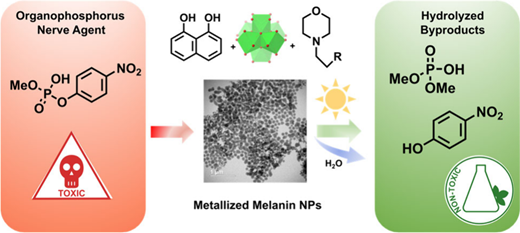
During laboratory evaluations, the combination of zirconium and allomelanin yielded two specific byproducts: dimethyl phosphate, which is non-toxic, alongside methylnitrophenol derivatives, which possess extreme toxicity. To counteract this secondary hazard, the research team utilized the binding capabilities of the allomelanin once more. In addition to capturing the initial toxic chemical, the material binds to the harmful byproducts, effectively reducing their concentration and overall potential harm. Experimental results demonstrated that methylnitrophenol concentrations decreased by 50 percent within 10 minutes.
Further investigations revealed that increasing the amount of allomelanin and exposing the treated material to sunlight could drive down the toxicity of these byproducts even further. However, the research team has not yet quantified the exact magnitude of improvement provided by sunlight exposure. Nathan Gianneschi, a professor at Northwestern University and co-author of the study, noted that his team has spent over 12 years studying melanin to understand its diverse natural functions and optimizing it through materials engineering for scalable applications. He stated that the breakthrough not only introduces a novel protective coating but also reshapes how engineers approach the design of safety equipment.
If fully realized, future protective gear could transition from passive containment to active chemical decomposition upon contact with hazardous substances, significantly minimizing the prolonged environmental and physical risks posed by persistent contaminants. Potential deployment scenarios span military personnel protection, agricultural pesticide handling, and chemical manufacturing environments. Despite these promising laboratory results, significant obstacles remain before the technology transitions from controlled tests to real-world deployment. Researchers must thoroughly evaluate the performance of the coating under variable environmental conditions, including fluctuating temperatures, humidity levels, and contamination densities, alongside long-term stability and efficacy against a broader spectrum of toxic agents. Confirmation that breakdown byproducts remain entirely controlled and that the material functions reliably over extended periods is required before large-scale production for personal protective equipment can be considered. The findings have been published in the journal ACS Nano.