In traditional physics, metals conduct electricity because electrons move freely throughout the material’s interior. However, a research team has observed that under specific quantum conditions, electron waves do not diffuse as expected. Instead, they become restricted to localized regions, unable to escape even when surrounded by numerous open paths for propagation.
Investigators observed this phenomenon in a specialized metal designated as Pd₅AlI₂, a material previously developed by a research team at Columbia University. This substance can be exfoliated into two-dimensional thin layers while retaining its metallic properties. During initial examinations, scientists noticed that the speed of electron movement within the material was slower than theoretical models predicted, which prompted a more detailed investigation.
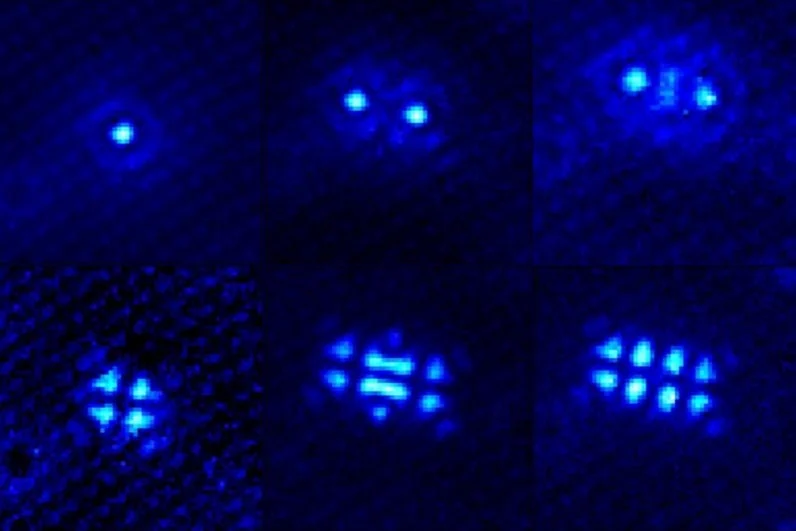
Further analysis revealed that the unique atomic structure of Pd₅AlI₂ provides electrons with multiple distinct movement pathways. When electrons attempt to navigate between atoms, the quantum waves generated by these paths interfere with one another. Certain paths mutually cancel each other out, thereby suppressing electron diffusion—a characteristic the team had previously identified as “frustrated hopping.”
To explore further, the researchers utilized scanning and spectroscopic measurement equipment capable of atomic-level resolution to observe the material with high precision. They identified unusual patterns near minor atomic defects within the crystal lattice. Additional study confirmed that these patterns represent electron waves permanently trapped in local regions.

According to quantum mechanics, electrons behave fundamentally as waves capable of propagating along multiple potential paths simultaneously. When these waves meet, they can either reinforce or cancel one another. Under rare and specific conditions, destructive interference prevents electron waves from spreading outward, locking them in place despite the theoretical presence of infinite escape routes. This phenomenon is known as a bound state in the continuum, or BIC.
While scientists have previously observed similar effects within optics, direct experimental verification in electronic systems has remained elusive. Consequently, this observation is regarded as a milestone achievement in the field. The research team noted that microscopic atomic defects played a critical role by serving as focal nodes that trigger quantum interference effects, allowing electron waves to remain stable at specific locations rather than flowing freely.
Researchers believe this finding deepens the scientific community’s understanding of quantum interference mechanisms and opens new design avenues for future quantum materials and devices. By artificially controlling atomic structures and defect distribution within metals, scientists may eventually be able to precisely manipulate electron behavior to develop novel electronic components with specialized quantum functions.
The findings have been published in the journal Science. Moving forward, the research team intends to explore the universality of this phenomenon across various material systems, alongside its potential application value in quantum computing, quantum information processing, and advanced electronic technologies.
Get the latest Science news
Subscribe to receive the latest stories from Science.