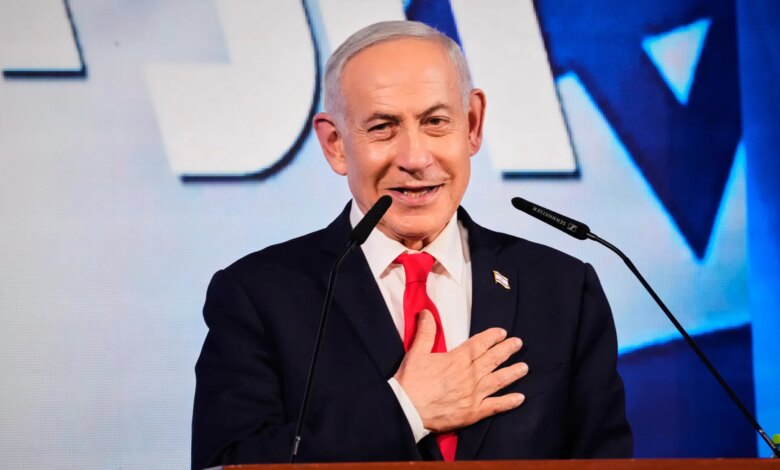
Israeli Prime Minister Benjamin Newtanyahu addressed supporters at his Likud party headquarters in West Jerusalem late Tuesday, asserting that a right-wing administration must be formed to secure the nation’s long-term future while warning against coalitions with Arab parties that he argued oppose the country’s existence. Speaking hours after polls closed in Israel’s legislative election, Netanyahu acknowledged that the definitive electoral outcome would take another one or two days to crystallize.
Early projections based on more than half of the counted ballots indicated that Netanyahu’s political bloc was on track to secure 56 Knesset seats, while a rival alliance led by Gadi Eisenkot projected to win 49 seats. Neither grouping appeared to hold a clear, straightforward path to an outright governing majority in the parliament.
Despite the lack of an immediate majority, Netanyahu emphasized that Likud was positioned to remain the largest single party in the country. Projections from Israeli broadcasters Channel 12 and Channel 13 placed Likud on track for an estimated 27 seats, compared to 21 seats for Eisenkot’s Yashar party, solidifying Likud’s numerical lead over all other individual factions.
During his address, Netanyahu pointed to his administration’s actions since taking office in 2022, framing his tenure around major military and regional shifts. Pointing to past operations, he listed the elimination of prominent adversaries including Mohammed Deif, Ismail Haniyeh, Yahya Sinwar, Hassan Nasrallah, and Iranian Supreme Leader Ali Khamenei. He also cited the establishment of security zones within Gaza, Lebanon, and Syria, arguing that his government had lifted an immediate existential threat from the country.

Netanyahu asserted that his administration had severely damaged the Iranian leadership, bringing Tehran to what he described as the edge of the abyss, and argued that Israel currently maintains a historical window of opportunity alongside United States President Donald Trump to permanently address the threat posed by Iran.
Political analysts and former diplomats offered differing perspectives on the unfolding parliamentary arithmetic. Alon Pinkas, a former Israeli ambassador and consul general in New York City, noted that whichever faction ultimately commands the majority of seats may be forced to pursue difficult coalition arrangements in order to establish a stable government, though he observed that opposition voters would strongly resist compromises involving Netanyahu’s existing coalition partners.
Marwan Bishara, a senior political analyst, suggested that Netanyahu’s address attempted to project confidence despite the underlying parliamentary constraints, noting that while Likud emerged as the largest individual party, the projected seat count represented a low point for the party relative to its standing since 2009. Analyst Dan Perry similarly noted that the speech sought to frame the exit poll figures as advantageously as possible while election officials continued processing the remaining ballots.